


Your lines are busy all day, yet output never seems to match the hours you run. Shifts stretch, overtime becomes normal, and every product change eats half a shift. This SMED changeover reduction pharma case study shows how Eris Lifesciences, at its Guwahati plant, cut changeover time by up to 59% and now makes the same 10 crore tablets a month in 12 hours a day instead of 24, with zero overtime and without buying a single new machine.
At a glance
Client: Eris Lifesciences Ltd, listed Indian pharma company (ranked #21 in the Indian Pharmaceutical Market), WHO-GMP oral solid dosage plant in Guwahati, Assam. Problem: changeovers ate 12–32% of line time, 5S score of 14 out of 100, no Kaizen culture, 24-hour running with heavy overtime. What Greendot did: a 3-pillar Lean manufacturing programme: 5S, Kaizen and SMED (Single Minute Exchange of Die) on the production floor. Duration: 8 months. Result: changeover time down up to 59%, same monthly output in half the running hours, overtime eliminated, ₹17.9 lakh a year in documented Kaizen savings.
About the Client
Eris Lifesciences Ltd is a publicly listed Indian pharmaceutical company focused on domestic branded formulations, ranked #21 in the Indian Pharmaceutical Market. Founded in 2007, it is strong in cardio-metabolic care, and chronic and sub-chronic therapies make up most of its business. Its WHO-GMP certified plant in Guwahati, Assam makes oral solids (tablets and capsules) through granulation, compression, coating, capsule filling and strip packing lines. Learn more at eris.co.in.
The Challenge: Long Changeovers, Long Hours, No Improvement Culture
As sales grew, the plant ran 24 hours a day to keep up. The symptoms were clear, but the causes were spread across the workplace, the people and the process:
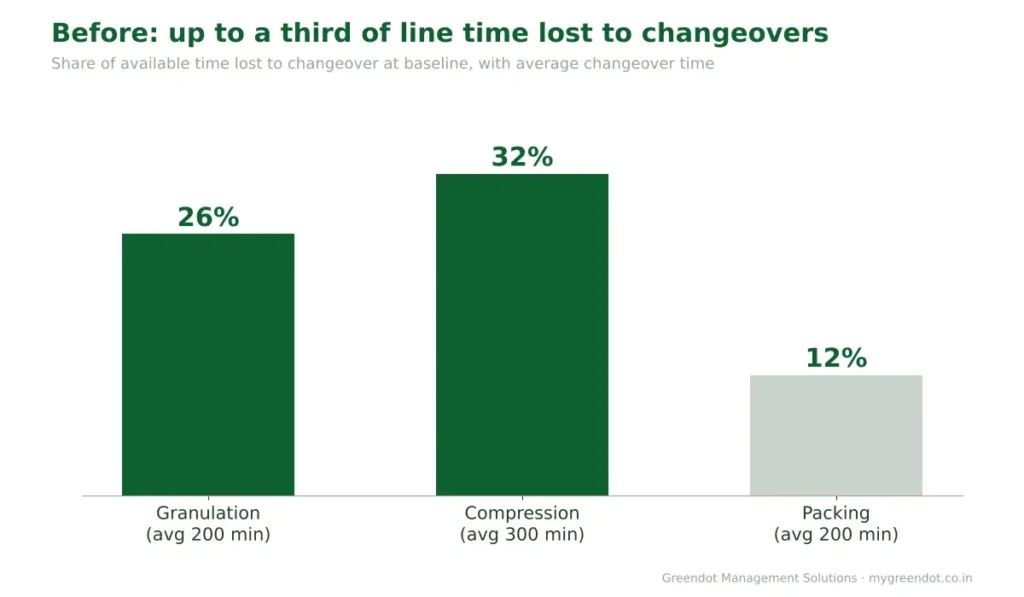
- Changeovers were eating the day. Granulation lost 26% of available time to changeovers (average 200 minutes), compression lost 32% (average 300 minutes) and packing lost 12% (average 200 minutes).
- The workplace was not under control. 5S awareness was almost nil. No visual controls, no standard practices. The first 5S assessment scored 14 out of 100.
- No culture of improvement. Kaizen activity was nearly absent (engagement score of 2 at baseline). Operators had little exposure to waste-reduction thinking.
- Hours and overtime kept rising. To meet a monthly output of 10 crore tablets, the plant ran round the clock, and overtime made up 28% of the budget.
Does this sound like your plant? If adding hours is the only way you know to add output, the lost capacity is usually hiding inside your changeovers.
Our Approach: 5S, Kaizen and SMED as One Programme
Greendot ran the three pillars in sequence, each building on the one before, over 8 months on the live production floor, without stopping supply.
| Pillar | Why first / next | What we did | Output |
|---|---|---|---|
| 1. 5S | No improvement lasts in a disorganised workplace | 5S training at every level on Sort, Set in Order and Shine; daily ‘1-Minute Sort’ and ‘5-Minute Shine’; red and yellow tags; PEEP (a Place for Everything, Everything in its Place); cleaning and inspection routines | 91 One Point Lessons (OPLs); QA department 5S self-assessment 15 out of 15 |
| 2. Kaizen | Turns operators from bystanders into problem-solvers | Awareness sessions on waste, flow and root cause; guided Kaizen workshops; a tracking and reward system | 38 Kaizens done, 11 with direct cost impact |
| 3. SMED | Biggest capacity gain, once 5S and Kaizen habits exist | Timed each changeover step by step; split internal and external tasks; standardised procedures; parallel execution | Changeover time down 26–59% on 6 lines |
How SMED worked on the floor
SMED (Single Minute Exchange of Die) asks one question for every changeover step: does the machine really have to stop for this? Our consultants worked with operators on each line:
- Record and split. Every changeover was timed step by step and each step marked as internal (machine must stop) or external (can be done while the machine runs).
- Move work outside the stop. Tools, change parts, documents and line clearance material were made ready before the line stopped.
- Standardise. Each line got a written changeover sequence and a ready-kit, captured in One Point Lessons so every shift does it the same way.
- Work in parallel. Operators work side by side on a clear split of tasks, instead of one person doing every step in turn.
Changeover results by line
| Line | Before | After | Reduction |
|---|---|---|---|
| Strip Packing I | 220 min | 90 min | 59% (best result) |
| Coating II | 180 min | 87 min | 52% |
| Compression | 300 min | 180 min | 40% |
| Granulation IV | 5 hours | 3 hours | 40% |
| Capsule Filling I | 180 min | 110 min | 39% |
| Granulation II | 240 min | 177 min | 26% |
Across 19 machines, the plant now saves about 525 minutes of production time every day. Over a month that is roughly 260 hours, about 10 extra days of round-the-clock production, from the same machines and the same people.
Are changeovers eating your shifts?
Book a free 30-minute Changeover Loss Check. Share the changeover times of your top 3 machines and we will show you how much capacity is hiding in them.
Book a Free Changeover Loss Check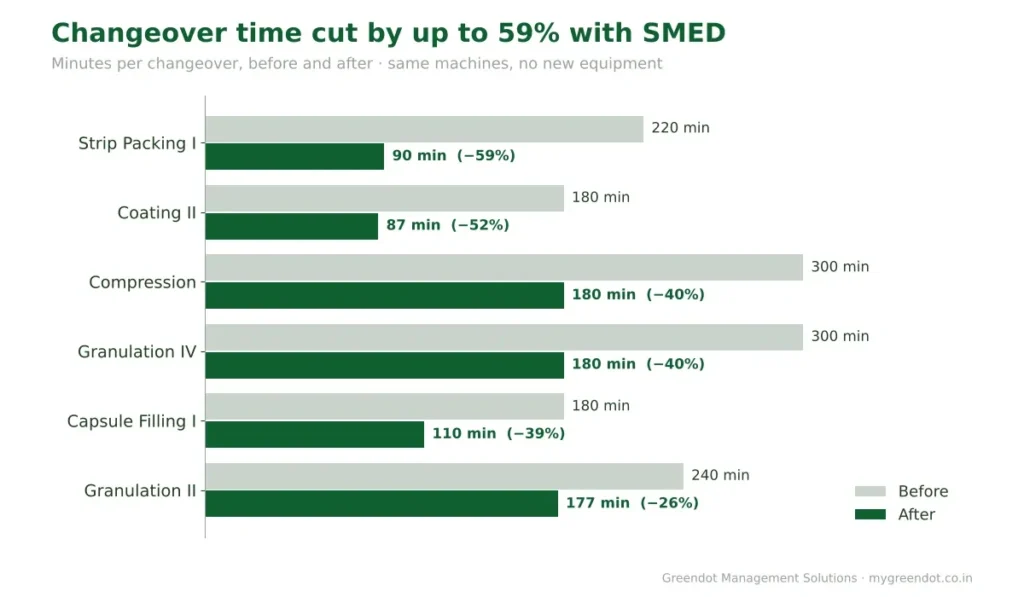
Results After 8 Months
| KPI | Before | After | Change |
|---|---|---|---|
| Plant running hours for 10 crore tablets a month | 24 hrs/day | 12 hrs/day | Same output in half the hours |
| Overtime | 28% of the budget | Nil | Eliminated |
| Compression changeover | 300 min | 180 min | −40% |
| Best changeover (Strip Packing I) | 220 min | 90 min | −59% |
| Production time saved (19 machines) | – | 525 min/day | ≈ 10 extra production days a month |
| Utility cost | ₹25.6 lakh | ₹9.3 lakh | −64% |
| 5S score | 14 / 100 (plant) | 15 / 15 (QA dept self-assessment) | Audit-ready workplace |
| Kaizens implemented | Almost none | 38 (11 with cost impact) | – |
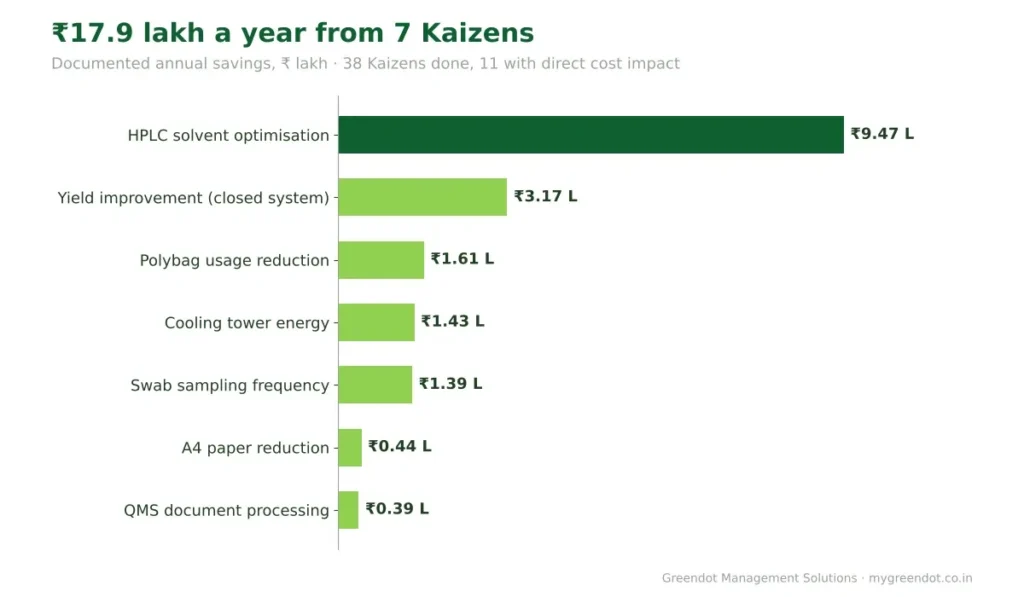
Where the ₹17.9 lakh a year came from
| Kaizen | What changed | Annual saving |
|---|---|---|
| HPLC solvent optimisation | Better control of solvent use in the QC lab | ₹9,47,175 |
| Yield improvement, Tendia M | Closed-system handling cut raw material loss; yield rose from 93.91% to 97.71% | ₹3,17,489 |
| Polybag usage | Packaging material rationalised | ₹1,60,650 |
| Cooling tower energy | Systematic cooling optimisation | ₹1,42,715 |
| Swab sampling | Sampling frequency reduced; 820 hours a year saved | ₹1,39,460 |
| A4 paper | ₹3,680 a month less paper | ₹44,160 |
| QMS document processing | Waiting time cut; 525 hours a year saved | ₹39,000 |
| Total | ₹17,90,649 |
On the shop floor: a cleaner, safer, audit-ready plant that impresses regulators and customers, and operators who now suggest improvements themselves.
In the Client’s Words
In a video conversation with Greendot founder Nirav Trivedi, Rakesh Mahajan, Production Head at the Eris Lifesciences Guwahati plant, explained that none of these results needed new machinery or extra manpower. The change came from a new way of looking at the process and from applying Lean tools to the machines and people the plant already had.
What Made It Work
- Foundation first. 5S came before SMED. Changeover kits and standard steps only work when every tool has a fixed place.
- Operators owned the change. The people who run the lines timed their own changeovers and wrote the new steps, so they trusted and kept them.
- Small daily habits. ‘1-Minute Sort’ and ‘5-Minute Shine’ built the discipline that big projects depend on.
- Knowledge captured. 91 One Point Lessons mean every shift does the best method, not its own method.
- Measured every week. 5S scores, Kaizen completion and changeover times were tracked on simple KPI boards.
Is Your Plant Facing the Same Problem?
Ask yourself these four questions:
- Do you know the average changeover time on your top 3 machines, in minutes?
- What share of your available line time goes into changeovers each month?
- Are you adding shifts or overtime to meet output, instead of using the hours you already have?
- Does every shift change over the same way, from a written standard?
If two or more answers are “no” or “not sure”, there is capacity locked inside your changeovers. Greendot has helped manufacturers across India with Lean manufacturing, 5S, Kaizen, SMED and TPM since 1999, as NPC and QCI approved Lean consultants. See our SMED consulting, 5S system and Kaizen implementation services, or the full lean manufacturing consulting page.
Want the same output from fewer hours?
Send us a message on WhatsApp. In a free 30-minute Changeover Loss Check we look at your changeover times and line hours and show you the first three actions to take.
Talk to Greendot on WhatsAppSMED and Lean in Pharma: Frequently Asked Questions
What is SMED in pharmaceutical manufacturing?
SMED (Single Minute Exchange of Die) is a Lean method to cut changeover time. Each changeover step is marked internal (machine must stop) or external (can be done while it runs), external work is moved outside the stop, and the remaining steps are standardised. At Eris Lifesciences it cut changeovers by 26–59%.
How much can changeover time be reduced in a pharma plant?
In this case study, Strip Packing I went from 220 to 90 minutes (59%), Coating II from 180 to 87 minutes (52%) and Compression from 300 to 180 minutes (40%), on the same machines.
Is SMED allowed under GMP and line clearance rules?
Yes. SMED does not skip any line clearance or cleaning step. It prepares tools, change parts and documents before the stop and organises the work so that the required GMP steps are done faster and the same way every time.
Do you need new machines to reduce changeover time?
No. Eris Lifesciences got its results without new machinery or extra people. The gains came from 5S, standard work, One Point Lessons and parallel working by operators.
How long does a lean manufacturing programme take in pharma?
This 5S, Kaizen and SMED programme ran for 8 months on the live production floor, without stopping supply.
How do I start reducing changeover time in my plant?
Book a free 30-minute Changeover Loss Check with Greendot on WhatsApp at +91 90237 28317. Share the changeover times of your top 3 machines and we will show you where the biggest gain is.