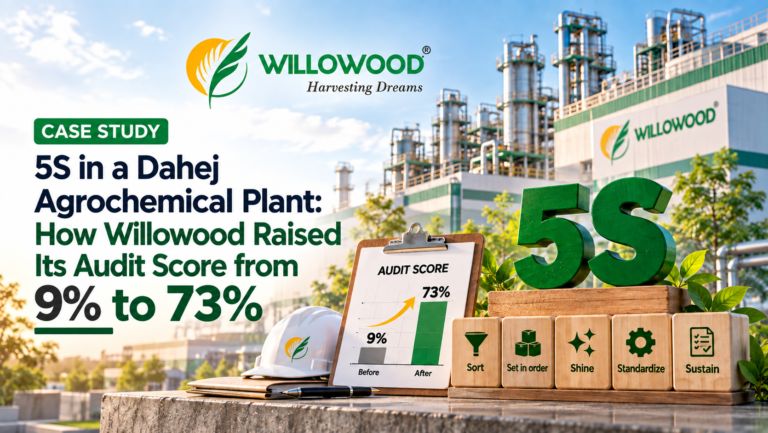
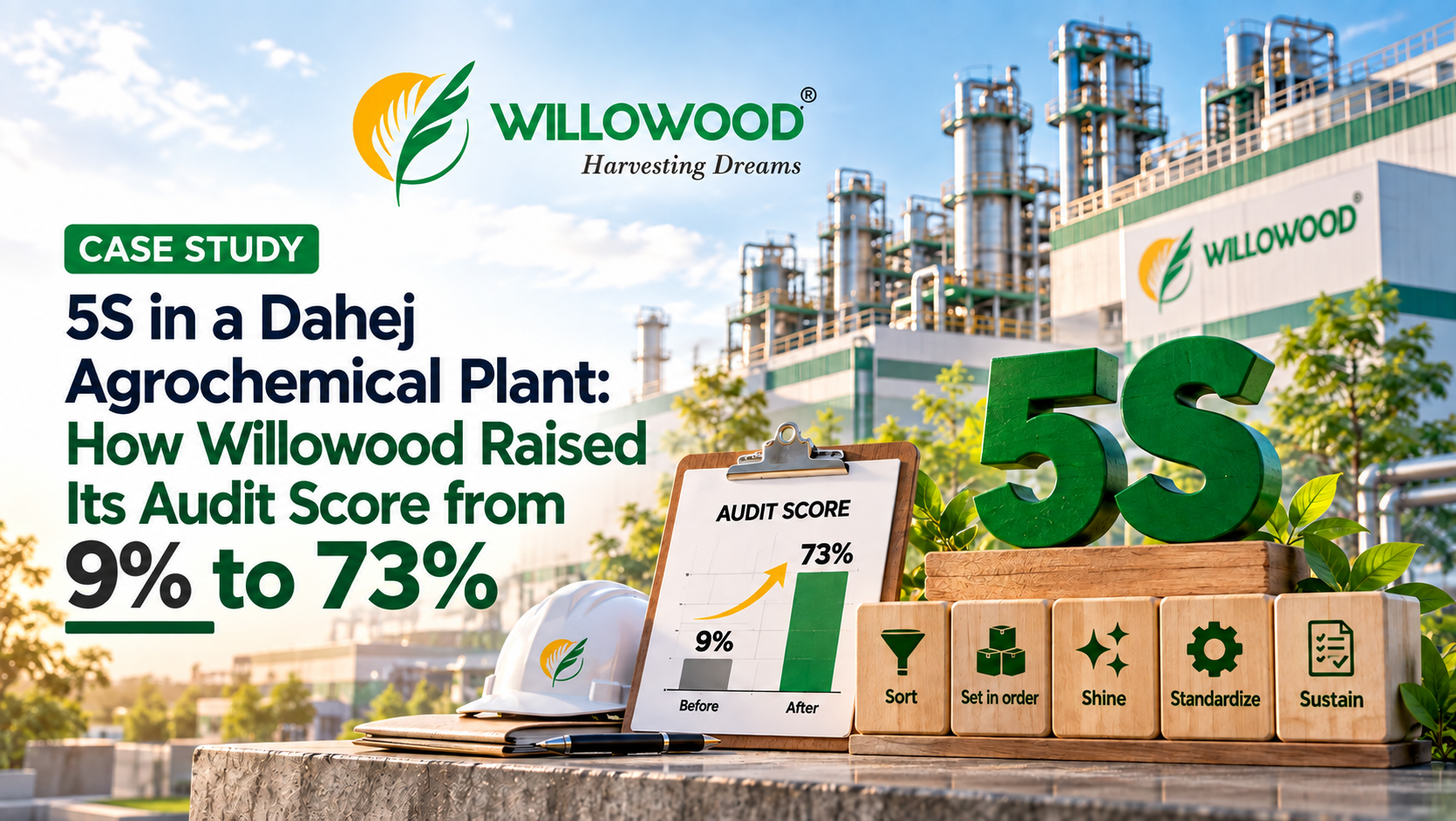

Result of 5s at a glance at Willowood
9% → 73% 5S audit score (Nov 2024 – Nov 2025) | 6,000+ Unwanted items removed |
288 / 295 Red tags closed (97.6%) | 144 Zones with visual controls |
| Project details | |
|---|---|
| Client | Willowood Industries Pvt. Ltd. |
| Industry | Agrochemicals – technical (active ingredient) manufacturing |
| Location | Dahej, Bharuch, Gujarat |
| Service | 5S implementation, visual management and 5S capability building |
| Measured period | Monthly audits, Nov 2024 – Nov 2025 |
Willowood Industries, part of the global Willowood Group, manufactures technical-grade active ingredients for crop protection at its multi-plant facility in Dahej, Gujarat.
In a plant with reactors, pressure systems and hazardous materials, workplace discipline is a safety requirement, not just a matter of appearance.
The Challenge: A Missing System, Not a Lack of Effort
The first 5S audit in November 2024 scored 2.2 out of 25 (9%). On GreenDot’s 5S maturity assessment, almost every area sat at Level 0–1: unneeded items mixed with needed ones, no fixed locations, no cleaning standard, no documented work methods and no routine review.
The root cause was not a lack of effort. It was a missing system. No one owned the areas, no standard defined what belonged where, and nothing caught the drift, so clutter kept returning and unsafe conditions went uncorrected.
How We Measured: The 5S Maturity Assessment
Every area is scored monthly on each of the five S’s, from Level 0 to Level 5, for a total out of 25. At the lower levels, the plant is described in terms of safety risk, so a rising score means a safer plant, not just a tidier one.
| Level | Stage | What it looks like on the floor |
|---|---|---|
| 0 | Baseline | Unsafe items, unsafe placement, spills; no methods, no review |
| 1 | Beginner | Needed and unneeded items mixed; occasional, unscheduled 5S |
| 2 | Basic | Unneeded items tagged; daily cleaning; methods documented |
| 3 | Visual | Red-tag area; marked locations; standard layouts and methods posted |
| 4 | Systematic | Needed-items lists; daily inspection; methods used by all; regular audits |
| 5 | Preventive | Root causes of dirt and spillage eliminated; methods reviewed and improved |
| Willowood, Dahej: 2.2 / 25 in Nov 2024 (Level 0–1) → 18.3 / 25 in Nov 2025 (between Visual and Systematic) | ||
The GreenDot 5S Approach
- Sort (1S): A red-tag drive across all departments removed more than 6,000 unwanted items. 288 of the 295 tags issued were closed.
- Set in Order (2S): 144 zones were created with floor marking, labelled locations, tool shadow boards and labelled waste bins, with labels in Gujarati and Hindi so every operator can read them.
- Shine (3S): Daily and weekly cleaning-and-inspection checklists were introduced, so cleaning also became inspection.
- Standardise (4S): Common formats were set for SOP displays, safety signage, zone displays, line tagging, valve open/close marking, PSV/RD set-pressure display, agitator rotation marking, preventive maintenance tags and calibration tags.
- Sustain (5S): Monthly scored audits now run plant-wide. Willowood’s teams delivered 18 department before–after presentations, and a model reactor, model equipment and model area serve as benchmarks.
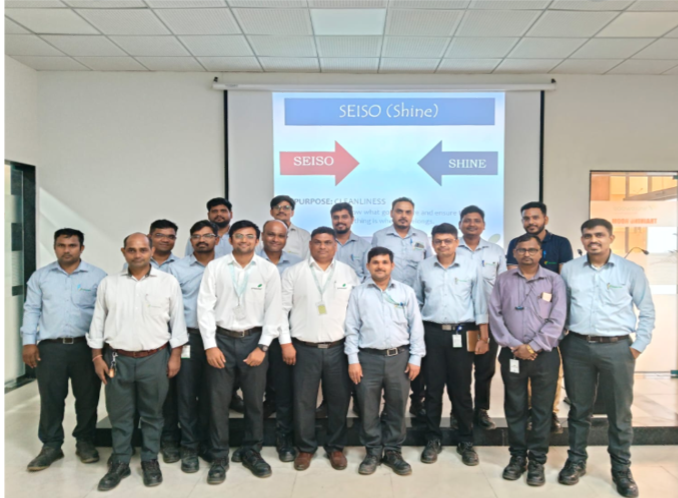
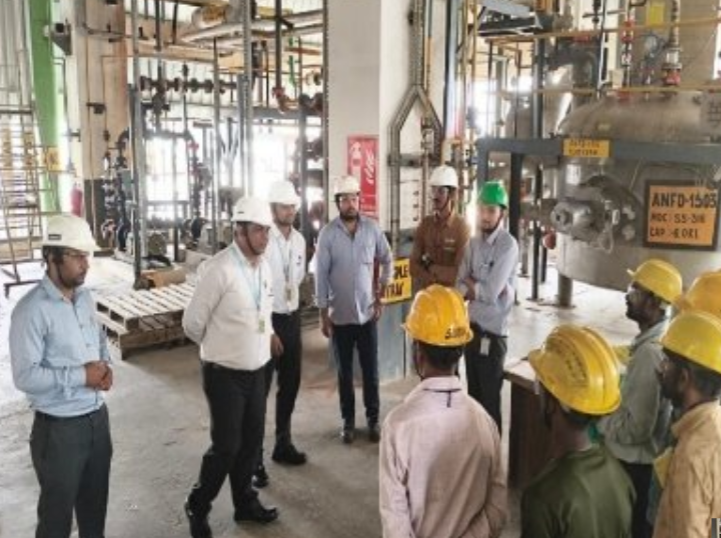
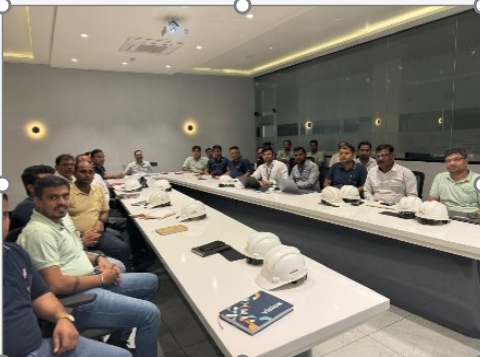
Glimps of 5s Training & Implementation
5S in Chemical Plant: Measurable Results
| Result area | What was achieved | Value |
|---|---|---|
| 5S audit score | Monthly scored audits, Nov 2024 – Nov 2025 | 9% → 73% (2.2 → 18.3 of 25) |
| Sort | Unwanted items removed from working areas | 6,000+ items |
| Red-tag closure | Tags issued vs closed | 288 of 295 (97.6%) |
| Visual management | Zones with floor marking, labels and displays | 144 zones |
| Ownership | Before–after presentations by client teams | 18 departments |
| Sustain system | Daily/weekly cleaning-and-inspection checklists; monthly audits | Live plant-wide |
5S That Measures Safety, Not Just Housekeeping
In a chemical plant, 5S is also a safety system. Every pipeline now carries flow-direction tags, valves show open or closed status, and relief devices display their set pressure.
Reactors carry tag number, capacity and material-of-construction labels, and maintenance and calibration status is visible at the equipment itself.
An operator can now read the plant correctly at a glance, which reduces the chance of a wrong valve operation or a missed inspection.
Because the lowest levels of the maturity assessment describe unsafe conditions, the climb from 2.2 to 18.3 is a measured move away from risk.
Building a 5S Organisation, Not Just a Clean Plant
A plant stays at 73% only if its own people can run the system. GreenDot trained Willowood’s teams in role-based skills:
- 5S Champions who lead their areas.
- 5S Auditors who score the plant every month using the maturity assessment.
- Red tagging and yellow tagging teams who make Sort a routine, not a one-time drive.
- Visual management teams who maintain zones, labels and line identification.
Front-line operators were trained as well, because they are the people who first see a misplaced item or an open valve.
Willowood’s teams presented their own before–after results across 18 departments, and the best teams were recognised.
What's Next: Moving to the Preventive Level
At 18.3 out of 25, Willowood is between the Visual and Systematic levels. The next stage is Level 5, Preventive: the sources of spillage and dirt are eliminated rather than cleaned up, and work methods are reviewed and improved on a regular cycle.
Willowood’s trained auditors and champions are carrying this forward under GreenDot’s roadmap.
Why It Worked
- Measured like safety, not housekeeping: a 25-point maturity score where the low levels describe unsafe conditions.
- On your shop floor: our consultants worked at reactors, pipelines and stores, not in meeting rooms.
- Capability, not dependency: your own champions, auditors and front-line teams were trained to run the system.
- Honest scoring: progress shown month by month, including the gap still left to close.
GreenDot has been doing this kind of practical, measured work since 1999, with 1200 manufacturers and a 80-member team across Gujarat and Maharashtra.
Frequently Asked Question
What is 5S in a chemical plant?
5S (Sort, Set in Order, Shine, Standardise, Sustain) is a workplace system that removes unneeded items, fixes a place for everything and makes standards visible. In a chemical plant it also covers line identification, valve status marking and pressure-device displays, so it directly supports process safety.
How is 5S progress measured in a plant?
Each area is scored monthly on all five S’s from Level 0 (Baseline) to Level 5 (Preventive), for a total out of 25. Willowood’s Dahej plant moved from 2.2 to 18.3.
How does 5S reduce safety risk in a chemical plant?
The lowest 5S levels describe unsafe conditions: unsafe items, unsafe placement, spills and no correction. Raising the score removes these conditions, and line tagging, valve marking and PSV set-pressure displays help operators read the plant correctly
Why does clutter keep coming back after a 5S drive?
Because the system is missing, not the effort. Without area ownership, a standard for what belongs where, and a monthly audit, items drift back. Trained 5S champions and auditors stop the drift.
How long does 5S implementation take?
Visible results come within months. Willowood’s audit score rose from 9% to 73% over 12 months of monthly audits.
Does GreenDot provide 5S consulting in Bharuch and Dahej?
Yes. From its head office in Valsad and branches in Surat and Vadodara, GreenDot implements 5S for manufacturers in Dahej, Bharuch, Ankleshwar and across Gujarat and Maharashtra.