
Most medical device plants that start ISO 13485 lose time doing things in the wrong order — writing procedures before the risks are known, or booking the certification audit before the system has produced records. This guide gives the correct sequence for the ISO 13485 certification process, the way our consultants run it on Indian shop floors.
Quick answer
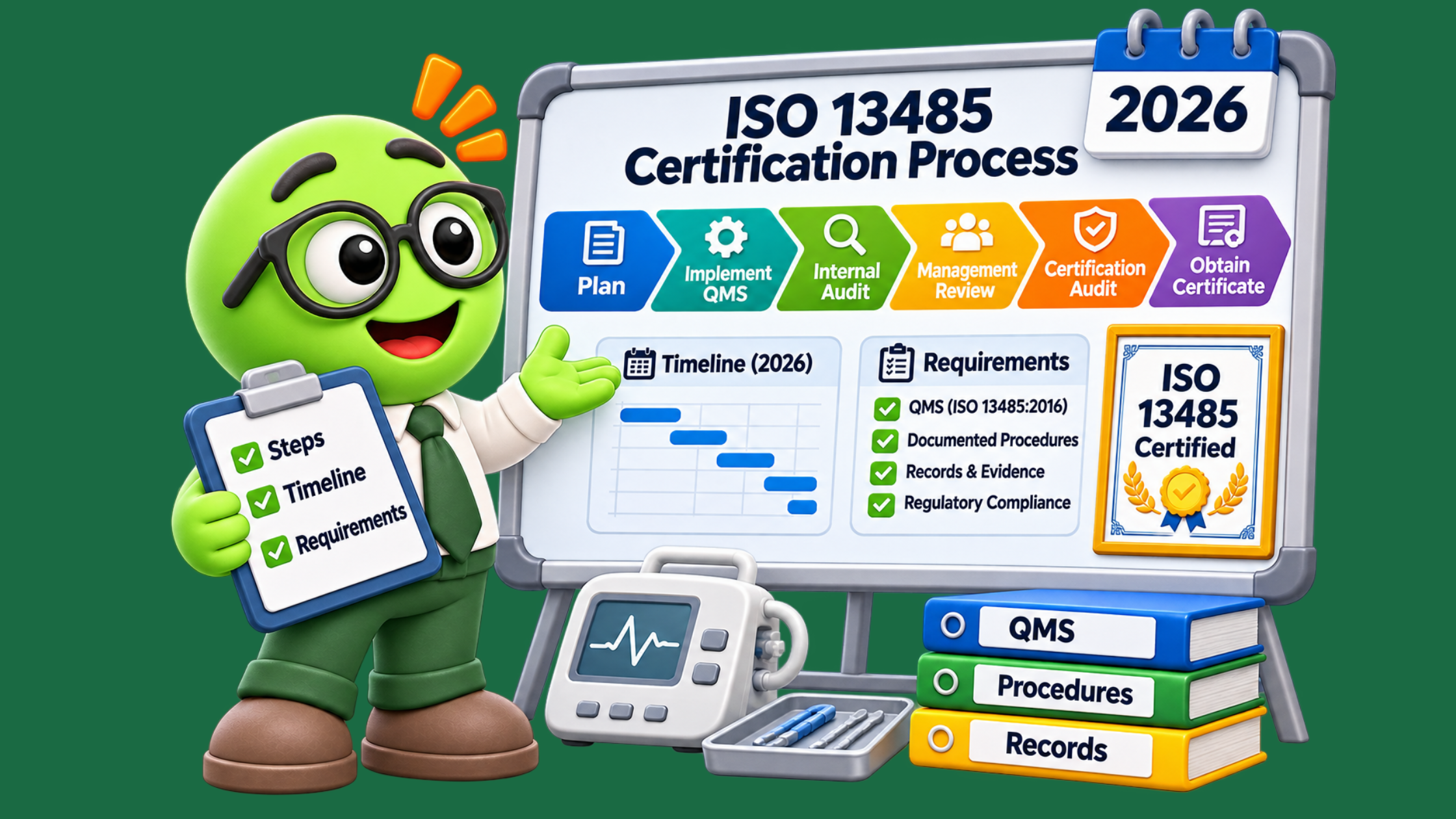
The ISO 13485 certification process has 8 steps: commitment and scope, gap analysis, risk management and medical device files, quality system documents, implementation and process validation, training, internal audit and management review, and the Stage 1 and Stage 2 audits by an accredited certification body. For most Indian manufacturers it takes 3–4 months.
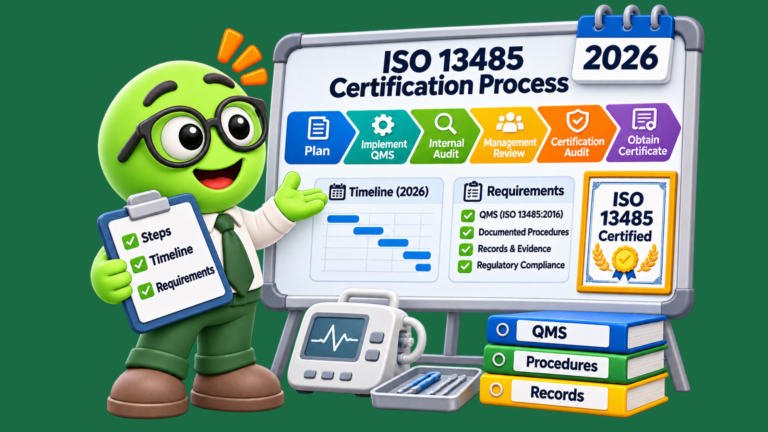
How to Get ISO 13485 Certification: 8 Steps
This is a typical ISO 13485 implementation plan for a single-site manufacturer. Several steps run in parallel.
Step 1: Commitment, scope and team
Top management decides to go ahead, fixes the scope — which sites, devices and activities, and whether design is included — and appoints a management representative and core team.
Step 2: Gap analysis
Compare your present practices, documents and records with ISO 13485:2016 on the shop floor. The result is a clear action list.
Step 3: Risk management and medical device files
Build an ISO 14971 risk management file and a medical device file for each device family, with labelling and traceability defined.
Step 4: Quality system documents
Quality manual, quality policy and objectives, required procedures, work instructions and formats — written for how your plant actually works.
Step 5: Implementation and process validation
Supplier control, production controls, clean room and contamination control, calibration, complaint handling and CAPA put in place; special processes validated.
Step 6: Training and competence
Awareness for everyone, role-based training, and internal auditor training for the audit team.
Step 7: Internal audit and management review
A full internal audit, corrective actions closed with evidence, and a management review with top management.
Step 8: Certification audit
Stage 1 and Stage 2 audits by an accredited certification body, closure of any nonconformities, and issue of the ISO 13485 certificate.
Not sure where your plant stands?
Book a free 30-minute ISO 13485 Gap Check. We tell you which of these steps you have already covered, what is missing and a realistic timeline.
Book My Free ISO 13485 Gap CheckStage 1 vs Stage 2: What the Certification Auditor Checks
| Stage 1 — Readiness review | Stage 2 — Certification audit |
|---|---|
| Scope, sites, devices and exclusions are clear | Controls are working on the shop floor |
| Quality manual, procedures and medical device files exist | People are interviewed about their work |
| Risk management and regulatory requirements are identified | Records of production, validation, calibration and complaints are checked |
| Internal audit and management review are done or planned | Supplier control, traceability and CAPA are verified |
| Areas of concern are listed for Stage 2 | Nonconformities are raised; major ones must be closed before the certificate is issued |
Requirements for ISO 13485 Certification: What Must Be Ready Before Stage 2
- Defined scope and justified exclusions
- Quality manual, quality policy and measurable objectives
- Medical device file for each device family
- Risk management file
- Required procedures, with records showing they are followed
- Supplier evaluation and purchasing records
- Process validation reports for special processes
- Calibration and maintenance records
- Training and competence records
- Complaint, feedback and CAPA records
- Internal audit report and management review minutes
Certification bodies want to see the system running long enough to produce records — another reason not to rush Stage 2.
After Certification
The certificate is valid for three years, with a surveillance audit every year and a recertification audit before expiry. In India, the same system supports your licence under the Medical Devices Rules, 2017.
7 Reasons ISO 13485 Projects Get Delayed
- Scope not fixed — design included or excluded too late
- Risk management written after the documents instead of before
- Procedures copied from a template that does not match the plant
- Sterilisation or sealing processes never validated
- No traceability from batch to raw material
- Internal audit rushed the week before Stage 2
- Top management not available for management review
More on this: why ISO audits fail and how to avoid it.
Get ISO 13485 Certified with Greendot
Greendot Management Solutions is an ISO 13485 certification consultant for medical device manufacturers, contract manufacturers and component suppliers, with offices in Valsad, Surat and Vadodara and on-site teams across Gujarat and Maharashtra. Since 1999 we have served 1,200+ mid and large-size companies and helped 200+ achieve ISO certification. Our consultants include IRCA-certified ISO Lead Auditors, and they build your ISO 13485 system on the shop floor with your team until you are certified — typically in 3–4 months. Read the complete guide to ISO 13485 for the background.
Start your ISO 13485 journey
Free 30-minute Gap Check · Written plan and timeline · Typical project 3–4 months · Any accredited certification body of your choice.
Get a Free ISO 13485 Gap CheckISO 13485 Certification Process — FAQs
How do I get ISO 13485 certification?
Follow 8 steps: commitment and scope, gap analysis, risk management and medical device files, quality system documents, implementation and process validation, training, internal audit and management review, then Stage 1 and Stage 2 audits by an accredited certification body.
How long does ISO 13485 certification take?
Most Greendot ISO 13485 projects take 3 to 4 months, depending on design scope, device families, sterile or clean room processes and your present system.
What is an ISO 13485 gap analysis?
A review of your present practices, documents and records against every ISO 13485 requirement, done on the shop floor. It produces the action list for the project.
What is the difference between Stage 1 and Stage 2?
Stage 1 checks readiness: scope, documents, risk management and plans. Stage 2 checks that the system works on the shop floor, through interviews, observation and records.
What happens if the auditor finds a nonconformity?
You submit corrective actions to the certification body. Major nonconformities must be closed before the certificate is issued; minor ones are usually accepted with a corrective action plan.
Do we need a consultant for ISO 13485?
It is not mandatory, but an experienced consultant saves time and avoids failed audits. Greendot's consultants include IRCA-certified ISO Lead Auditors.