
Why Manufacturing Efficiency Has Become a Competitive Advantage
Every manufacturing company faces the same challenge—produce more, waste less, and deliver consistently.
Yet rising energy costs, labour shortages, quality expectations, and supply chain disruptions make that goal harder every year.
When equipment stops unexpectedly, production schedules slip. When maintenance becomes reactive, costs rise. And when operators aren’t involved in equipment care, small problems quickly become expensive breakdowns.
After working with manufacturing companies for more than 25 years, we’ve seen that the most efficient factories don’t simply buy better machines—they build better systems around those machines.
That’s where a TPM Consultant for Manufacturing creates real value.
Instead of treating maintenance as a separate department, a TPM consultant helps organizations build a culture where operators, engineers, supervisors, and leadership work together to improve equipment reliability and operational performance.
The result isn’t just fewer breakdowns.
It’s a more productive, predictable, and profitable factory.
What Is TPM in Manufacturing?
Total Productive Maintenance (TPM) is a proven manufacturing methodology that improves equipment performance by involving everyone—not just maintenance teams—in maintaining and improving machinery.
The primary objective is to maximize Overall Equipment Effectiveness (OEE) by reducing equipment losses and creating reliable production systems.
Rather than fixing machines after they fail, TPM focuses on preventing failures before they happen.
A successful TPM implementation combines:
- Equipment reliability
- Operator ownership
- Preventive maintenance
- Continuous improvement
- Cross-functional collaboration
Why Companies Hire a TPM Consultant
Many organizations begin TPM initiatives with enthusiasm.
They launch cleaning campaigns.
Install visual boards.
Conduct training sessions.
But after a few months, progress slows because TPM requires more than activities—it requires systems.
An experienced TPM consultant helps organizations build those systems while avoiding common implementation mistakes.
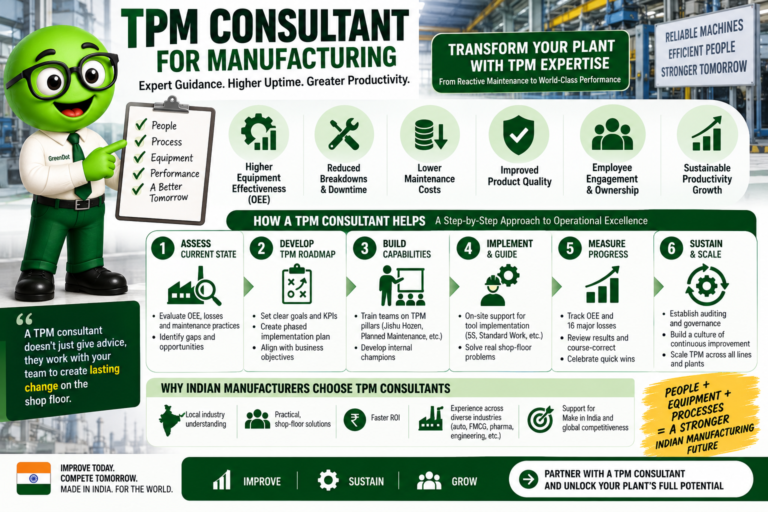
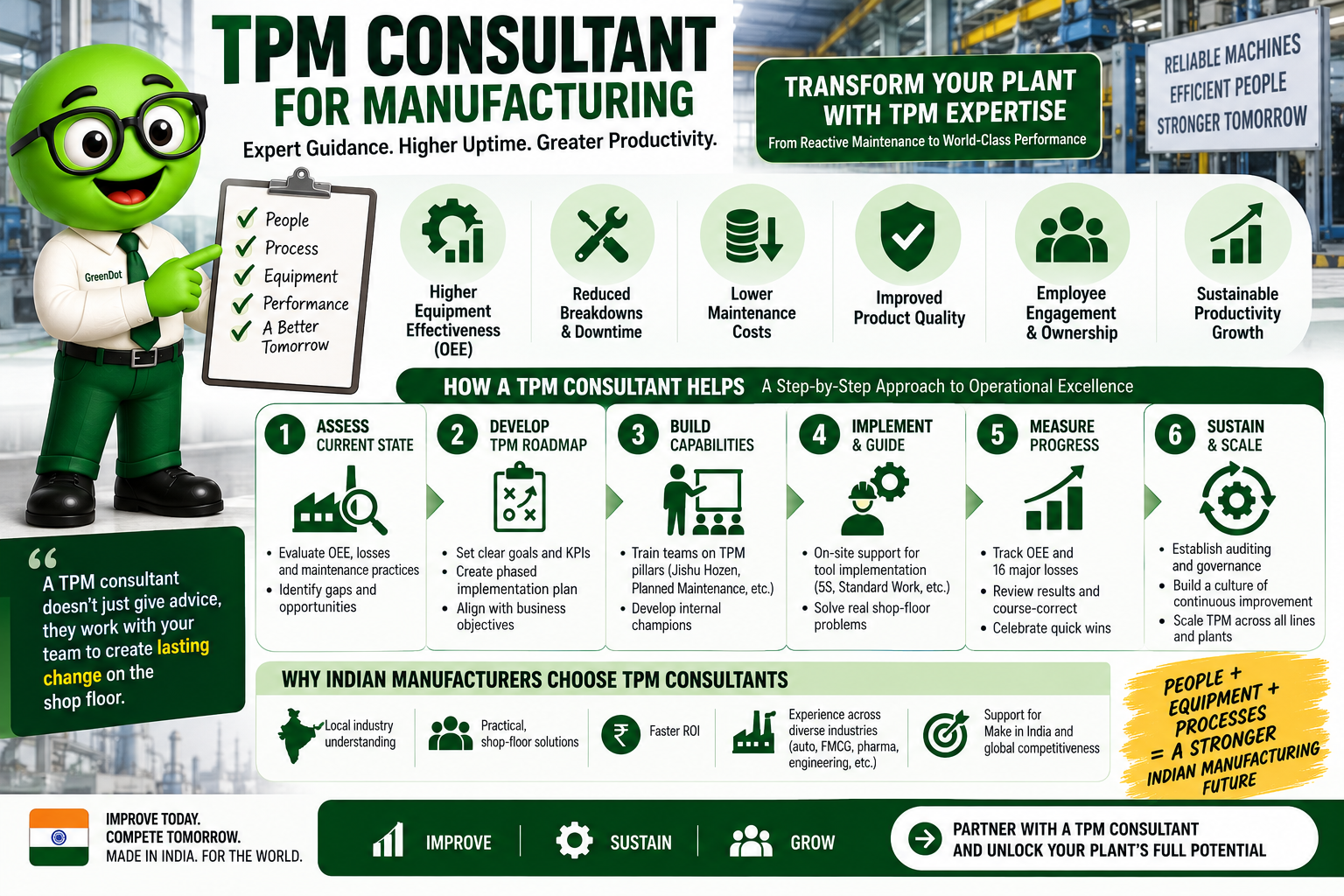
How a TPM Consultant Improves Manufacturing Performance
1. Conducts a Factory-Wide Assessment
Every TPM journey begins with understanding current performance.
A consultant typically evaluates:
- OEE
- Breakdown trends
- Maintenance practices
- Equipment losses
- TPM maturity
This creates a clear starting point for improvement.
2. Builds a Practical TPM Roadmap
Instead of implementing everything at once, a consultant prioritizes improvements that deliver both quick wins and long-term sustainability.
The roadmap aligns TPM activities with business objectives.
3. Works Directly on the Shop Floor
The best TPM consultants spend time where production happens.
They coach:
- operators,
- supervisors,
- maintenance teams,
- engineers,
- pillar leaders.
This practical involvement helps TPM become part of daily routines instead of remaining a classroom concept.
Key Areas Where a TPM Consultant Adds Value
Improving Overall Equipment Effectiveness (OEE)
One of the biggest responsibilities of a TPM consultant is improving Overall Equipment Effectiveness (OEE).
OEE combines three critical factors:
- Availability – Reducing breakdowns
- Performance – Improving production speed
- Quality – Reducing defects
When these three areas improve together, productivity increases without adding new equipment.
Building Autonomous Maintenance
Autonomous Maintenance is one of TPM’s most powerful concepts.
Instead of waiting for maintenance teams, operators learn to:
- inspect equipment,
- clean critical components,
- lubricate machines,
- identify abnormalities early,
- prevent minor issues from becoming major failures.
This creates stronger equipment ownership across the factory.
Reducing Downtime Through Planned Maintenance
Reactive maintenance often creates unnecessary costs.
TPM consultants help organizations strengthen preventive maintenance using tools such as:
- MTBF analysis
- MTTR tracking
- maintenance planning
- equipment history reviews
The goal is simple—prevent failures instead of responding to them.
Developing Problem-Solving Skills
Technical improvements alone aren’t enough.
High-performing factories build people who solve problems every day.
Consultants often train teams in:
- 5 Whys
- PDCA
- Root Cause Analysis
- Standard Work
- Kaizen
These skills help employees continuously improve production performance.
A Practical Manufacturing Example
Imagine a precision components manufacturer experiencing frequent CNC machine breakdowns.
Instead of replacing expensive equipment, the company introduced a structured TPM implementation with consultant support.
The project focused on:
- OEE measurement
- Autonomous Maintenance
- Planned Maintenance
- Kaizen
- Daily equipment inspections
Within months, operators became more proactive in identifying abnormalities before failures occurred.
Maintenance teams shifted from emergency repairs toward reliability improvement projects.
The biggest improvement wasn’t simply higher uptime.
It was changing how people worked with equipment every day.
TPM Consultant vs Internal Teams
A TPM consultant doesn’t replace internal teams.
They strengthen them.
| Consultant Value | Business Impact |
|---|---|
| Independent assessment | Identifies hidden inefficiencies |
| TPM implementation experience | Faster deployment |
| Change management | Better employee adoption |
| JIPM preparation | Stronger audit readiness |
| Practical coaching | Sustainable daily routines |
This outside perspective often accelerates improvements that internal teams struggle to sustain alone.
10 Common Mistakes That Reduce TPM Success
Many organizations lose momentum because they make avoidable implementation mistakes.
- Treating TPM as a maintenance project.
- Ignoring operator ownership.
- Measuring OEE inconsistently.
- Delaying Autonomous Maintenance.
- Weak leadership participation.
- Poor documentation.
- Irregular TPM meetings.
- Limited cross-functional involvement.
- Focusing only on cleaning activities.
- Stopping improvements after early success.
Sustainable TPM depends on consistency—not campaigns.
How to Choose the Right TPM Consultant
Before selecting a consultant, evaluate practical experience rather than presentations.
Look for someone with:
- Manufacturing implementation experience
- TPM deployment expertise
- JIPM assessment familiarity
- OEE improvement capability
- Shop-floor coaching skills
- Strong change management experience
The right consultant helps build capability inside the organization rather than creating dependency.
Why Greendot Management Solution?
At Greendot Management Solution, we’ve spent more than 25 years helping manufacturing companies improve operational performance through practical TPM implementation.
Our consulting approach combines:
- Total Productive Maintenance
- OEE Improvement
- Autonomous Maintenance
- JIPM TPM Preparation
- Kaizen
- Lean Manufacturing
- Management Consulting
We work alongside production and maintenance teams to build systems that continue delivering measurable improvements long after implementation.
Frequently Ask question
1. what does tpm consultant do?
A TPM Consultant helps manufacturing companies improve equipment reliability, reduce downtime, increase OEE, and implement Total Productive Maintenance successfully.
2. what is tpm benifit we can expect.
TPM improves equipment availability, production performance, and product quality by reducing equipment losses and involving operators in maintenance.
3. What is oee in TPM
Overall Equipment Effectiveness (OEE) measures Availability, Performance, and Quality to evaluate equipment productivity
4. Can small manufacturers implement TPM
Yes. TPM principles can be scaled for organizations of different sizes by focusing on practical improvements and operator involvement.
5. Does tpm help to get JIPM certification.
Yes. A structured TPM implementation builds many of the systems and evidence required for JIPM assessment.
Conclusion
A TPM Consultant for Manufacturing does far more than improve maintenance practices.
They help organizations build a culture where operators take ownership, equipment performs reliably, and continuous improvement becomes part of everyday work.
For manufacturers aiming to increase OEE, reduce downtime, and compete at world-class levels, TPM isn’t simply another initiative.
It’s a long-term business strategy that turns operational excellence into a sustainable competitive advantage.