
An auditor conducting a SMETA 4-Pillar assessment at a Gujarat chemical plant spent the first 20 minutes of the factory tour walking through the production area. She said nothing — but she was noting everything: chemicals stored without labels, blocked emergency exits, SDS sheets buried under stacks of paper, PPE hanging on a hook next to a chemical drum. Before she had reviewed a single document, she already had 7 potential non-conformances.
The factory had ISO 14001 certification. It had safety training records. It had written procedures for everything. But it had not implemented 5S — and without 5S, none of those systems were visible, accessible, or believable to the auditor.
This is the foundational truth of 5S in chemical and pharmaceutical plants: 5S is not just a housekeeping programm. It is the visible infrastructure of your entire management system. A clean, organised, labelled, standardized factory communicates compliance. A cluttered, inconsistent, difficult-to-navigate factory communicates risk — regardless of what the documents say.
5S in Chemical Plants Is Not Optional:
In chemical and pharmaceutical manufacturing, 5S is simultaneously a lean productivity tool, a safety management system, a compliance enabler for SMETA, ISO 14001, and ISO 45001 — and the single most visible indicator of management discipline that every auditor, buyer, and regulator uses to form their first impression of your factory.
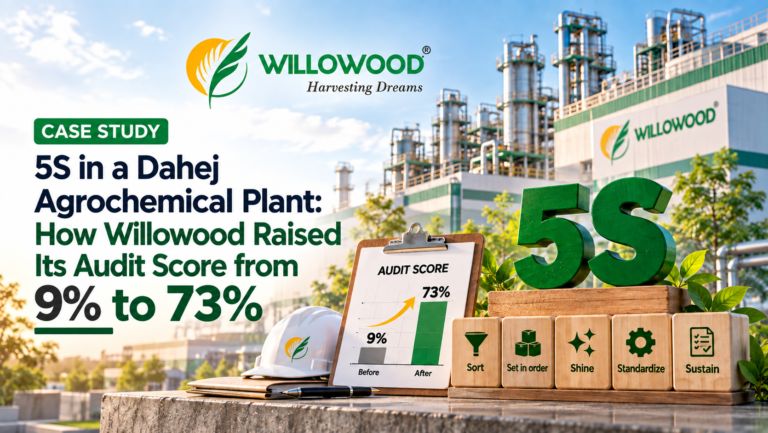
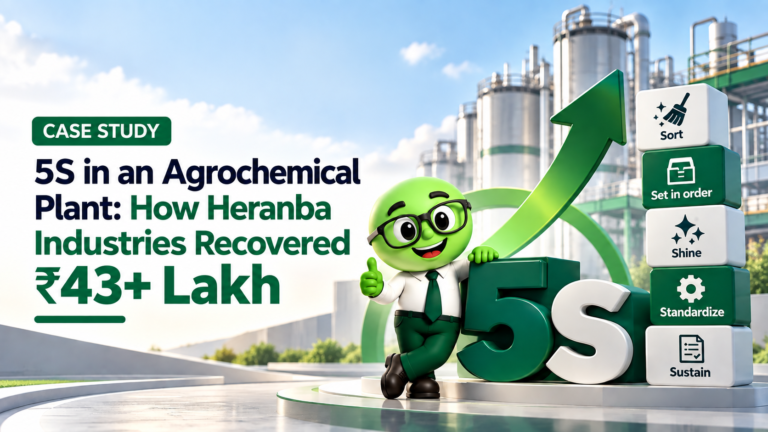
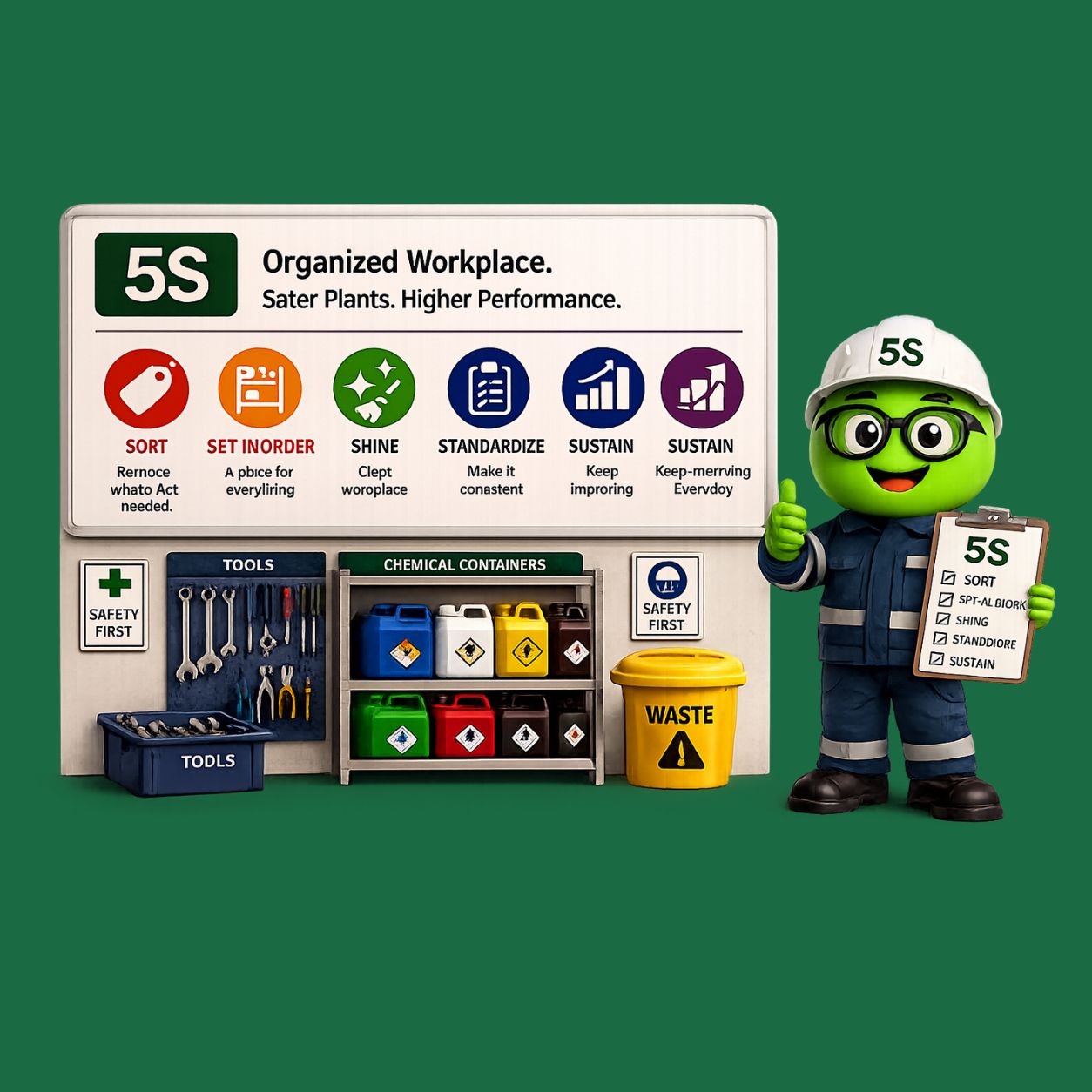
1. The 5 Pillars of 5S — Explained for Chemical and Pharma Factories
| S | Japanese | English | What It Means in a Chemical Plant |
| 1S | Seiri | Sort | Remove everything that is not needed from the workspace. Expired chemicals, unused equipment, obsolete documents, broken tools — all must be identified and removed. In chemical plants, this includes disposing of expired hazardous materials through licensed disposal routes. |
| 2S | Seiton | Set in Order | A place for everything, everything in its place. All chemicals labelled and stored in designated locations. SDS sheets at point of use. Fire extinguishers and PPE at fixed, clearly marked positions. Emergency exits permanently clear. |
| 3S | Seiso | Shine | Clean the workspace deeply — and use cleaning as an inspection. In chemical plants, cleaning reveals leaks, corrosion, deteriorating equipment, and containment failures that would otherwise go unnoticed. Shine is not about aesthetics; it is about detecting problems early. |
| 4S | Seiketsu | Standardise | Create standards that make Sort, Set in Order, and Shine the norm rather than the exception. Written cleaning schedules, visual standards, colour-coded chemical storage zones, standardised labelling formats. Standards prevent backsliding. |
| 5S | Shitsuke | Sustain | Build 5S into daily habits through regular audits, management walk-throughs, and a 5S culture where every employee takes ownership of their workspace. Without Sustain, the other four S’s deteriorate within months. |
2. Why 5S Is Uniquely Critical in Chemical and Pharmaceutical Plants
In most manufacturing environments, a disorganised workplace costs efficiency. In a chemical or pharmaceutical plant, a disorganised workplace costs lives — and compliance status. Here is why 5S has higher stakes in chemical/pharma than in general manufacturing:
| Risk Factor | How 5S Directly Addresses It |
| Chemical misidentification — wrong chemical used in a process due to poor labelling or disorganised storage | 2S (Set in Order): all chemicals in designated locations with standardised labels; colour-coded storage zones by chemical class |
| Emergency response failure — delayed evacuation or incorrect first aid because emergency equipment is inaccessible | 2S: all emergency exits permanently clear; all fire equipment at fixed, marked positions; first aid kit at designated location with expiry dates checked |
| Regulatory audit failure — SMETA, ISO, factory inspection finds visible non-conformances before documentation is reviewed | All five S pillars: a visibly organised factory immediately signals compliance discipline to any auditor |
| Chemical spillage or reaction due to incompatible chemicals stored together | 1S + 2S: Segregation standards for incompatible chemicals enforced through 5S; secondary containment in designated areas |
| Worker health exposure — chronic low-level chemical exposure from uncontained spills or poor housekeeping | 3S (Shine): regular cleaning and inspection of containment, ventilation, and spillage areas; early detection of leaks |
| Batch contamination in pharma (cross-contamination between products) | 2S + 4S: product-dedicated storage zones; standardised cleaning verification; clear visual demarcation between product areas |
3. 5S and SMETA Audit Compliance — The Direct Connection
Every SMETA 4-Pillar audit begins with a factory walk. Before a single document is reviewed, the auditor forms a compliance impression from what they observe. Here is how each 5S pillar directly supports or undermines specific SMETA pillars:
| 5S Pillar | SMETA Pillar Supported | What Auditors Look For | 5S Gap → SMETA Finding |
| 1S Sort | H&S + Environment | No unnecessary materials, chemicals, or equipment in work areas | Obsolete chemicals stored = Environment NC; expired PPE stored with active PPE = H&S NC |
| 2S Set in Order | H&S + Environment | PPE at point of use; emergency equipment accessible; chemicals properly stored and labelled | Blocked exit = Critical NC; unlabelled chemical = Major NC |
| 3S Shine | H&S | Clean work areas; no chemical spills or leak accumulation; maintained equipment | Accumulated chemical residue = NC; equipment corrosion indicating poor maintenance = H&S NC |
| 4S Standardise | MSA (all pillars) | Written procedures exist AND are visibly implemented; visual standards consistent with documents | Gap between procedure and practice = Major NC under SMETA 7.0 MSA |
| 5S Sustain | MSA | Evidence of regular 5S audits; management involvement; ongoing maintenance | No 5S audit records = management system not functioning = Major MSA finding |
4. 5S and ISO 14001 / ISO 45001 Alignment
One of the most practical benefits of 5S for Indian chemical companies is how directly it supports ISO 14001 (Environment) and ISO 45001 (H&S) management system requirements:
- ISO 14001 Clause 8.1 (Operational control): 5S standard operating procedures for chemical storage, waste segregation, and spill containment directly fulfil operational control requirements
- ISO 45001 Clause 8.1.2 (Hierarchy of controls): 5S Sort and Set in Order eliminate hazards and reduce exposure — the highest levels of the hierarchy
- ISO 14001 Clause 9.1 (Monitoring and measurement): 5S audit scores provide measurable environmental and H&S performance data for management review
- Both standards, Clause 7.5 (Documented information): 5S checklists, audit scores, and corrective action records directly fulfil documented information requirements
5. Implementing 5S in an Indian Chemical Plant — Common Challenges and How to Overcome Them
| Challenge | Why It Happens in Indian Chemical Plants | Solution |
| ‘We already tried 5S and it didn’t last’ | Previous 5S was implemented as a one-time cleaning exercise, not as a management system | Build Sustain (5S) with monthly scored audits, management walk-throughs, and team accountability |
| Workers resist participation | 5S seen as extra work imposed by management; no explanation of why it matters | Explain 5S in terms of worker safety, not management preference; involve workers in designing standards |
| Chemical storage area reverts quickly | No fixed standards; new chemicals received without designated storage assignment | Create a chemical storage map; require formal storage assignment for every new chemical receipt |
| Management only checks 5S before audits | 5S treated as an audit-day preparation exercise, not a daily discipline | Implement weekly unannounced 5S walks by supervisors; publish monthly 5S scores for each area |
| Hazardous waste accumulates between disposal | Disposal is expensive and complicated; tendency to store rather than dispose | Establish a monthly hazardous waste disposal cycle with a licensed vendor; track in waste manifest |
FAQs — 5S in Chemical Plants
Q1: How long does 5S implementation take in a chemical plant?
An initial 5S implementation campaign in a chemical plant — covering Sort, Set in Order, and Shine — typically takes 4–8 weeks for a focused team. Standardise and Sustain are ongoing, built into the management system over 3–6 months. Full 5S culture, where all five pillars are consistently maintained without management intervention, typically takes 12–18 months.
Q2: Can 5S implementation cause production disruption in a chemical plant?
If planned well, 5S causes minimal disruption. Sort and Set in Order activities are typically conducted department by department during planned shutdown periods or low-production windows. Greendot Management Solutions designs 5S implementation schedules that minimise production impact while maintaining safety standards throughout the process.
Q3: Is 5S the same as GMP housekeeping requirements in pharmaceutical plants?
5S and GMP housekeeping are closely aligned but not identical. GMP requirements are product-quality focused — preventing contamination and cross-contamination. 5S is more comprehensive — covering safety, environmental management, and operational efficiency in addition to cleanliness. The most effective approach is to implement 5S as the overarching framework and demonstrate how it fulfils both GMP and management system requirements simultaneously.