
1. What Is SMETA — And How Does It Actually Work?
SMETA stands for Sedex Members Ethical Trade Audit. It is the world’s most widely used ethical trade audit methodology, developed by SEDEX (Supplier Ethical Data Exchange) — a not-for-profit membership organisation based in the UK.
Here is what most articles on this topic do not explain clearly:
SMETA is not a certificate. It is an audit report, uploaded to the Sedex platform, that your buyers can access and review. You do not receive a certificate to frame and hang on your wall. You receive an audit report with findings, and that report is visible to all your buyers who are also on the Sedex platform.
This distinction matters because:
- If your audit report shows non-conformances, your buyers can see them
- If your report is missing or expired, buyers can see that too
- A “passed” SMETA audit means your findings were minor — there is no binary pass/fail system
How the process works in practice:
- Your company registers on the Sedex platform as a supplier (AB Member)
- Your buyer links to your Sedex account and requests an audit
- You engage an approved third-party auditing body (Bureau Veritas, SGS, Intertek, TÜV SÜD, or similar)
- The auditor visits your site and assesses against the SMETA framework
- The audit report is uploaded to the Sedex platform
- Your buyer reviews the report — not you sending them a document
The 4 Pillars of SMETA
| Pillar | What Is Assessed |
|---|---|
| Labour Standards | Working hours, wages, child labour, forced labour, freedom of association, non-discrimination |
| Health & Safety | Workplace safety, emergency preparedness, incident management, protective equipment |
| Environment (4-Pillar only) | Waste, GHG emissions, energy usage, water, environmental compliance |
| Business Ethics (4-Pillar only) | Anti-bribery, corruption prevention, transparent governance |
2-Pillar vs. 4-Pillar — Which One Does Your Buyer Require?
| 2-Pillar SMETA | 4-Pillar SMETA | |
|---|---|---|
| Covers | Labour + Health & Safety | All 4 pillars including Environment and Business Ethics |
| Typical requirement | Entry-level export supply chains | High-risk industries, ESG-committed buyers |
| Who typically requires it | Retailers, FMCG, textiles | Pharma, chemicals, food, automotive multinationals |
| Cost (India) | ₹1,20,000 – ₹2,00,000 | ₹1,80,000 – ₹3,00,000+ |
| Preparation time | 8–12 weeks | 12–18 weeks |
| With SMETA 7.0 | Harder — stronger labour documentation required | Significantly harder — now includes GHG, Net Zero goals |
Practical rule: If your buyer has an ESG commitment, a Net Zero target, or operates in Germany, France, or the Netherlands — ask for the 4-Pillar. Do not assume. When in doubt, ask your buyer directly which they require.
2. Why Indian Exporters Need to Pay Attention to SMETA 7.0 Right Now
Most Indian manufacturers think SMETA is a European problem. It is not. It has become an Indian business problem — and the consequences of ignoring it are real.
Here is what has changed in the global regulatory environment and why it directly affects suppliers in Gujarat, Maharashtra, and Rajasthan:
The Laws That Are Driving Buyer Pressure on You
German Supply Chain Due Diligence Act (LkSG) — Effective since January 2023 German companies with 1,000+ employees are now legally required to identify and manage human rights and environmental risks across their entire supply chain — including their Indian suppliers. If you supply to any German company (directly or through a trading house), they are required by law to audit you.
EU Corporate Sustainability Due Diligence Directive (CSDDD) — Rolling out 2024–2026 This extends similar obligations across the entire European Union. EU companies must conduct due diligence on suppliers, and failure to do so carries penalties. SMETA is one of the accepted audit mechanisms to demonstrate compliance.
UK Modern Slavery Act UK companies are required to report on steps taken to ensure their supply chains are free from forced labour. Indian textile, garment, and packaging suppliers to UK brands are directly in scope.
What This Means in Plain Language: Your European and UK buyer does not have a choice. Their own government is holding them legally accountable for what happens in your factory. They will ask for your SMETA report. If you do not have one, they will either move to a supplier who does — or they will pressure you to get one urgently, with very little lead time.
Which Indian Sectors Are Most Affected
| Sector | Primary Buyer Markets | Why SMETA Is Being Demanded |
|---|---|---|
| Textiles & Garments (Surat, Jaipur, Tirupur) | UK, EU, US retailers | Modern Slavery Act + EU CSDDD |
| Chemicals & Speciality Chemicals (Ankleshwar, Vapi, Bharuch) | German, Dutch buyers | German LkSG, REACH compliance linkage |
| Pharmaceuticals (Ahmedabad, Hyderabad) | European pharma companies | ESG supplier requirements |
| Packaging (Baroda, Pune, Mumbai) | FMCG multinationals | Responsible sourcing policies |
| Engineering & Auto Components (Pune, Rajkot, Ahmedabad) | German, Japanese OEMs | Tier-1 supplier compliance requirements |
| Food & Agro Processing | UK, EU food retailers | Ethical trade requirements |
3. What Changed in SMETA 7.0 — Full Breakdown
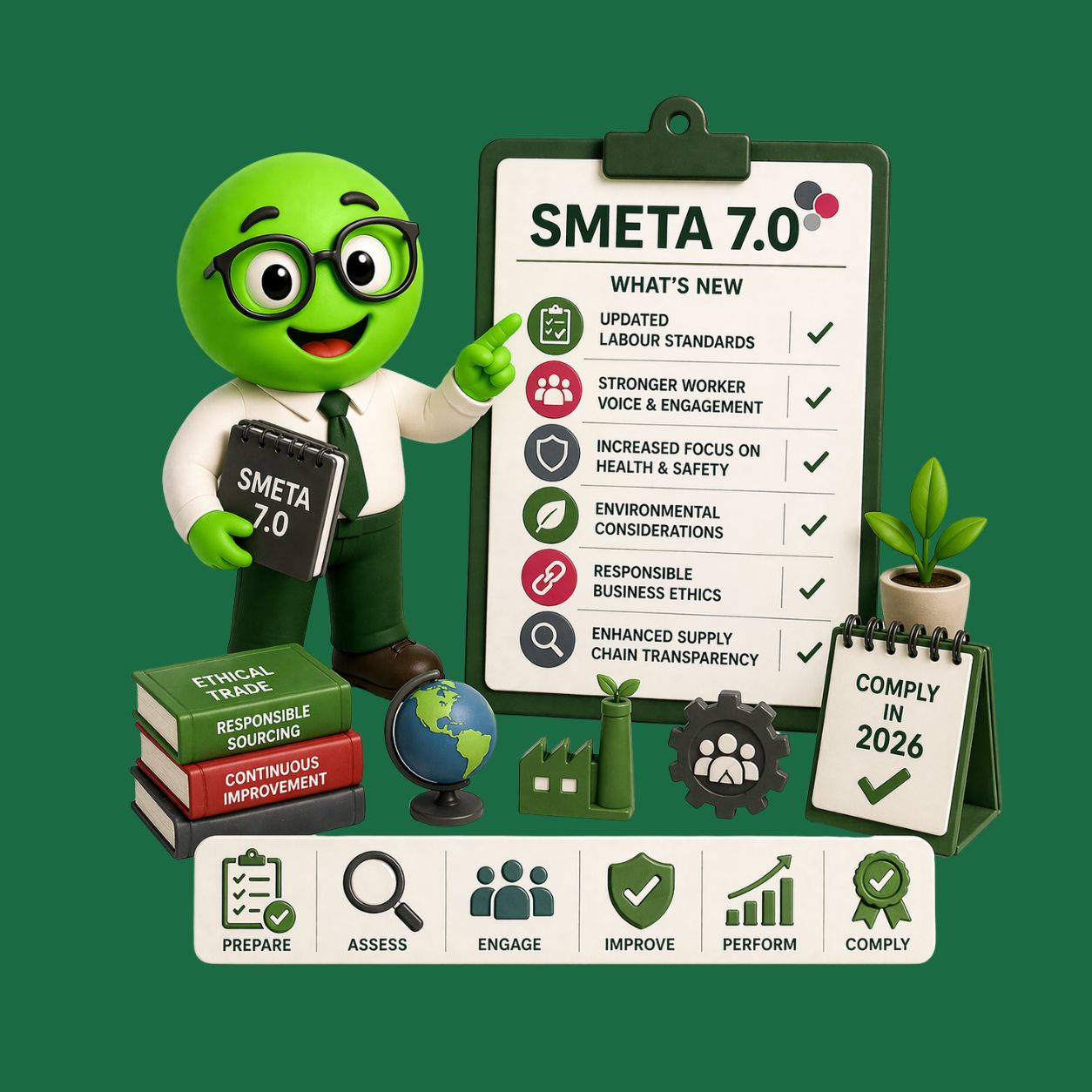
SMETA 7.0 was released in 2025. It is a significant upgrade from version 6.1 — not just a minor revision. Here is exactly what changed, and what your organisation needs to do about each change.
Change 1: Strengthened Environmental and Climate Expectations
What is new:
- You must now document energy usage, GHG (greenhouse gas) emissions, and site-level environmental risks — with actual data, not just policy statements
- Net Zero goals and carbon reduction plans must be disclosed (if your buyer requires 4-Pillar)
- Staff must receive climate literacy and environmental awareness training
- Environmental KPIs must be tracked, not just stated
What you need to do: Install basic energy and waste metering if you have not already. Assign an internal owner for environmental data. This does not need to be a sophisticated system — a monthly energy log and a documented environmental objective is a starting point.
Where many Indian factories fall short: Having an ISO 14001 Certification does not automatically mean you are SMETA 7.0 ready on environment. Auditors will look for GHG data specifically — not just compliance with Factories Act environmental provisions.
Change 2: Reinforced Human Rights and Labour Protections
What is new:
- Mandatory, documented risk assessments for child labour, forced labour, and workplace discrimination — not just a policy statement saying “we do not use child labour”
- Timekeeping and rest period records must be accurate and verifiable (auditors will cross-reference wage records with attendance)
- Anonymous grievance mechanisms with documented non-retaliation policies are now mandatory
- Union rights and collective bargaining must be actively supported, not just mentioned in a policy
What you need to do: If your grievance mechanism is a suggestion box that no one has used in three years, that will be a finding. You need a documented process, evidence of it being communicated to workers, and records of any grievances received and resolved.
The India-specific challenge: Many Indian factories use contract labour and migrant workers. SMETA 7.0 scrutinises these arrangements more closely — you need records for contract workers at the same standard as permanent employees.
Change 3: Simplified and Transparent Audit Reporting
What is new:
- Standardised report format with visual summaries and a traffic light risk indicator system (Green / Amber / Red findings)
- Worker interview insights are now formally integrated into the report
- Root cause analysis is required for findings — not just corrective action statements
- Reports are more comparable across suppliers and audit cycles
What you need to do: When you receive a SMETA audit report with findings, your corrective action response must include root cause analysis. “We will train staff” is not sufficient. “We identified that the supervisor was unaware of the overtime limit under the Factories Act. We have conducted a documented briefing, updated the shift roster system, and will verify compliance in the next monthly review” — this is the standard required.
Change 4: Expanded Supply Chain Due Diligence
What is new:
- Auditors now assess your own supplier and subcontractor management — not just your site
- Your onboarding process for vendors, training of subcontractors, and codes of conduct for supply partners are in scope
- Traceability of key inputs is increasingly reviewed
What you need to do: Prepare a vendor code of conduct if you do not have one. Document how you select and monitor contractors who work on your site. If you use job work facilities or third-party production, understand that these may come into scope.
Change 5: Amplified Worker Voice and Representation
What is new:
- Confidential worker interviews are now a core audit component — not optional or light-touch
- Anonymous, retaliation-free grievance channels are mandatory
- Worker committees and feedback platforms are actively encouraged
- The auditor will speak to workers without management present — and the report will reflect what workers say
What you need to do: This is the change that surprises most Indian factories. Prepare your workers — not by coaching them on what to say (that would be a serious violation if discovered), but by ensuring the actual workplace conditions match your documented policies. If workers are working beyond legal overtime limits, if wages are being delayed, if there are no fire drills — the worker interviews will surface this regardless of your documentation.
4. SMETA 6.1 vs SMETA 7.0 — Side-by-Side Comparison
| Audit Area | SMETA 6.1 | SMETA 7.0 |
|---|---|---|
| Environmental Management | General compliance review | GHG tracking, Net Zero goals, environmental KPIs, staff training |
| Human Rights Approach | Policy-level due diligence | Documented risk assessments, structured grievance handling, stakeholder consultation |
| Labour — Contract Workers | Limited focus | Explicit scrutiny of migrant, seasonal, and contract labour |
| Reporting Format | Text-heavy, inconsistent | Standardised format, traffic light system, root cause analysis |
| Climate Change | Minimal | Emissions data, adaptation planning required |
| Worker Voice | Basic interviews | Confidential interviews mandatory, anonymous grievance mechanism required |
| Supply Chain Scope | Primarily your own site | Extended to subcontractors, vendors, job workers |
| Corrective Actions | Statements accepted | Root cause analysis required |
Already have a SMETA 6.1 report? Your existing report remains valid until its expiry date (typically 12 months from audit date). However, your next audit will be conducted against the 7.0 framework. Plan your preparation accordingly — do not wait until one month before renewal.
5. Why Indian Companies Fail SMETA Audits — And How to Fix It
This section is based on GreenDot’s direct experience supporting SMETA preparation for manufacturers across Gujarat and Maharashtra, including companies like DBS Chemical (near Pune) and Oriana Pack (near Por, Baroda), as well as clients in chemical, textile, and packaging sectors.
These are the most common non-conformances found during SMETA audits at Indian manufacturing sites:
1. Working Hours Records Are Incomplete or Inconsistent
What auditors find: Attendance registers show one set of hours. Wage calculations imply a different set of hours. Production records suggest a third. Fix: Synchronise your attendance system, payroll system, and production records. They must tell the same story.
2. Overtime Is Excessive — and Undocumented
What auditors find: Workers regularly work beyond the Factories Act limits (48 hours/week normal, 60 hours including overtime). No overtime consent forms. No records of compensatory rest. Fix: Implement shift planning that brings overtime within legal limits. Where overtime is unavoidable, document worker consent and ensure it stays within legal limits.
3. No Functional Grievance Mechanism
What auditors find: A grievance policy exists in the HR manual. No worker knows about it. No grievance has ever been recorded. The suggestion box is empty — or missing. Fix: Conduct a documented communication to all workers. Post the grievance process in local language (Gujarati, Marathi, Hindi as applicable). Maintain a register even if it shows zero complaints — with evidence the channel exists and is accessible.
4. Contract and Migrant Worker Records Are Incomplete
What auditors find: Permanent employee records are well-maintained. Contract workers hired through a labour contractor have no wage records at the site level. No clarity on whether they are paid minimum wage. Fix: Require your labour contractor to submit wage records monthly. Retain copies at your site. Verify minimum wage compliance for the relevant state.
5. Fire and Emergency Preparedness Is on Paper Only
What auditors find: Fire extinguishers present. Fire drill records — last drill was 18 months ago. Workers do not know the assembly point. Emergency exits are partially blocked. Fix: Conduct drills every 6 months minimum. Maintain records with photographs, attendance, and learnings. Train new joiners within 30 days.
6. No Written Environmental Targets or Data
What auditors find (4-Pillar): Environmental policy exists. No measurable targets. No energy consumption data. No waste data. No water usage records. Fix: Set three measurable environmental objectives (e.g., reduce electricity consumption by 5%, reduce effluent by 10%). Track monthly. Maintain a simple log.
7. Health and Safety Training Has No Records
What auditors find: “Yes, we give safety training to new workers.” No training records. No signed attendance. No training content. Fix: Maintain a training register for every safety training session — date, trainer, topics covered, attendees (with signatures).
8. Chemical Handling and MSDS Are Incomplete
What auditors find (especially in chemical and pharma sectors): Some chemicals on-site have no MSDS (Material Safety Data Sheets). Workers using chemicals have not received documented handling training. Fix: Audit your chemical inventory. Ensure MSDS is available for every chemical. Train workers using the MSDS and record the training.
9. Supplier Code of Conduct Does Not Exist
What auditors find (under SMETA 7.0’s expanded scope): No documented code of conduct shared with vendors or contractors. No process for evaluating whether your own suppliers meet ethical standards. Fix: Draft a one-page Supplier Code of Conduct. Share it with your top 10 vendors and contractors. Keep acknowledgment records.
10. Workers Cannot Explain Basic Rights During Interviews
What auditors find: Worker interview reveals workers are unaware they have the right to raise complaints, unaware of their wage components, or unaware of the factory’s safety procedures. Fix: Hold a documented worker communication session. Post key information in local language. This is about genuine awareness — not scripted answers.
6. SMETA 7.0 Preparation Timeline for Indian Companies
| Phase | Key Activities | Typical Duration |
|---|---|---|
| Phase 1: Gap Assessment | Review current documentation vs SMETA 7.0 checklist. Identify missing records, policies, and systems. Prioritise by risk level. | Weeks 1–3 |
| Phase 2: System Building | Draft or update: HR policies, grievance mechanism, environmental data log, worker communication process, vendor CoC. Conduct internal training. | Weeks 4–10 |
| Phase 3: Mock Audit | Conduct an internal or consultant-led mock audit. Identify remaining gaps. Review records for consistency. Test worker awareness. | Weeks 11–13 |
| Phase 4: Audit Booking | Register on Sedex platform (if not already done). Book approved auditing body. Confirm scope (2-pillar or 4-pillar). | Week 13–14 |
| Phase 5: Audit Day | Auditor visits site. Reviews documents. Conducts worker interviews. Walks the facility. | 1–2 days |
| Phase 6: Corrective Actions | Receive preliminary findings. Prepare root cause analysis and corrective action plan. Submit to auditing body. | Weeks 15–18 |
Total realistic timeline for a first-time SMETA 7.0 audit (India): 16–20 weeks from start to closed report.
Important: Companies that attempt SMETA with 4–6 weeks of preparation consistently receive more findings and spend more time on corrective actions than companies that plan for 16+ weeks.
7. SMETA vs SA 8000 Consulting vs BSCI Consulting vs EcoVadis — Which Audit Does Your Buyer Require?
This is one of the most common questions from Indian exporters. Here is a direct comparison:
| SMETA | SA 8000 | BSCI | EcoVadis | |
|---|---|---|---|---|
| Type | Audit report (uploaded to Sedex platform) | Certification | Audit report (uploaded to BSCI platform) | Scorecard / rating |
| Framework owner | Sedex (UK non-profit) | Social Accountability International | Amfori (EU trade association) | EcoVadis (private company) |
| What it covers | Labour, H&S, Environment, Ethics | Labour rights (9 standards) | Labour + H&S + Environment | Environment, Labour, Ethics, Sustainable Procurement |
| Who typically requires it | UK and EU retailers, FMCG, pharma, chemicals | Higher-risk social compliance buyers | EU apparel, footwear, lifestyle brands | Large corporate procurement programs |
| Certificate validity | 12 months (report, not certificate) | 3 years (with annual surveillance) | 1–3 years | 12 months (scorecard) |
| India cost range | ₹1.2L – ₹3L+ | ₹2.5L – ₹5L+ | ₹1L – ₹2.5L | ₹80,000 – ₹1.5L (assessment fee) |
| Audit by | Approved CB (Bureau Veritas, SGS, etc.) | Approved CB (SAI-accredited) | Approved CB (Amfori-approved) | EcoVadis internal scoring team |
| Best for | Suppliers to UK/EU/US retailers, FMCG, chemicals | Suppliers requiring formal social certification | Suppliers to European fashion/lifestyle brands | Suppliers to large corporates with ESG scorecards |
GreenDot consulting note: Many Indian companies are asked for more than one of these. A chemical company supplying to European buyers may need both SMETA (from one buyer) and EcoVadis (from another). We help companies build their compliance systems so they serve multiple frameworks without duplicating work.
8. Sedex Platform Registration — What Indian Companies Need to Know
Before you can have a SMETA audit, you must register on the Sedex platform. Many Indian companies skip this step and then face delays.
Steps to register on Sedex:
- Go to www.sedex.com and register as an AB Member (supplier)
- Pay the annual Sedex membership fee (approximately USD 170–400 depending on company size — verify current rates at sedex.com)
- Complete your company profile and self-assessment questionnaire (SAQ)
- Link with your buyer on the platform (your buyer will send you an invitation)
- Book an approved SMETA auditor from the Sedex-approved body list
- After the audit, the report is uploaded directly by the auditor — you do not upload it yourself
Common mistake: Some Indian companies register on Sedex but never complete the SAQ. Your buyers can see an incomplete profile — it signals lack of readiness.
Approved SMETA auditing bodies in India include: Bureau Veritas, SGS, Intertek, TÜV SÜD, ELEVATE (formerly Openview), and Rina. Always confirm current Sedex approval status before booking, as the approved body list is updated periodically.
9. How GreenDot Supports SMETA 7.0 Preparation
At GreenDot, we have supported SMETA preparation for manufacturers across Gujarat and Maharashtra — including chemical manufacturers, packaging companies, textile processors, and engineering suppliers.
Our SMETA 7.0 consulting engagement covers:
Step 1 — Gap Assessment (Weeks 1–2) We conduct a structured review of your current documentation, records, and systems against the full SMETA 7.0 checklist. You receive a written gap report with findings prioritised by severity.
Step 2 — System Building (Weeks 3–10) We work alongside your HR, EHS, and operations teams to build or improve: grievance mechanisms, worker communication systems, labour record-keeping, environmental data logs, vendor code of conduct, and training records. Everything is built to your factory’s actual operations — not from generic templates.
Step 3 — Worker Awareness Program We conduct a structured communication session with your workforce explaining their rights under SMETA — in the language your workers understand. This is the most commonly neglected step, and the one that most often causes audit findings.
Step 4 — Mock Audit We conduct a full pre-audit review, including document review, facility walkthrough, and worker interviews. You see exactly what an auditor will see before the auditor arrives.
Step 5 — Audit Support and Corrective Action We support you through the formal audit and, where findings arise, help you prepare root cause analysis and corrective action responses that meet auditor expectations.
We have worked with manufacturers in sectors including chemicals (Pune region), packaging (Baroda region), textiles, and engineering components — companies ranging from 80 to 800 workers.
Contact GreenDot for a free SMETA 7.0 readiness discussion: Sedex (SMETA) Consulting Services
10. Frequently Asked Questions About SMETA 7.0
Q: What is SMETA 7.0? SMETA 7.0 is the latest version of the Sedex Members Ethical Trade Audit framework, released in 2025. It introduces stronger environmental reporting requirements (including GHG tracking and Net Zero goal disclosure), deeper human rights due diligence aligned with UN Guiding Principles and ILO Conventions, mandatory confidential worker interviews, a standardised traffic-light reporting format, and expanded supply chain due diligence covering subcontractors and vendors.
Q: When does SMETA 7.0 take effect? SMETA 7.0 became effective in 2025. New audits are now conducted against the 7.0 framework. If you hold a SMETA 6.1 report, it remains valid until its expiry date — but your next audit will follow the 7.0 standard.
Q: Is SMETA mandatory or voluntary? SMETA itself is not mandated by any Indian law. However, it is increasingly a contractual requirement imposed by international buyers. If your buyer’s contract or supplier code of conduct requires SMETA, then for you it is effectively mandatory — refusing will cost you the contract.
Q: How long is a SMETA audit report valid? Typically 12 months from the audit date. Some buyers accept up to 18 months for lower-risk sites. High-risk sites or those with critical findings may require re-audit within 6–9 months. Always confirm validity requirements with your specific buyer.
Q: How much does a SMETA 7.0 audit cost in India? A 2-Pillar audit typically costs ₹1,20,000 – ₹2,00,000. A 4-Pillar audit ranges from ₹1,80,000 – ₹3,00,000 or more, depending on site size, location, and the auditing body. These figures include auditor fees but not Sedex platform registration or pre-audit consulting support. Contact GreenDot for a detailed estimate specific to your site.
Q: What is the difference between SEDEX and SMETA? SEDEX (Supplier Ethical Data Exchange) is the online platform used to store and share ethical supply chain data. SMETA (SEDEX Members Ethical Trade Audit) is the audit methodology — the process used to assess your company. The SMETA audit report is then uploaded to and shared via the SEDEX platform. SEDEX is the platform; SMETA is the audit.
Q: Do I need to register on the Sedex platform before booking an audit? Yes. You must register as an AB Member on the Sedex platform and complete your self-assessment questionnaire (SAQ) before an audit can be scheduled. The auditor uploads the report directly to the platform — your Sedex registration must exist for this to happen.
Q: What happens if my SMETA audit finds non-conformances? Non-conformances are classified as Critical, Major, or Minor. Critical findings (such as evidence of child labour or serious safety risk) require immediate corrective action and may trigger buyer escalation. Major and Minor findings require a written corrective action plan with root cause analysis, submitted to the auditing body within a specified timeframe (usually 30–60 days). Most first-time audits in India produce some Major or Minor findings — this is normal. The key is a quality corrective action response.
Q: Can small factories with fewer than 100 workers get SMETA? Yes. SMETA has no minimum workforce size requirement. The audit scope and assessment depth are adjusted to the size and complexity of your operation. GreenDot has supported companies with 80–120 workers through SMETA preparation successfully.
Q: Should I get a 2-Pillar or 4-Pillar audit? Ask your buyer. If they specify 4-Pillar, that is your answer. If they do not specify, 2-Pillar is the default — but with SMETA 7.0’s increased focus on environment, an increasing number of buyers are moving to 4-Pillar requirements, especially in chemicals, pharma, and FMCG supply chains.
Q: Is SMETA applicable to service companies or only manufacturers? SMETA was originally designed for manufacturing and production sites. It can be applied to service operations, but the majority of buyer requirements in India target manufacturing, processing, and packing sites. If you are a service company being asked for SMETA, confirm the scope with your buyer.
Q: How is SMETA 7.0 different from ISO 14001 or ISO 45001? ISO 14001 Certification and ISO 45001 Certification are management system certifications — they assess whether you have a system in place to manage environmental and safety risks. SMETA is an ethical trade audit — it assesses actual conditions on the ground, including worker welfare, labour rights, and social practices. Having ISO 14001 or ISO 45001 is helpful preparation for SMETA, but it does not substitute for it. Auditors will look at actual worker interviews and records, not just system documentation.
11. SMETA 7.0 — Industry-Wise Readiness Checklist
Use this as a starting point to assess your organisation’s current state:
Textile and Garment Manufacturers (Surat, Jaipur, Tirupur)
- Wage records for all workers including piece-rate workers
- Overtime records within Factories Act limits — with worker consent for any overtime
- Age verification records for all workers (no workers below 18 years)
- Documented grievance mechanism in local language
- Records of payment of PF, ESIC for all eligible workers
- No home-working arrangements undisclosed to buyer
- Chemical (dye, chemical treatment) handling records and MSDS
- Effluent treatment system documentation (4-Pillar)
Chemical Manufacturers (Vapi, Ankleshwar, Bharuch, Pune region)
- MSDS for all chemicals on-site — accessible to workers in local language
- PPE provision records per chemical handling requirement
- Hazardous waste disposal records and authorised disposal vendor documentation
- Environmental compliance records (GPCB/CPCB authorisations)
- GHG or energy consumption data (at minimum, electricity bills by month)
- Emergency response plan — tested and documented
- Contractor safety induction records
Packaging Manufacturers (Baroda, Mumbai, Pune region)
- Shift management records — especially for night shift workers
- Machine guarding inspection records
- Noise and vibration exposure assessments (if applicable)
- Supplier CoC for raw material suppliers
- Environmental targets for waste and energy (4-Pillar)
Engineering and Auto Component Manufacturers (Pune, Rajkot, Ahmedabad)
- Contractor and job worker records at par with permanent employee records
- Tool and machine safety certification records
- Working hours records for multi-shift operations
- Sub-supplier assessment process (SMETA 7.0 extended scope)
- No-retaliation policy for workers raising safety concerns
12. Key Takeaways for Indian Manufacturers
- SMETA 7.0 is significantly harder than 6.1 — especially on environmental documentation, worker voice, and supply chain due diligence. Do not assume your previous compliance level is sufficient.
- European buyer demand is increasing — driven by law (German LkSG, EU CSDDD), not just preference. This is not going away.
- Preparation time matters — companies that prepare for 16+ weeks consistently have cleaner audit outcomes than those who rush in 4–6 weeks.
- Worker interviews are now central — the audit is not only about your documents. It is about whether your workers experience what your policies say they experience.
- Non-conformances are not the end — a quality corrective action response is as important as the initial audit outcome.
- SMETA 7.0 readiness often improves other things — companies that go through SMETA preparation commonly find they improve their HR documentation, safety systems, and worker communication in ways that benefit operations beyond the audit.