
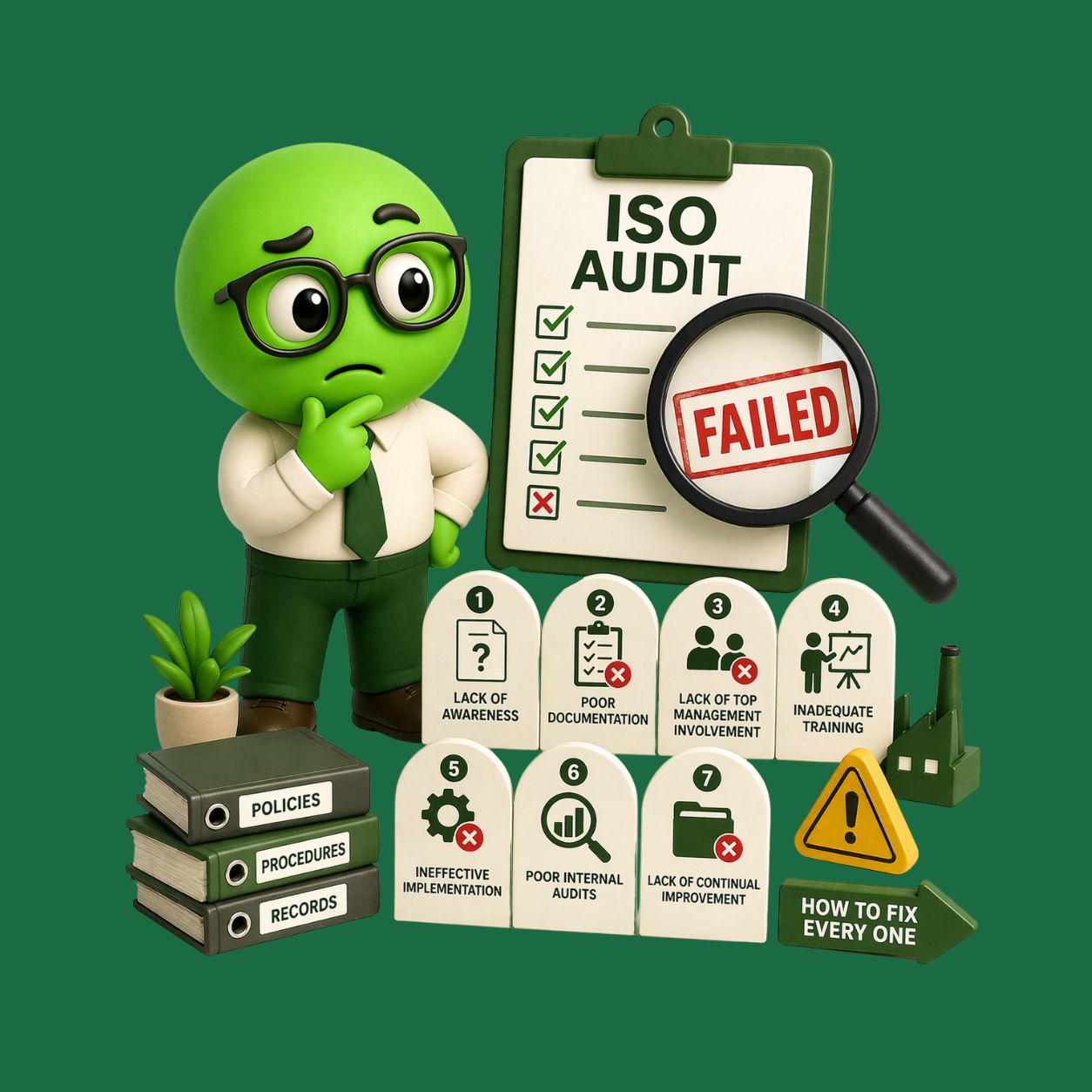

Every year, many Indian MSME factories walk into their ISO audit confident and walk out with a list of non-conformities. The reason is almost always the same: they confused looking compliant with being compliant. An audit does not test your files — it tests whether your system works every day, not just on audit day. After working with 1,200+ companies since 1999 across chemical, pharma, engineering and plastics plants, these are the seven reasons we see again and again.
Most Indian MSMEs fail ISO audits for the same seven reasons: documents that do not match practice, management reviews done as a formality, weak internal audits, corrective actions without root cause analysis, meaningless objectives, incomplete competence records and an ISO system owned by one person. Each one is fixable before your next audit.
1. Documents Exist, but the System Does Not
What the auditor finds: This is the most common finding in Indian MSME audits, across ISO 9001, 14001 and 45001. The manual and forms look perfect, but when the auditor asks an operator how a job is done, the answer is different from the written procedure.
How to fix it: Write procedures with the people who do the work, in their language, and keep them short. If the floor does it better than the procedure says, change the procedure. This is exactly what a good ISO 9001 consultant should fix first.
2. Management Review Is a Formality, Not a Tool
What the auditor finds: ISO requires top management to review the system with real data. In many MSMEs the review happens once a year, just before the audit, and the minutes look the same every year.
How to fix it: Hold a short review every quarter using real numbers — complaints, rejections, delivery, audit results — and record the decisions taken. Auditors look for decisions, not attendance sheets.
3. Internal Audits Are Superficial, or Not Done
What the auditor finds: Many companies skip the internal audit or let the person who wrote a procedure audit it. The auditor sees a checklist ticked ‘OK’ everywhere and knows nothing was really checked.
How to fix it: Make an annual audit calendar, train two or three internal auditors from different departments, and audit against a clause-wise checklist. Train your own internal auditors (ISO 9001 Internal Auditor Training – link when live).
4. Corrective Actions Are Closed Without Root Cause
What the auditor finds: The problem is blamed on ‘human error’, the operator is retrained and the non-conformity is closed. Three months later the same problem is back.
How to fix it: Do a 5-Why or fishbone analysis before closing any non-conformity, and check after 30–60 days whether the action worked. See our 8D problem-solving training.
5. KPIs and Objectives Are Meaningless
What the auditor finds: Objectives are set so that they are always met — ‘100% training completed’, ‘zero major complaints’. The system shows improvement on paper while nothing changes.
How to fix it: Set a few measurable objectives tied to real problems — rejection rate, on-time delivery, customer complaints — and review them every month.
6. Competence and Training Records Are Incomplete
What the auditor finds: Training attendance is recorded, but nobody checks whether people became competent. Critical roles have no defined skill requirements.
How to fix it: Build a competence matrix for key roles, assess after training and plan refresher training. Start with ISO 9001:2026 awareness training for all staff.
7. The ISO System Is Owned by One Person
What the auditor finds: The QA head or management representative runs everything. Other departments call it ‘their ISO’ and cannot answer the auditor’s questions.
How to fix it: Make each department head own their processes, objectives and records, and bring ISO topics into normal monthly meetings. ISO 9001:2026 now expects top management to promote a quality culture.
Worried about your next audit? Book a free ISO audit gap check with an IRCA-certified Lead Auditor.
Will ISO 9001:2026 make audits harder?
ISO 9001:2026, published in September 2026, keeps the same clause structure but asks top management to show a quality culture and ethical behaviour, and to plan risks, opportunities and changes more clearly. Every one of the seven failures above becomes more visible under the 2026 edition, because auditors will look for leadership involvement, not just records. Read what changed and a 90-day transition plan → /iso-9001-2026/
Summary: the 7 reasons at a glance
| Failure Reason | Root Cause | Fix |
| Documents ≠ Systems | Procedures describe an ideal, not real work | Write procedures with the people who do the work |
| Formal management review | Done only for the audit | Quarterly review with real data and decisions |
| Weak internal audits | No trained or independent auditors | Annual calendar, trained auditors, clause-wise checklist |
| No root cause | Symptoms fixed, causes ignored | 5-Why / fishbone before closing; check effectiveness |
| Meaningless KPIs | Objectives set to be met | Measurable objectives tied to real problems |
| Weak competence records | Training not evaluated | Competence matrix and post-training assessment |
| One-person ISO | System not part of operations | Department ownership; ISO in monthly meetings |
Frequently asked questions
Q: How long should we allow to prepare for an ISO surveillance audit?
Allow at least four to six weeks: enough time for an internal audit, a management review and closure of the findings before the certification body arrives.
Q: Can we fail an ISO audit and lose our certificate?
Yes. Major non-conformities that are not closed within the certification body’s deadline can lead to suspension or withdrawal of the certificate.
Q: We passed our ISO audit last year but got many NCs this year. What changed?
Usually the system was built for certification, not for daily operations, and it has drifted. Auditors also rotate and look at different processes. With ISO 9001:2026 now published, transition audits will also test leadership involvement, quality culture and change planning. A short gap check before your next surveillance audit shows where you stand.
Q: Can a consultant help us close non-conformities after the audit?
Yes. Greendot’s IRCA-certified Lead Auditors help your team find the root cause, correct it and prepare the evidence your certification body needs within its deadline. Learn more about our ISO 9001 consultant services.
