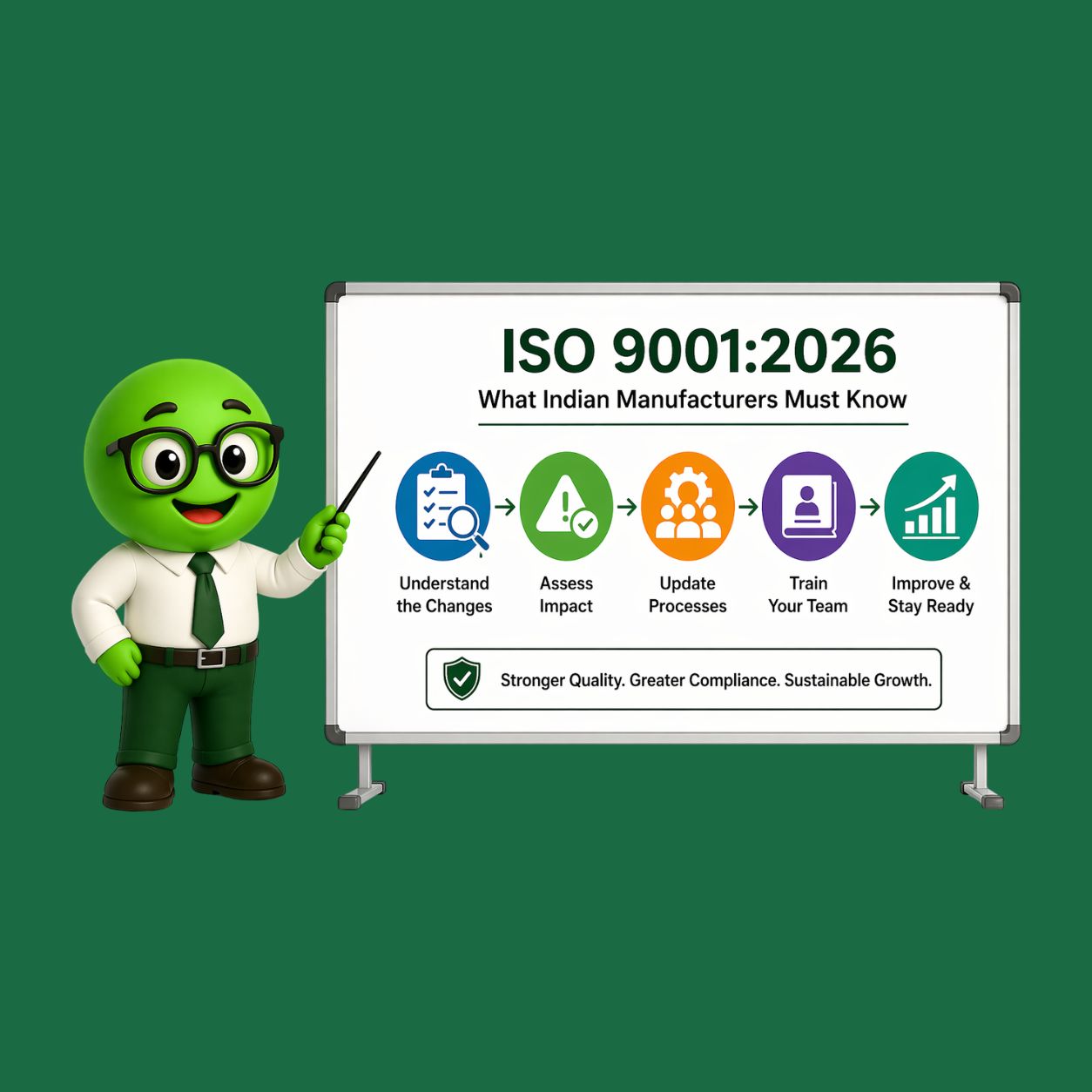

ISO 9001 — the world’s most widely adopted quality management standard with over one million certified organizations globally — is undergoing its most significant revision since 2015. The new ISO 9001:2026 standard is expected to be published in the second half of 2026, with a transition period of approximately 3 years following publication.
For Indian manufacturers — whether you are a pharmaceutical company in Hyderabad, a chemical plant in Surat, or an engineering MSME in Pune — this revision will require updating your Quality Management System, your internal audit programm, your management review process, and potentially your documentation structure.
The organizations that begin preparing now — before the standard is published — will transition smoothly and cheaply. Those that wait until the deadline will scramble, risk certification gaps, and incur higher consulting and audit fees.
This guide from Greendot Management Solutions covers everything currently known about ISO 9001:2026 — the confirmed changes, the expected timeline, and a practical preparation roadmap for Indian manufacturers.
Current Status as of March 2026:
Draft International Standard (DIS): Published and approved — final review complete
Final Draft International Standard (FDIS): Expected mid-2026 Full Publication: Expected second half of 2026
Transition Period: Approximately 3 years from publication (estimated deadline ~2029)
Current certificates: ISO 9001:2015 certificates remain valid until the transition deadline
1. Why Is ISO 9001 Being Revised?
ISO standards are reviewed every 5 years. The 2015 version introduced risk-based thinking, stronger leadership requirements, and the Annex SL High-Level Structure (HLS). The 2026 revision responds to significant changes in the business environment since 2015:
- Climate change and sustainability — the 2024 amendment to ISO 9001:2015 (Amendment 1) added climate change as a consideration in Clause 4.1 and 4.2. ISO 9001:2026 formally integrates this into the standard body.
- Updated Harmonized Structure (HS) — ISO has updated its master structure (formerly Annex SL) to better reflect modern management thinking. ISO 9001:2026 aligns with this updated HS for better integration with ISO 14001:2026, ISO 45001, and ISO 27001.
- Stronger focus on leadership and quality culture — top management’s active role in building a quality culture goes beyond the 2015 requirements.
- Digital transformation — the revision acknowledges that documented information is increasingly digital, and that quality management systems operate in digital environments.
- Lessons from global implementation — 10+ years of ISO 9001:2015 implementation has revealed areas where requirements were ambiguous or insufficiently specific.
2. The Confirmed Key Changes in ISO 9001:2026
| Change Area | What ISO 9001:2015 Requires | What ISO 9001:2026 Adds / Changes |
| Climate Change | Amendment 1 (2024) added climate to Clause 4.1/4.2 as an external issue to consider | Climate change formally integrated into the standard text; organizations must actively consider how climate issues affect product/service quality and the QMS |
| Harmonized Structure Alignment | Annex SL structure (shared with ISO 14001, 45001) | Updated Harmonized Structure (HS) — improved clause numbering and definitions; better integration with ISO 14001:2026 and ISO 45001 |
| Leadership & Quality Culture | Top management must demonstrate leadership and commitment | Specific new requirements for building and promoting a quality culture; ethical behaviour requirements for top management |
| Knowledge Management | Clause 7.1.6 — organisational knowledge must be determined, maintained, and made available | Expanded — explicit requirements for knowledge transfer when staff leave, and for capturing lessons learned systematically |
| Documented Information | ‘Documents and records’ replaced with ‘documented information’ | Further clarification on digital documented information — organisations can explicitly reference cloud-based and digital systems |
| Risk-Based Thinking | Required throughout — risks and opportunities must be addressed | Further strengthened — risk treatment effectiveness must be verified more rigorously |
| Interested Parties | Clause 4.2 — understand interested parties and their requirements | Enhanced requirements to actively monitor changes in interested party requirements, not just identify them at one point in time |
| Supply Chain | Clause 8.4 — control of externally provided processes | Strengthened requirements for supplier risk assessment and extended supply chain visibility |
3. What Is NOT Changing in ISO 9001:2026
This is equally important for Indian manufacturers to understand. ISO 9001:2026 does NOT:
- Change the fundamental PDCA structure of the standard
- Remove or significantly alter any of the current 10 clauses
- Introduce entirely new topic areas — it refines and strengthens existing requirements
- Require a complete rebuild of your existing QMS — it requires targeted updates
- Change the certification process — third-party certification through NABCB-accredited bodies continues as before
Bottom Line for Indian Manufacturers:
If your ISO 9001:2015 QMS is genuinely functioning (not just maintaining the certificate), the transition to ISO 9001:2026 will require targeted updates rather than a complete overhaul. The biggest areas of effort will be: (1) integrating climate considerations, (2) building evidence of quality culture, and (3) aligning documentation with the updated HS structure.
4. ISO 14001:2026 and ISO 45001 — The Parallel Revisions
Indian manufacturers with Integrated Management Systems (IMS) — combining ISO 9001, ISO 14001, and ISO 45001 — should note that all three standards are being revised on overlapping timelines:
| Standard | Current Version | Revision Status | Expected Publication |
| ISO 9001 | 2015 | DIS approved — FDIS expected mid-2026 | Second half of 2026 |
| ISO 14001 | 2015 | DIS published — FDIS expected late 2025 | January 2026 (already published) |
| ISO 45001 | 2018 | Early revision stage — committee meeting planned | Approximately 2027 |
For Indian manufacturers with IMS, the most significant immediate action is ISO 14001:2026 — already published. ISO 9001:2026 follows. ISO 45001 revision is the furthest out. A well-planned IMS transition can handle all three revisions with a single coordinated programme rather than three separate projects.
5. Preparation Roadmap — What Indian Manufacturers Should Do Now
- Review the 2024 Amendment to ISO 9001:2015 (Amendment 1 — Climate Change): ensure your Clause 4.1 and 4.2 analysis already addresses climate-related issues. Most Indian manufacturers have not yet done this.
- Conduct a management review that specifically discusses quality culture: gather evidence that leadership is actively building — not just declaring — a quality culture. This will be examined more deeply in 2026.
- Assess your knowledge management system: identify how your organisation captures, retains, and transfers critical quality knowledge. Are your SOPs up to date? Is product/process knowledge documented beyond individuals’ heads?
- Review your interested parties register: update it more frequently (annually minimum) and document that changes in their requirements are being monitored and acted upon.
- Prepare your ISO 14001:2026 transition (if applicable): ISO 14001:2026 is already published. Begin your gap assessment now — this will also prepare you for the ISO 9001:2026 structural alignment changes.
- Engage your certification body: ask your certification body for their specific transition plan and timeline. NABCB-accredited bodies in India will publish transition audit requirements once the standard is published.
FAQs — ISO 9001:2026 India
Q1: Will we need to be re-certified when ISO 9001:2026 is published?
No — you will not need to start a new certification from scratch. Your existing ISO 9001:2015 certificate remains valid until the transition deadline (expected approximately 2029, 3 years after publication). Your certification body will conduct a transition audit during your next scheduled surveillance or recertification audit within the transition period.
Q2: Is ISO 14001:2026 already published? What are the key changes?
Yes — ISO 14001:2026 was published in January 2026. Key changes include: stronger integration of climate-related physical and transition risks, enhanced requirements for environmental performance evaluation, stronger supply chain environmental requirements, and alignment with the updated Harmonized Structure. Greendot Management Solutions offers ISO 14001:2026 gap assessments for Indian manufacturers.
Q3: Does ISO 9001:2026 require us to measure our carbon footprint?
No — ISO 9001:2026 does not require carbon footprint measurement or greenhouse gas reporting. However, it requires organizations to consider whether climate change is a relevant external issue that could affect product/service quality or the ability of the QMS to achieve its intended outcomes. For most Indian manufacturing companies, the answer is yes — and the organization must then address how their QMS manages climate-related risks to quality.