
The Export Contract That Was Never Lost on Quality
A specialty chemical manufacturer in Ankleshwar — good product, clean facility, ISO 9001 certified — lost a significant export order to a European buyer. Not on price. Not on quality. The buyer’s procurement checklist had a single line item the factory had never seen before: “Responsible Care Signatory or Logo Holder — mandatory for supplier registration.”
The factory had never heard of Responsible Care.
This situation is no longer unusual. In the last three years, I have seen it repeat across Vapi, Dahej, Nandesari, and Bharuch. Global chemical buyers — including ICCA member companies — have begun treating Responsible Care as a baseline supplier qualification, not a bonus. For Gujarat’s chemical manufacturers, the question is no longer “Should we pursue Responsible Care?” It is “How long can we afford not to?”
This guide covers everything a chemical company MD, EHS Head, or Compliance Manager needs to know — what Responsible Care is, the 7 ICC Codes, who qualifies, how the audit works, common failure points, and how to start.
At a Glance: Responsible Care in India
| What it is | Global voluntary initiative for continuous EHS&S improvement in the chemical industry |
| Who manages it in India | Indian Chemical Council (ICC), Mumbai — the apex body for India’s chemical industry |
| Global reach | 70+ economies, managed internationally by ICCA |
| Year launched | 1985 (Canada); India joined through ICC |
| Indian signatories (2025) | 163+ companies have signed the Global Charter |
| Indian logo holders (2025) | 83 companies have completed the independent audit and hold the logo |
| Logo validity | 2 years — renewal requires a fresh ICC audit |
| Annual obligation | KPI data submission to ICC every year |
| Applicable industries | Chemical manufacturing, pharma APIs, agrochemicals, petrochemicals, chemical distributors, chemical logistics |
| Governing codes | 7 ICC Codes of Management Practice |
| Audit conducted by | ICC-empanelled independent auditors |
| Named logo holders | Reliance Industries, BASF India, Tata Chemicals, Atul Limited, UPL, and 78 others |
1. What is Responsible Care?
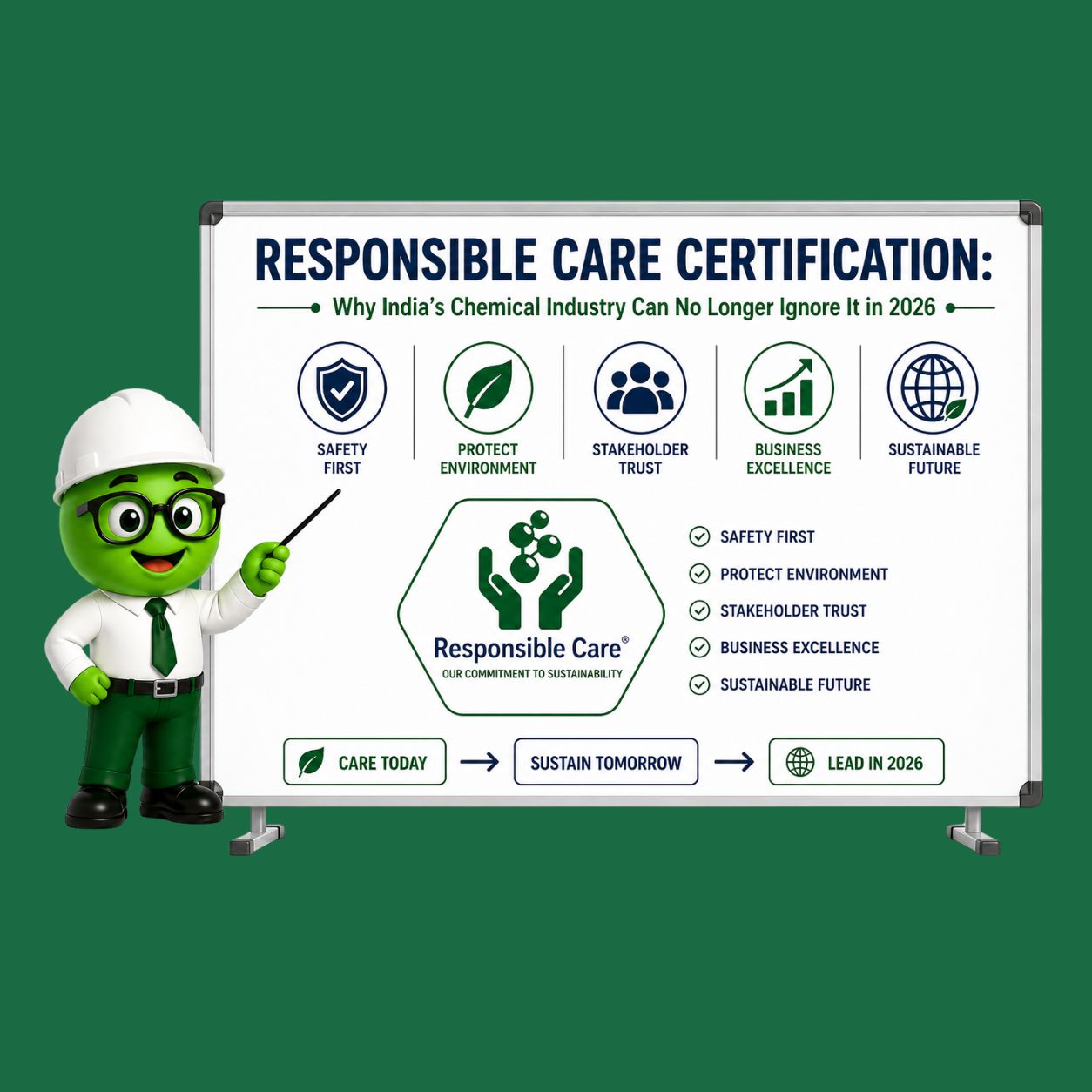
In one sentence: Responsible Care is the global chemical industry’s voluntary but internationally recognised commitment to continuously improve environmental, health, safety, and security (EHS&S) performance — verified through an independent audit and awarded as a logo by the Indian Chemical Council (ICC) in India.
Responsible Care was launched in 1985 by the Chemistry Industry Association of Canada (CIAC) in response to a growing trust deficit between the chemical industry and the public — particularly after incidents like Bhopal in 1984. Today it operates in more than 70 economies through the International Council of Chemical Associations (ICCA).
In India, the Indian Chemical Council (ICC) — established in 1938, headquartered in Mumbai — manages the programme. ICC is the only body authorised to award the Responsible Care logo in India and to conduct or commission the independent verification audit.
The initiative rests on one foundational principle: chemical companies must go beyond legal compliance. They must proactively commit to protecting the health of workers, surrounding communities, and the environment — through measurable, continuously improving practices — and they must be able to demonstrate this commitment through independent verification, not just claim it.
Signatory vs Logo Holder — What Is the Difference?
This distinction matters enormously when you receive a buyer’s supplier questionnaire.
| RC Signatory | RC Logo Holder | |
|---|---|---|
| What they have done | Signed the Responsible Care Global Charter; committed to implementing the codes | Completed the full ICC independent audit; verified as meeting code requirements |
| ICC membership required? | Yes | Yes |
| Audit required? | No | Yes |
| Can display the RC logo? | No | Yes |
| Typical journey time | Immediate after ICC membership | 12–18 months from membership |
| What buyers typically accept | Some — for initial supplier registration | Most — for full qualification and tender compliance |
| Annual obligation | KPI reporting to ICC | KPI reporting + 2-year re-audit cycle |
Practical implication: If a buyer’s procurement checklist says “Responsible Care membership”, Signatory status may satisfy initial supplier screening. If it says “Responsible Care Logo”, you need the full audit. When in doubt, ask the buyer which they require — and start the logo journey regardless, because the direction of travel is toward logo holders.
2. The 7 ICC Codes of Management Practice — Explained for Indian Factories
ICC evaluates Indian companies against 7 Codes of Management Practice. Six codes are mandatory for the logo audit. The Security Code (Code 7) is voluntary but increasingly expected by global buyers.
Here is what each code requires — and where Indian factories most commonly fall short.
| # | Code Name | What the Auditor Checks | Most Common Gap in Indian Factories |
|---|---|---|---|
| 1 | Community Awareness & Emergency Response (CAER) | Community outreach programme; emergency preparedness plan; mock drills (frequency, records); communication with local authorities (fire department, GPCB, municipality); incident reporting to community | Drills conducted but not documented; no formal community engagement plan; no local authority communication record |
| 2 | Process Safety Code | Hazard identification (HAZID/HAZOP records); risk assessment for all processes; Management of Change (MOC) system; safety review for process modifications; incident and near-miss investigation records | MOC system absent or not consistently applied; HAZOP done once but never reviewed after process changes; near-miss reporting culture weak |
| 3 | Employee Health & Safety Code | H&S management system; PPE matrix and usage records; safety training records; occupational health monitoring; incident investigation and corrective action closure; leading vs lagging safety KPIs | Training records incomplete; occupational health monitoring done informally; incident investigations stop at corrective action without effectiveness verification |
| 4 | Pollution Prevention Code | Air emission controls and monitoring; effluent management (ETP records, GPCB compliance); solid and hazardous waste management records; resource conservation (energy, water); waste minimisation initiatives | ETP records maintained but not analysed for trends; no formal waste minimisation target or programme; energy tracking done for electricity but not for steam/fuel |
| 5 | Distribution Code | Safe transport procedures for chemicals; packaging and labelling compliance; transporter evaluation and training; emergency response for transport incidents; TREM cards or equivalent | Transporters used without formal evaluation; TREM cards not provided; no emergency response procedure for in-transit incidents |
| 6 | Product Safety & Stewardship Code | Safety Data Sheets (SDS) for all products — current, GHS-aligned, and provided to customers; hazard communication system; product lifecycle responsibility; customer safety communication | SDS outdated or not GHS-compliant; SDS not systematically shared with all customers; no product stewardship programme beyond SDS |
| 7 | Security Code (voluntary) | Facility physical security; access control system; cyber risk assessment; chemical inventory security; protection from theft, sabotage, or misuse; supply chain security | Usually the weakest code for Indian SMEs; often no formal security risk assessment exists |
Important: The audit does not require perfection on every element. What ICC auditors assess is whether you have a functioning system in place and whether you are demonstrating continuous improvement. A company with a minor gap but a clear corrective action plan in place can still pass.
3. How Responsible Care Connects to ISO 14001, ISO 45001, SMETA, and REACH
The most common question I receive from Gujarat chemical company executives: “We already have ISO 14001. Do we still need Responsible Care?”
The short answer: they are complementary, not interchangeable. Here is the full picture.
| Feature | Responsible Care (ICC India) | ISO 14001 | ISO 45001 | SMETA 4-Pillar | EU REACH |
|---|---|---|---|---|---|
| Scope | EHS&S + community + security + product stewardship | Environmental management system | Occupational health & safety management system | Labour, H&S, environment, business ethics | Chemical substance registration |
| Type | Voluntary initiative + audited logo | Certifiable standard | Certifiable standard | Buyer-mandated social audit | Legal regulation |
| Issued by | ICC (India) | Accredited certification bodies | Accredited certification bodies | SMETA-registered auditors | European Chemicals Agency (ECHA) |
| Chemical industry specific? | Yes — designed exclusively for chemical industry | No — applies to all industries | No — applies to all industries | No — applies to all industries | Yes — chemical substances only |
| Community engagement required? | Yes — CAER code is mandatory | Not required | Not required | Environment pillar — partial | Not required |
| Process safety focus? | Yes — dedicated code | Partially — within EMS scope | Partially — within OHS scope | No | No |
| Product stewardship required? | Yes — dedicated code | No | No | No | Yes — registration only |
| Buyer recognition (EU exporters) | Growing rapidly; now in ICCA member procurement checklists | Very high — universal baseline | High — increasingly expected | High — UK/EU retail buyers | Mandatory for EU chemical exports |
| Audit frequency | Every 2 years | Annual surveillance + 3-year recertification | Annual surveillance + 3-year recertification | 1–3 years depending on buyer | Ongoing compliance obligation |
The Practical Answer
ISO 14001 gives you an environmental management system. ISO 45001 gives you a safety management system. Responsible Care gives you chemical-industry-specific credibility that generic ISO certification cannot provide — including community engagement, process safety, product stewardship, and distribution safety, which are absent from ISO 14001 scope.
For Indian chemical companies exporting to EU buyers or supplying to ICCA member multinationals, pursuing all three — ISO 14001 + ISO 45001 + Responsible Care — is increasingly the competitive standard. The good news: there is significant implementation overlap, and doing them together is more efficient than doing them sequentially.
How EU CBAM and EU Chemical Strategy Are Raising the Bar
The EU Carbon Border Adjustment Mechanism (CBAM) and the EU Chemical Strategy for Sustainability (CSS) are pushing European chemical buyers to scrutinise their supply chains more rigorously than ever before. Responsible Care gives Indian chemical exporters a structured, independently verified response to these demands. It is not a guarantee of EU market access, but it is becoming a recognised signal that your factory manages EHS&S systematically — which is exactly what EU procurement teams are now asking for.
4. Who Should Pursue Responsible Care in India?
Responsible Care is designed for the chemical value chain — not just pure chemical manufacturers. Here is who qualifies, and under which scheme.
| Company Type | Qualifies? | Relevant Codes (Priority) | India Examples |
|---|---|---|---|
| Bulk chemical manufacturers (dyes, intermediates, commodity chemicals) | Full RC — Signatory + Logo path | All 6 mandatory codes | Ankleshwar GIDC, Nandesari GIDC units |
| Specialty chemical manufacturers | Full RC — Signatory + Logo path | All 6; Process Safety + Product Stewardship critical | Dahej, Bharuch corridor |
| Pharmaceutical API manufacturers | Full RC — Signatory + Logo path | Process Safety + Employee H&S + Product Stewardship critical | Ahmedabad pharma cluster, Surat |
| Agrochemical formulators & manufacturers | Full RC — Signatory + Logo path | Product Stewardship + Distribution + CAER critical | Vapi GIDC units |
| Petrochemical companies | Full RC — Signatory + Logo path | Process Safety + Pollution Prevention critical | Dahej SEZ, ONGC/GAIL supply chain |
| Chemical distributors & logistics companies | RC Partner / Distribution scheme | Distribution Code + Security Code primary | Pan-Gujarat chemical logistics |
| Companies using/handling significant hazardous chemicals | RC Partner scheme (associate membership) | Pollution Prevention + Employee H&S primary | Engineering, packaging companies |
Gujarat Is India’s Responsible Care Hub
Gujarat accounts for the highest concentration of Responsible Care signatory and logo holder companies in India. The key industrial clusters where RC is most relevant:
- Ankleshwar GIDC — India’s largest chemical industrial area with 2,000+ chemical units; many supply to EU pharma and agrochemical buyers who now include RC in vendor questionnaires
- Dahej Petrochemical Complex and SEZ — Companies in Dahej’s export-oriented units face direct buyer pressure from ICCA member multinationals
- Vapi GIDC — Known for dyes, intermediates, and specialty chemicals; has faced environmental scrutiny historically; RC provides a structured, externally verified response
- Nandesari GIDC, Vadodara — Hosts mid-to-large chemical manufacturers; proximity to ONGC/GAIL supply chains where RC expectations are growing
- Bharuch / Jhagadia — Emerging chemical corridor where new greenfield units are building RC into their systems from the start
If you are a chemical manufacturer in any of these clusters supplying to global buyers, Responsible Care membership is increasingly a competitive necessity — not a luxury.
5. The Path to the Responsible Care Logo — Step by Step
This is the complete journey from where most Indian factories currently are, to holding the ICC Responsible Care logo.
Step 1 — Become an ICC Member
Responsible Care is only available to ICC member companies. ICC membership is the starting point. Fees vary by company size and turnover. Contact ICC directly (Mumbai) to initiate membership.
Step 2 — CEO/MD Signs the Responsible Care Global Charter
Top leadership commitment is mandatory. The CEO or MD must formally sign the RC Global Charter, making a visible commitment to implement the codes and continuously improve EHS&S performance. This is not a formality — ICC takes leadership commitment seriously as part of the audit assessment.
Step 3 — Conduct a Gap Assessment Against All 7 Codes
Before implementing, you need to know where you stand. A structured gap assessment maps your current practices against each code requirement, identifies the gaps, and estimates the implementation effort required. This step is where Greendot typically begins.
Step 4 — Implement the Responsible Care Management System (RCMS)
The RCMS is the management system framework that embeds all RC codes into your operations using a Plan-Do-Check-Act cycle. For companies with existing ISO 14001 or ISO 45001, significant portions of the RCMS will build on what is already in place — reducing implementation time considerably.
Note on RCMS vs RC14001: Some companies implement RC14001 — a technical specification that formally integrates Responsible Care requirements into an ISO 14001 framework. For Gujarat SMEs starting without ISO 14001, implementing RCMS first is typically more practical. RC14001 is better suited to companies that already have a mature ISO 14001 system and want a formally integrated approach.
Step 5 — Submit Annual KPI Data to ICC
Before the audit, companies must establish systems to track and report the following KPIs to ICC annually:
- Safety: Fatalities, Lost Time Injury Rate (LTIR), Total Recordable Incident Rate (TRIR), process safety incidents
- Environment: Significant environmental releases, energy consumption, water consumption, waste generated and disposed
- Health: Occupational illness cases, health monitoring coverage
- Security incidents (if pursuing Security Code)
Setting up reliable KPI tracking systems is one of the most underestimated elements of RC implementation. Many factories track some of these informally — the RCMS requires them to be systematic, consistent, and auditable.
Step 6 — Undergo the ICC Independent Audit
Once RCMS is implemented and KPIs are being tracked, ICC arranges the independent audit through an ICC-empanelled auditor. The audit is typically conducted over 1–3 days at your facility, depending on company size.
What happens on audit day:
- Document review (RCMS documentation, KPI records, training records, incident investigation records, SDS library, MOC log, community engagement records)
- Site walkthrough — the auditor visits operational areas, checks physical conditions, speaks with workers
- Management interviews — EHS Head, Production Head, and CEO/MD are typically interviewed
- Code-by-code assessment with findings recorded
Auditors raise Observations, Minor Non-Conformances, or Major Non-Conformances. A Major NC in any code will prevent logo award until resolved and re-assessed.
Step 7 — Receive the Responsible Care Logo
Upon satisfactory audit completion, ICC awards the Responsible Care Logo. The logo is valid for 2 years and can be displayed on company stationery, website, export documentation, and marketing materials. Logo holders are listed on ICC’s website — a public, searchable verification that EU buyers use.
Step 8 — Annual KPI Reporting + 2-Year Re-Audit
Logo holders continue submitting annual KPI data to ICC. At the end of the 2-year logo validity period, a fresh audit is required for renewal.
6. How Long Does It Take? — Timeline by Company Profile
One of the most practical questions — and one where the answer genuinely varies.
| Phase | Starting from scratch | With ISO 14001 already | With ISO 14001 + ISO 45001 |
|---|---|---|---|
| ICC Membership | 1–2 months | 1–2 months | 1–2 months |
| Gap Assessment | 1–2 months | 1 month | 3–4 weeks |
| RCMS Implementation | 8–12 months | 5–7 months | 3–5 months |
| KPI System Setup | Included in above | Included in above | Included in above |
| Mock Audit + Readiness | 1–2 months | 1 month | 1 month |
| ICC Audit + Logo | 1–2 months | 1–2 months | 1–2 months |
| Estimated total | 12–18 months | 9–12 months | 6–9 months |
These are realistic estimates for a committed factory with management buy-in. Companies where implementation is treated as a “compliance exercise” rather than a genuine improvement programme routinely take longer and struggle at the audit.
7. Why Indian Chemical Companies Fail the RC Audit — And How to Avoid It
Based on implementation experience across Gujarat’s chemical sector, these are the most common reasons Indian factories do not pass their first ICC audit:
1. Management of Change (MOC) system absent or inconsistently applied Process changes — new chemicals, equipment modifications, recipe changes — happen without formal MOC documentation. The Process Safety auditor will specifically check this.
2. SDS library outdated or not GHS-compliant Many factories have SDS documents but they are years old, not revised to GHS Revision 7 format, or not systematically provided to all customers. The Product Stewardship code auditor checks SDS currency and customer communication records.
3. Community engagement documented only on paper Companies often conduct community meetings but have no structured records — attendance registers, minutes, action items, or evidence of follow-up. CAER auditors look for a genuine two-way engagement process, not a one-time event.
4. Near-miss reporting culture is weak Most Indian chemical factories track accidents. Few track near-misses systematically. RC auditors specifically look at near-miss reporting rates as a leading indicator. A factory with zero near-misses reported is often seen as a red flag — it usually means underreporting.
5. KPI data is not trend-tracked Factories submit KPI numbers but cannot demonstrate trend analysis — whether performance is improving, declining, or stable, and what actions have been taken in response to the trend. This is a core RC requirement.
6. Transporter qualification is absent The Distribution Code requires formal evaluation and qualification of chemical transporters. Most factories use transporters without any documented evaluation process.
7. CEO/MD disengagement RC explicitly requires visible leadership commitment. If the CEO or MD has signed the Charter but is not engaged in the audit interview, cannot speak to RC objectives, and has not assigned accountability within the organisation, auditors will flag this as a system-level weakness.
8. Business Benefits — With Real-World Context
| Benefit | Who It Applies To Most | Real-World Context |
|---|---|---|
| Export market access | Chemical exporters to EU, UK, US | ICCA member buyers (BASF, Bayer, LANXESS, DSM) include RC in vendor qualification forms; EU-based agrochemical buyers are increasingly making it mandatory |
| Competitive differentiation in tenders | Mid-size Gujarat chemical manufacturers | In a field of 10 suppliers quoting the same price, the one with the RC Logo wins on trust — especially for new buyer relationships |
| Reduced facility insurance premiums | Companies with hazardous chemical storage | Demonstrated EHS&S management through RC reduces the risk profile; some Gujarat-based chemical clients have reported 8–15% reduction in facility insurance costs post-implementation |
| Regulatory compliance readiness | All chemical manufacturers | RC implementation builds the systems needed for ISO 14001, ISO 45001, SMETA, and REACH compliance simultaneously — reducing the effort and cost of each additional certification |
| Licence to operate | Factories near residential areas (common in older GIDCs) | Communities near chemical facilities in India are increasingly vocal about safety and environmental impact; RC provides a structured community engagement mechanism under the CAER code |
| Operational efficiency | All manufacturers | Pollution prevention and process safety codes drive waste reduction, energy efficiency, and incident reduction — all of which reduce operating costs and improve OEE |
| Talent attraction | Growing R&D-intensive chemical companies | Skilled chemical engineers increasingly prefer employers with demonstrable EHS&S credentials — especially those returning from abroad |
| Banking and investor confidence | Companies seeking PE investment or expansion finance | ESG-conscious investors and banks are beginning to include EHS&S frameworks like RC in their due diligence checklists |
9. Is Responsible Care Mandatory in India?
No — Responsible Care remains a voluntary initiative in India. No legislation currently mandates it.
However, voluntary does not mean optional for companies with global ambitions. The mandate increasingly comes from buyers, not from regulators:
- ICCA member companies — global chemical giants like BASF, Dow, and LANXESS — have committed to responsible care principles and often extend this expectation to their Indian suppliers
- EU-based specialty chemical buyers are including RC in supplier qualification criteria as part of their own supply chain ESG obligations under the EU Corporate Sustainability Due Diligence Directive (CSDDD)
- Indian PSU tenders are beginning to include EHS&S framework references, and RC is increasingly cited
ICC’s own position: “Responsible Care is no longer a choice but an imperative for sustained business growth” for Indian chemical companies with export ambitions.
10. FAQs — Responsible Care India
Q1: Is Responsible Care mandatory in India? No — it is voluntary. However, for companies exporting to EU or supplying ICCA member multinationals, it is increasingly required by buyers. The regulatory direction is toward greater chemical supply chain accountability.
Q2: How long does it take to get the Responsible Care logo? Typically 12–18 months from starting the ICC membership process for a company with no prior EHS&S management system. Companies with existing ISO 14001 can achieve it in 9–12 months. With both ISO 14001 and ISO 45001 already in place, 6–9 months is achievable.
Q3: What is the difference between RC Signatory and RC Logo Holder? A Signatory has signed the Global Charter and committed to implementing the codes — but has not yet undergone the ICC audit. A Logo Holder has completed the independent ICC audit and been formally verified. Most EU buyers and ICCA members require Logo Holder status for supplier qualification.
Q4: We already have ISO 14001. Do we need Responsible Care as well? Yes, if your customers or target markets require it. ISO 14001 covers environmental management — it does not cover community engagement, process safety, product stewardship, chemical distribution safety, or security. These are all mandatory RC codes. Think of ISO 14001 as a subset of what Responsible Care requires. Having ISO 14001 means faster RC implementation, not RC exemption.
Q5: What KPIs must we report to ICC every year? The key reporting areas are: safety (fatalities, LTIR, TRIR, process safety incidents), environmental (significant releases, energy consumption, water consumption, waste generated), occupational health (illness cases, monitoring coverage), and security incidents. ICC provides the reporting format.
Q6: What happens if we fail the ICC audit? An audit failure does not mean the end of the process. If auditors raise Major Non-Conformances, you receive a detailed finding report and a defined corrective action period. Once you have addressed the findings, ICC can arrange a follow-up verification. Most companies that fail their first attempt do so on documentation gaps rather than fundamental EHS&S failures.
Q7: What is RCMS and how does it differ from RC14001? RCMS (Responsible Care Management System) is the management framework that operationalises all RC codes using a Plan-Do-Check-Act structure. RC14001 is a technical specification that formally integrates RC requirements into an ISO 14001 framework. For most Indian SMEs starting their RC journey, RCMS is the practical starting point. RC14001 is better suited to companies with a mature ISO 14001 system.
Q8: Can chemical distributors and transporters get Responsible Care? Yes — through ICC’s partner scheme and the Distribution Code. Chemical distributors, warehouse operators, and logistics companies that handle significant volumes of chemicals can participate in Responsible Care through specific partner membership categories. The Distribution Code and Security Code are the primary focus.
Q9: Does Responsible Care help with EU REACH compliance? Indirectly, yes. The Product Safety and Stewardship Code requires SDS management, hazard communication, and customer safety communication — which overlaps with REACH obligations. However, RC does not replace REACH compliance. EU REACH requires formal substance registration with ECHA for volumes above 1 tonne/year — that is a separate regulatory obligation.
Q10: How does the Responsible Care logo renewal work? The logo is valid for 2 years from award. At the end of the validity period, the company must undergo a fresh ICC audit. Between audits, annual KPI reporting to ICC is mandatory. Logo holders who fail to submit KPI data or whose performance shows consistent decline may receive additional scrutiny at renewal.
Q11: Can Responsible Care be implemented across multiple plant locations simultaneously? Yes — and for multi-site chemical companies in Gujarat, a coordinated multi-site RC implementation is typically more efficient than sequential site-by-site rollouts. The ICC audit scope is defined at the company level; ICC will determine whether a single audit covers all sites or whether separate audits are required.
Q12: What is the ICC membership fee? ICC membership fees are determined by ICC directly and depend on company turnover and size. Contact ICC (Mumbai) for current fee structure. Implementation and audit costs are separate from membership fees. Greendot can provide an indicative total investment estimate after a free eligibility assessment.
Greendot’s Responsible Care Implementation Support
Greendot Management Solutions is one of very few consulting firms in India offering full Responsible Care implementation support — from gap assessment through to mock audit preparation and annual KPI reporting. With our base in Gujarat and 25+ years of experience in the chemical, pharma, and process sectors, we work on-site at your facility — not remotely.
Our Responsible Care engagement follows a 5-phase model:
Phase 1 — Eligibility & Gap Assessment (4–6 weeks) Current state evaluation against all 7 RC codes; gap report with prioritised action plan; ICC membership guidance.
Phase 2 — RCMS Design & Documentation (6–10 weeks) Design of your Responsible Care Management System; all required policies, procedures, and records templates for each code.
Phase 3 — Implementation Support (ongoing, typically 4–8 months) On-site support for embedding systems; training of EHS team and department heads; SDS library review; KPI tracking setup; community engagement programme design.
Phase 4 — Mock Audit & Readiness (4–6 weeks before ICC audit) Internal mock audit conducted against ICC audit criteria; management review; corrective actions for identified gaps.
Phase 5 — ICC Audit Support & Post-Logo Maintenance Coordination with ICC for audit scheduling; support during the audit; annual KPI reporting; ongoing improvement advisory.
We have supported chemical manufacturers across Ankleshwar, Vapi, Bharuch, Dahej, and Vadodara. Our clients include companies in the specialty chemicals, dyes and intermediates, agrochemicals, and industrial chemicals sectors.