
A chemical company in Gujarat recently lost a major export contract to a European buyer — not because of product quality, but because they could not demonstrate responsible chemical management practices. The buyer’s procurement checklist included Responsible Care membership, and the factory had never heard of it.
This scenario is becoming increasingly common. As global buyers, investors, and regulators tighten their expectations around chemical safety, environmental performance, and product stewardship, Responsible Care has moved from a voluntary aspiration to a near-mandatory requirement for Indian chemical companies that want to compete globally.
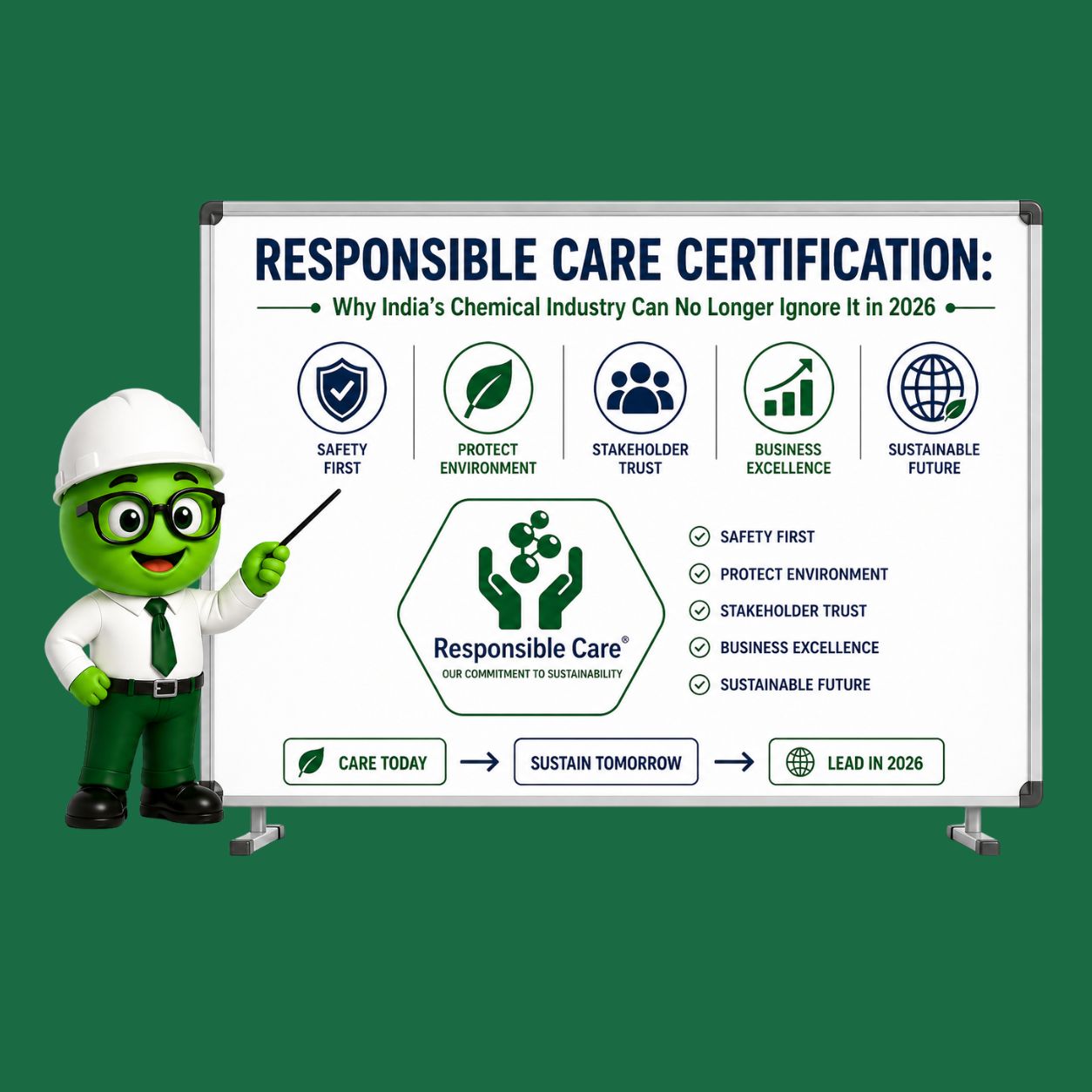
This guide from Greendot Management Solutions explains everything — what Responsible Care is, the 7 ICC codes, who qualifies, and how to start your journey toward the Responsible Care logo.
In One Sentence: Responsible Care is the global chemical industry’s voluntary but globally recognised commitment to continuously improve environmental, health, safety, and security (EHS&S) performance — verified by an independent audit and awarded as a logo by the Indian Chemical Council (ICC).
1. What is Responsible Care?
Responsible Care is a global voluntary initiative launched in 1985 by the Chemistry Industry Association of Canada. Today it operates in over 70 economies through the International Council of Chemical Associations (ICCA). In India, it is managed by the Indian Chemical Council (ICC) — the apex body for the Indian chemical industry.
The initiative is built on one fundamental principle: chemical companies must look beyond legal compliance and proactively commit to protecting the health of workers, communities, and the environment — through measurable, continuously improving practices.
As of 2025, over 163 Indian companies are Responsible Care signatories, with 83 holding the prestigious Responsible Care logo — awarded by ICC after a comprehensive independent audit. Companies holding the logo include Reliance Industries, BASF India, Tata Chemicals, Atul Limited, and dozens of mid-size chemical manufacturers.
2. The 7 ICC Responsible Care Codes for India
In India, ICC evaluates companies against 7 Codes of Management Practice. Each code defines specific management practices and performance expectations:
| # | Code | What It Covers | Why It Matters to Buyers |
| 1 | Community Awareness & Emergency Response (CAER) | Community outreach, emergency preparedness, incident reporting, local stakeholder communication | Buyers need proof you manage community risk around your facility |
| 2 | Process Safety Code | Hazard identification, risk assessment, MOC (Management of Change), safety reviews, HAZOP | EU buyers increasingly require process safety evidence for chemical suppliers |
| 3 | Employee Health & Safety Code | Worker H&S management system, PPE, training, occupational health, incident investigation | Aligns directly with SMETA H&S pillar and ISO 45001 |
| 4 | Pollution Prevention Code | Air, water, and land pollution controls; emission reduction; effluent management; waste minimisation | Critical for SMETA 4-Pillar environment assessment and EU REACH compliance |
| 5 | Distribution Code | Safe transport and handling of chemicals throughout the supply chain | Essential for chemical companies with logistics and distribution operations |
| 6 | Product Safety & Stewardship Code | Safe product design, SDS (Safety Data Sheets), hazard communication, lifecycle responsibility | Directly supports REACH compliance and customer safety obligations |
| 7 | Security Code (Voluntary) | Facility security, access control, cyber risk, protection from theft, sabotage, or misuse | Growing importance as global chemical security regulations expand |
3. How Responsible Care Connects to SMETA, ISO 14001, and REACH
The most common question Greendot receives from Indian chemical factories is: ‘We already have ISO 14001. Do we need Responsible Care as well?’ The answer requires understanding how these standards relate:
| Feature | Responsible Care | ISO 14001 | REACH (EU) |
| Scope | EHS&S + community + security | Environmental managementsystem | Chemical substance registration |
| Type | Voluntary initiative + audited logo | Certifiable standard | Legal regulation |
| Issued by | ICC (India) / national associations | Accredited certification bodies | European Chemicals Agency (ECHA) |
| Chemical-specific? | Yes — designed for chemical industry | No — applies to all industries | Yes — chemical substances only |
| Community engagement | Central requirement | Not required | Not required |
| Process safety focus | Yes — dedicated code | Partial — under EMS scope | No |
| Buyer recognition | Growing rapidly with EU buyers | Very high — universal | Mandatory for EU chemical exports |
| SMETA alignment | High — especially H&S + Environment | High — Environment pillar | Partial — documentation overlap |
The practical answer: ISO 14001 and Responsible Care complement each other. ISO 14001 gives you the environmental management system. Responsible Care gives you the chemical-industry-specific credibility that generic ISO certification cannot. For Indian chemical exporters, pursuing both is increasingly the competitive standard.
4. Who Should Pursue Responsible Care in India?
Responsible Care is primarily designed for chemical manufacturers, but the scope extends beyond pure chemical producers:
- Bulk chemical manufacturers — dyes, intermediates, speciality chemicals, commodity chemicals
- Pharmaceutical API (Active Pharmaceutical Ingredient) manufacturers
- Agrochemical formulators and manufacturers
- Petrochemical companies and refineries
- Chemical distributors and logistics companies — via Distribution and Security codes
- Companies that handle, store, or use significant quantities of hazardous chemicals
Gujarat Is India’s Responsible Care Hub Vadodara, Ankleshwar, Vapi, Dahej, and Surat have the highest concentration of Responsible Care signatory companies in India. If you are a chemical manufacturer in Gujarat supplying to global buyers, Responsible Care membership is increasingly a competitive necessity — not a luxury.
5. The Path to Responsible Care Logo — Step by Step
- Become an ICC Member — Responsible Care is only available to ICC member companies
- CEO/MD signs the Responsible Care Global Charter — top leadership commitment is mandatory
- Conduct a gap assessment against all 7 codes — identify compliance gaps
- Implement the Responsible Care Management System (RCMS) — embed all codes into operations
- Submit KPI data to ICC — annual environmental, health, safety, and security performance data
- Undergo ICC independent audit — conducted by ICC-empanelled auditors across all 6 evaluated codes
- Receive the Responsible Care Logo — valid for 2 years, then re-audit required
- Annual reporting — continue submitting KPIs and improvement data to ICC
6. Business Benefits of Responsible Care for Indian Chemical Companies
- Export market access: EU, UK, and US chemical buyers are increasingly including Responsible Care in supplier qualification criteria
- Reduced insurance premiums: demonstrable EHS&S management lowers risk profiles and can reduce facility insurance costs
- Regulatory compliance readiness: Responsible Care implementation builds the systems needed for ISO 14001, ISO 45001, REACH, and SMETA 4-Pillar compliance simultaneously
- Licence to operate: communities near chemical facilities in India are increasingly vocal about safety and environmental impact; Responsible Care provides a structured engagement mechanism
- Operational efficiency: pollution prevention and process safety codes drive waste reduction and energy efficiency — both of which reduce operating costs
- Talent attraction: increasingly, skilled chemical engineers prefer employers with demonstrable EHS&S credentials
FAQs — Responsible Care India
Q1: Is Responsible Care mandatory in India?
No — it remains voluntary. However, for Indian chemical companies exporting to EU or global buyers who are ICCA members, or seeking partnerships with multinational chemical companies, Responsible Care membership is increasingly expected. ICC actively advocates that it is ‘no longer a choice but an imperative for sustained business growth.’
Q2: How long does it take to get the Responsible Care logo?
From beginning your ICC membership to receiving the logo, the journey typically takes 12–18 months for a committed factory. Companies with existing ISO 14001 or ISO 45001 systems will find significant overlap and can often move faster.
Q3: What is the difference between being a Responsible Care Signatory and holding the RC Logo?
A Signatory has signed the Global Charter and committed to implementing the codes. A Logo holder has completed the independent ICC audit and been verified as meeting the code requirements. Many signatories work toward the logo over 1–2 years of implementation.
Q4: Does Greendot Management Solutions support Responsible Care implementation?
Yes. Greendot is one of very few consulting firms in India offering full Responsible Care implementation support — from gap assessment and documentation through to mock audit preparation and KPI reporting. We specialise in Gujarat’s chemical and pharmaceutical sectors.