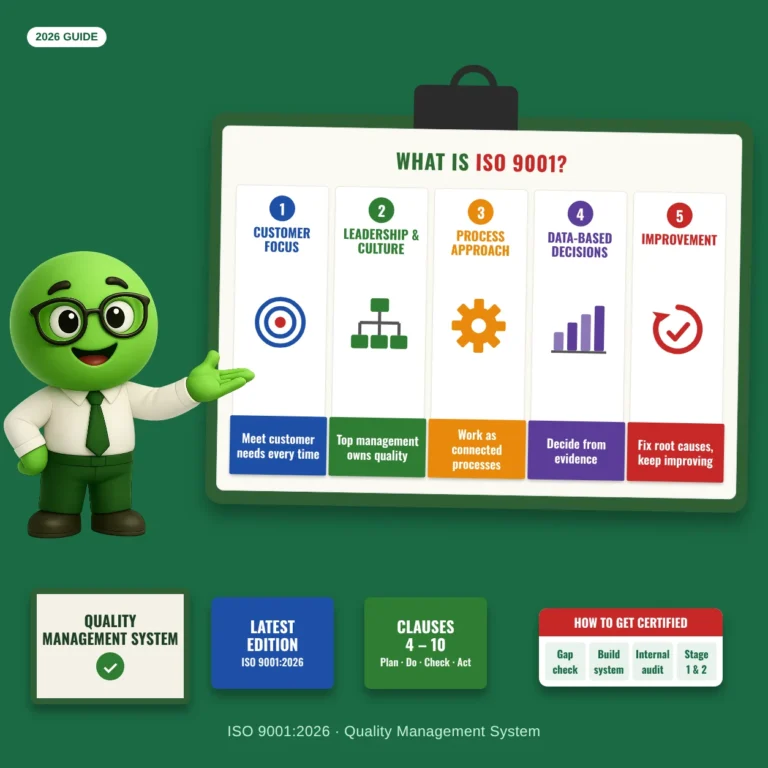
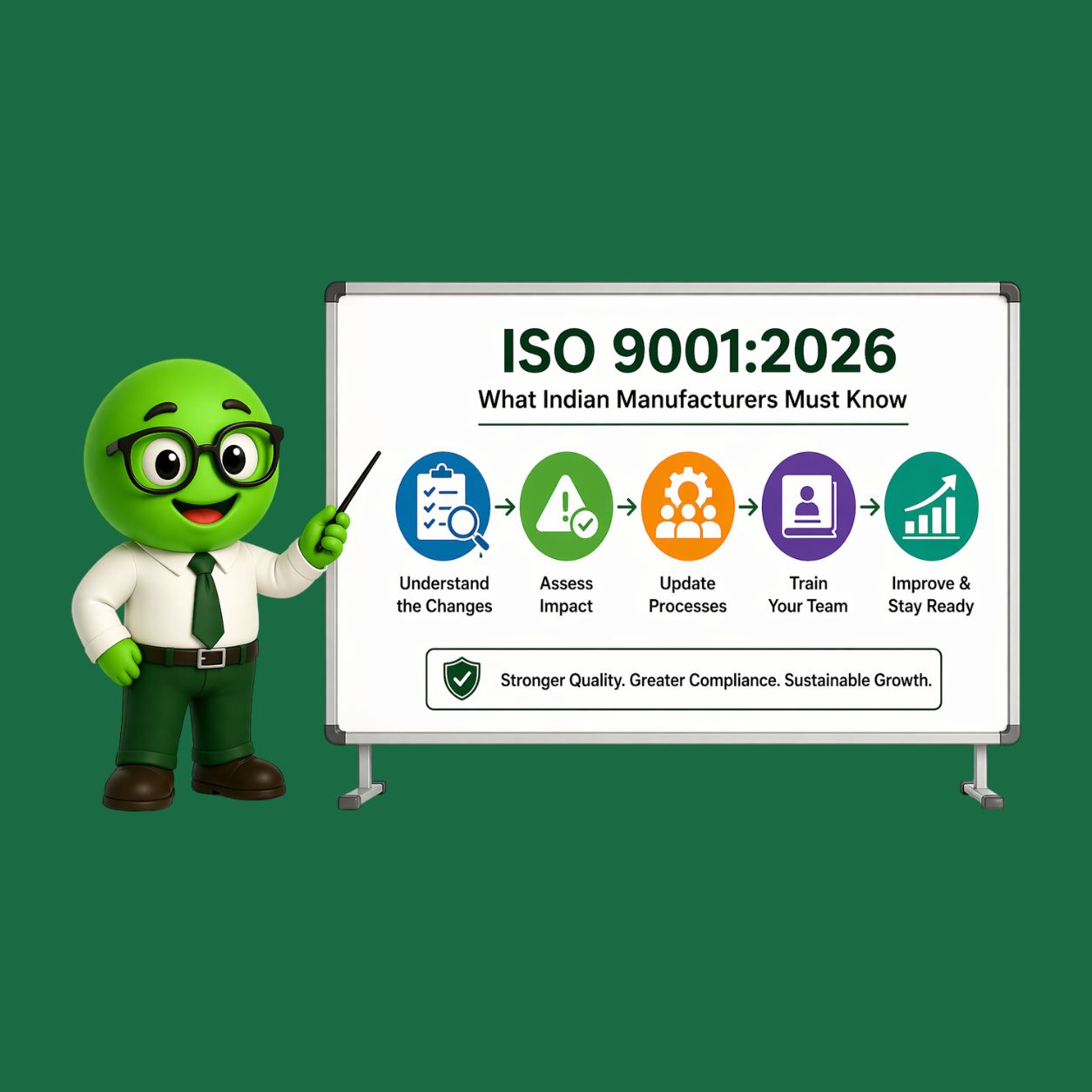

ISO 9001:2026 was published in September 2026. It keeps the familiar clause structure (clauses 4–10) and adds limited new requirements — mainly quality culture and ethical behaviour, clearer separation of risks and opportunities, and planned management of change. ISO 9001:2015 certificates remain valid during a transition period that certification bodies expect to end in September 2029. Most Indian manufacturers can complete the update in about 90 days.
What is confirmed so far (as of November 2026)
- ISO 9001:2026, the sixth edition of the standard, was published in September 2026.
- The Annex SL high-level structure stays: clauses 4 to 10 are still there, with some re-arrangement inside clauses 6, 7 and 8.
- The revision brings limited new requirements; most changes add clarity. Annex A now gives clause-by-clause guidance, and new quality-management terms are added in clause 3.
- Certification bodies are applying a three-year transition period expected to end in September 2029. The formal deadline is set by the accreditation bodies, so check the exact date with your certification body.
- ISO 9001:2015 certificates remain valid during the transition period.
What changed in ISO 9001:2026 — clause by clause
| Clause | What changed | What to do in your plant |
| 4 Context | Mainly clarity. The climate-change consideration added by the 2024 amendment remains. | Record whether climate change is relevant to your context and interested parties. |
| 5 Leadership | Greater focus on quality culture, ethical behaviour and continual improvement. The quality policy should reflect strategy and external context. | Update the quality policy; show how top management promotes quality culture and ethics. |
| 6 Planning | Risks and opportunities split into separate subclauses; planning of changes emphasised. | Separate your risk register and opportunity list; formalise change planning.ac |
| 7 Support | Restructured. Awareness now includes quality culture and ethical behaviour. | Add quality culture and ethics to awareness training and induction. |
| 8 Operation | Mostly terminology and layout.ac | Update clause references in your manual and procedures. |
| 9 Performance evaluation | Largely the same as 2015. | Check management review inputs against the new text. |
| 10 Improvement | Added guidance on continual improvement, linked to leadership. | Link improvement projects to quality objectives and management review. |
Is my ISO 9001:2015 certificate still valid?
Yes. Your ISO 9001:2015 certificate stays valid during the transition period. But do not wait until 2029: certification bodies will plan transition audits into your surveillance or recertification audits, and the last months before a deadline are always crowded. Plan your transition for your next scheduled audit.
Who should act now?
- Certified companies — start a 2026 gap assessment so the change is ready for your next audit.
- Companies starting ISO 9001 now — ask your certification body whether it can already certify to ISO 9001:2026. If yes, start directly on 2026.
- Companies with recertification due in 2027 — combine recertification and transition in one audit.
A 90-day ISO 9001:2026 transition plan
| Days | What to do |
| 1–15 | Buy the standard. Run a gap assessment of your system against ISO 9001:2026. Agree the list of changes with top management. |
| 16–45 | Update the quality policy, risk and opportunity planning, change-planning method and awareness training (quality culture and ethics). Update documents only where the standard changed. |
| 46–75 | Train process owners and internal auditors on the changes. Run a full internal audit against ISO 9001:2026 and a management review. |
| 76–90 | Close internal audit findings. Ask your certification body to schedule the transition at your next surveillance or recertification audit. |
Common mistakes to avoid
- Rewriting the whole quality manual when only a few clauses changed
- Buying a ‘2026 document kit’ and filing it without changing how the plant works
- Treating quality culture and ethics as a new form instead of a leadership habit
- Waiting until 2029, when certification bodies are busiest
How Greendot helps
Greendot Management Solutions has worked with 1,200+ mid and large-size companies since 1999. Our IRCA-certified ISO Lead Auditors run ISO 9001:2026 transitions on the shop floor for plants from Ahmedabad to Mumbai:
- Free ISO 9001:2026 Transition Gap Check (30 minutes, WhatsApp)
- Full transition support with our ISO 9001 consultant team
- Online course — ISO 9001:2026: From Theory to Execution, with an online certificate from Greendot
- ISO 9001 Document Kit — formats as per ISO 9001:2026
- Also read: Why Indian MSMEs fail ISO audits
Frequently asked questions
Q: When was ISO 9001:2026 published?
ISO 9001:2026, the sixth edition of ISO 9001, was published in September 2026.
Q: Is my ISO 9001:2015 certificate still valid?
Yes. ISO 9001:2015 certificates stay valid during the transition period. Certification bodies expect it to end in September 2029, but the formal arrangements come from the accreditation bodies, so confirm your dates with your certification body.
Q: Do I need to rewrite my whole quality manual?
No. ISO 9001:2026 keeps the same clause structure and adds limited new requirements. Most companies update their policy, awareness training, risk and opportunity planning, change planning and internal audit checklists rather than rewriting everything.
Q: Should a new company certify to ISO 9001:2015 or ISO 9001:2026?
If your certification body is already accredited for ISO 9001:2026, start directly on 2026. If not, ask when it expects to be; certifying to 2015 now means a transition audit later.
Q: How long does the ISO 9001:2026 transition take?
For a company with a working ISO 9001:2015 system, the update can usually be done in about 90 days, then verified at the next surveillance or recertification audit.