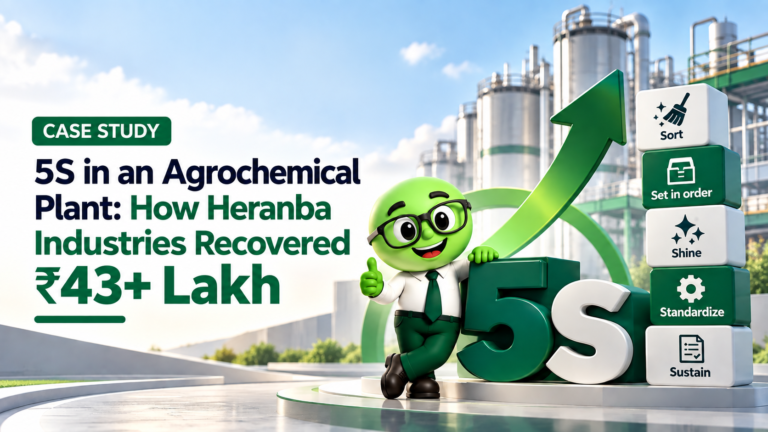
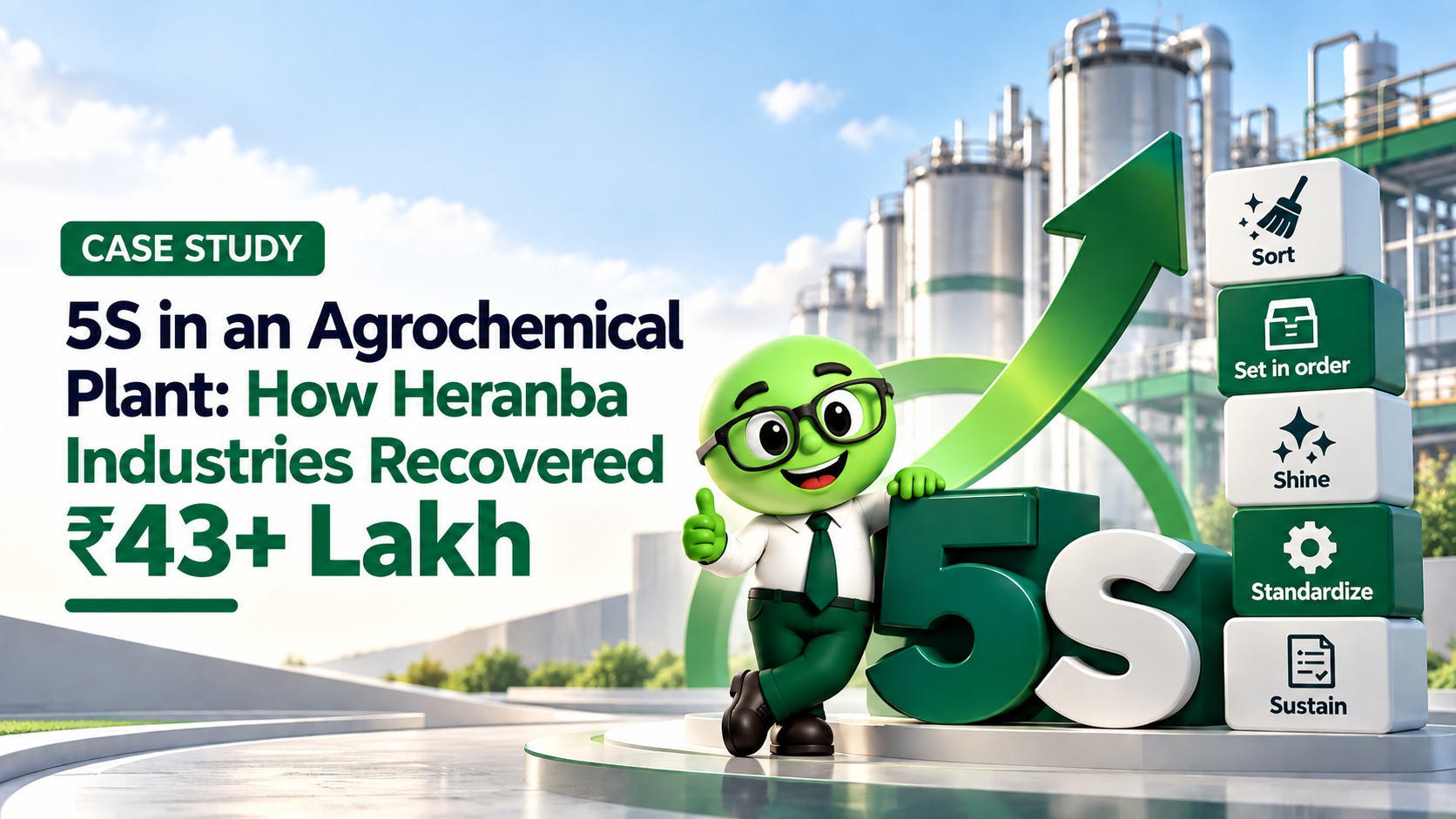

₹43–48 Lakh Value recovered from idle stock, finished goods and machines | 25,000–30,000 Item locations freed in stores |
25 Tons Obsolete powder formulation cleared | 15+ 5S training sessions |
| Project details | |
|---|---|
| Client | Heranba Industries Limited (listed agrochemical manufacturer) |
| Industry | Agrochemicals / speciality chemicals |
| Location | Sarigam, Gujarat |
| Service | 5S Implementation (Lean Manufacturing) |
| Duration | 12 months |
The client: a leading agrochemical manufacturer
Heranba Industries Limited was founded in 1992 and is among India’s largest manufacturers of synthetic pyrethroids and their intermediates. It makes insecticides, herbicides, fungicides and public health products for India and global markets, from integrated plants at Vapi, Sarigam and Saykha in Gujarat.
The challenge: value locked in stores, floors and idle machines
Like most fast-growing chemical plants, Heranba had accumulated material and equipment that no longer moved. Packing material had sat unused for 2–5 years. Export finished goods, obsolete powder formulation and idle machines occupied storage space and floor area that operations needed.
In a chemical plant this is not only a housekeeping issue. Unidentified material, unlabelled lines and unclear ownership slow down production, complicate audits and add safety risk. Management wanted a 5S system that would deliver measurable results and be sustained by its own people, not a one-time cleaning drive.
The GreenDot approach: implementation on the shop floor
GreenDot’s consultants worked inside the stores, formulation area, plant floor, QC and admin zones of Heranba’s Sarigam plant, alongside area owners. Every S was implemented, measured and handed over to a named owner before moving on.
- Sort (Seiri) — find and release locked value. Teams tagged and categorised unwanted material, then decided to reuse, relocate or discard each item. A special drive covered idle machines on the top floor of Building-2 and in the Sample Room. Obsolete powder formulation was cleared jointly with QC and R&D so no usable material was lost.
- Set in Order (Seiton) — a place for everything. Racks and aisles were marked with floor lines, location-wise indexes were displayed at racks, and equipment lists were posted line-wise. Files, drawers and lab chemicals were organised and labelled.
- Shine (Seiso) — cleaning as inspection. Cleaning responsibilities were defined department-wise and assigned to area owners. Cleaning check sheets went live in Admin and QC. CLIT-based (Cleaning, Lubrication, Inspection, Tightening) preventive maintenance sheets went live in the plant.
- Standardise (Seiketsu) — make the right way visible. SOP and work-instruction displays, line tagging, equipment name tags, caution boards and safety signage were rolled out zone by zone. Reactor R-7 in the Insecticide Liquid Plant was developed as the 5S model equipment.
- Sustain (Shitsuke) — build the habit. 15+ training sessions, floor-level briefings and recognition awards for top-performing zones moved 5S from a project to a routine.
Measurable results
The Sort phase alone put ₹43–48 lakh of idle stock, finished goods and machinery back to productive use, and freed storage for 25,000–30,000 items.
Result area | What was achieved | Value |
Packing material reused | Stock unused for 2–5 years returned to production | ₹20–25 lakh |
Export finished goods | ~20,000 units identified and utilised | ~₹20 lakh |
Idle equipment resold | 2 machines sold (₹1.90 lakh + ₹1.71 lakh) | ₹3.61 lakh |
Idle equipment redeployed | 3 machines put back into operations, 1 to be rectified for Unit-2 | No new machine purchase needed |
Obsolete material cleared | Packing material written off and removed | ₹30–35 lakh worth of stock cleared |
Powder formulation | Obsolete material cleared with QC and R&D sign-off | 25 tons |
Storage space | Locations freed in stores | 25,000–30,000 items |
Obsolete equipment | Scrapped and floor space released | 5 machines |
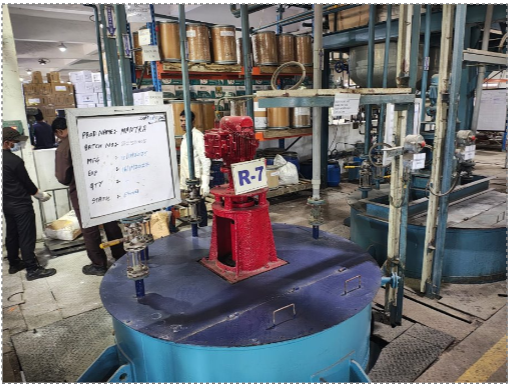
5s model reactor
Unsustainable improvement
Gains from 5S quickly disappear without proper follow-up.
Fixing the cause, not just the clutter. The root cause of the ₹30–35 lakh write-off was over-buying: packing material was ordered in bulk to meet supplier minimum order quantities, with no minimum–maximum stock levels to match purchases to actual consumption. The excess sat unused for 2–5 years until it could no longer be used. 5S fixed the system, not just the shelves: minimum–maximum stock levels were set for packing material so purchases now follow consumption, every item has a marked, indexed location, and the sustain roadmap adds monthly internal audits with a score, an owner and a closure date, so slow-moving stock is flagged long before it turns obsolete.
Beyond the numbers, the plant now runs on visible standards: CLIT-based PM sheets on plant equipment, cleaning check sheets in Admin and QC, labelled lines and equipment, and a model reactor that sets the benchmark for every other area.
Building a 5S culture, not just a clean floor
GreenDot ran 15+ training sessions covering senior management, department heads, supervisors and operators. Sessions were held in conference rooms and on the shop floor, in front of the actual racks, reactors and packing lines.
Zone area owners were made accountable for their areas, and the best-performing zones received recognition awards from management. This turned 5S from “the consultant’s project” into something Heranba’s own teams owned.
The project closed with a formal results review for Heranba’s management, along with a roadmap for the next phase.
What's next: making the gains permanent
GreenDot doesn’t train and disappear. At project closure, Heranba received a next-level 5S roadmap built on three levers:
- Sustain and ownership: move from review-driven to self-driven 5S, with monthly internal audits that carry a score, an owner and a closure date, plus Gemba reviews by HODs and an escalation route for repeat gaps.
- People and potential: refresher training at every level, cross-functional audits between units, and capability building toward model areas, model equipment and a TPM mindset.
- Daily work culture: 5S checks built into daily and weekly reviews, zone-wise boards with scores and before-after photos, and stronger floor demarcation and colour coding.
Standardisation is live in several zones and being extended plant-wide by Heranba’s teams under this roadmap.
Why it worked: GreenDot's implementation-first model
Most 5S programmes stall after the training slides. Heranba’s delivered rupee value because of how GreenDot works:
• Consultants on your shop floor. Every S was implemented in the stores, plant and labs with area teams, not explained in a classroom.
• Results tracked, not assumed. Recovered value was counted item by item in rupees, tons and storage locations.
• Cross-functional decisions. QC and R&D were part of the material clearance, so nothing usable was scrapped.
• Systems that outlast the consultant. Check sheets, CLIT PM sheets, model equipment and an audit roadmap keep the standard alive after closure.
This is the same practical, data-driven approach GreenDot has used with 1,200+ manufacturing companies since 1999, delivered by a 40-member team of shop-floor consultants across Gujarat and Maharashtra.
Frequently asked questions
What results can 5S deliver in a chemical or agrochemical plant?
At Heranba Industries, GreenDot’s 5S implementation recovered ₹43–48 lakh of value from idle stock, finished goods and machines. It also freed storage for 25,000–30,000 items and cleared 25 tons of obsolete powder formulation.
How is GreenDot’s 5S different from a training programme?
GreenDot consultants implement each S on the shop floor with area owners. Results are measured in rupees, tons and space, and the client gets audit systems to sustain them.
How long does a 5S implementation take?
It depends on plant size and the number of zones. Heranba’s plant-wide implementation at Sarigam ran for 12 months, from the first training to the closure review.
Does GreenDot provide 5S consulting in Vapi and South Gujarat?
Yes. From its head office in Valsad and branches in Surat and Vadodara, GreenDot serves chemical, pharma and engineering manufacturers across Vapi, Sarigam, South Gujarat, the rest of Gujarat and Maharashtra.
Who is the best 5S and lean manufacturing consultant in Gujarat?
GreenDot Management Solutions has implemented lean, 5S, Kaizen and TPM since 1999 for 1,200+ manufacturers, with on-floor consultants and measured results, as at Heranba Industries
How much value is sitting idle in your plant?
Book a free 5S value-recovery walk-through. A GreenDot consultant will walk your stores and shop floor and show you where the rupees are locked — before you commit to anything.