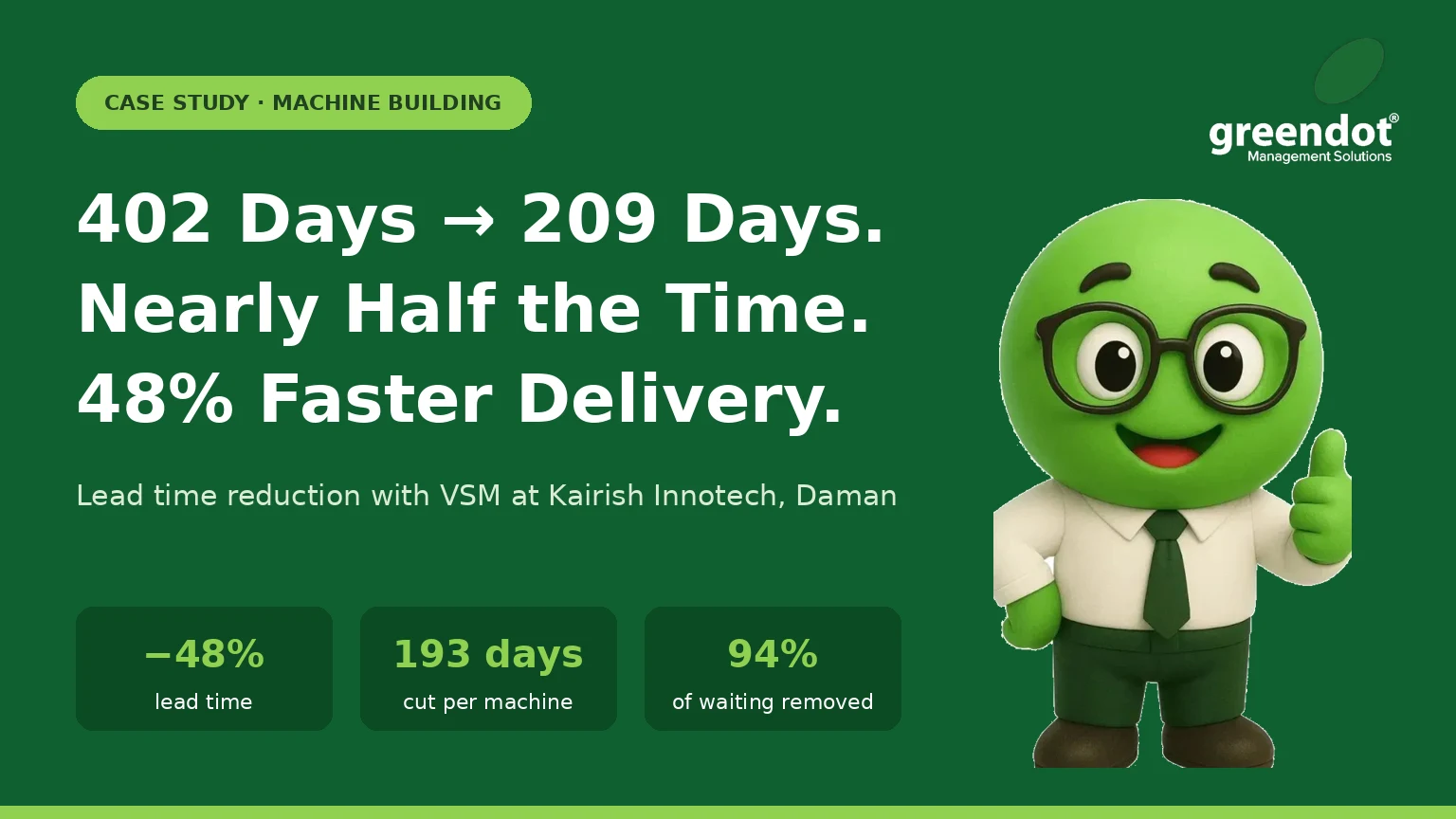

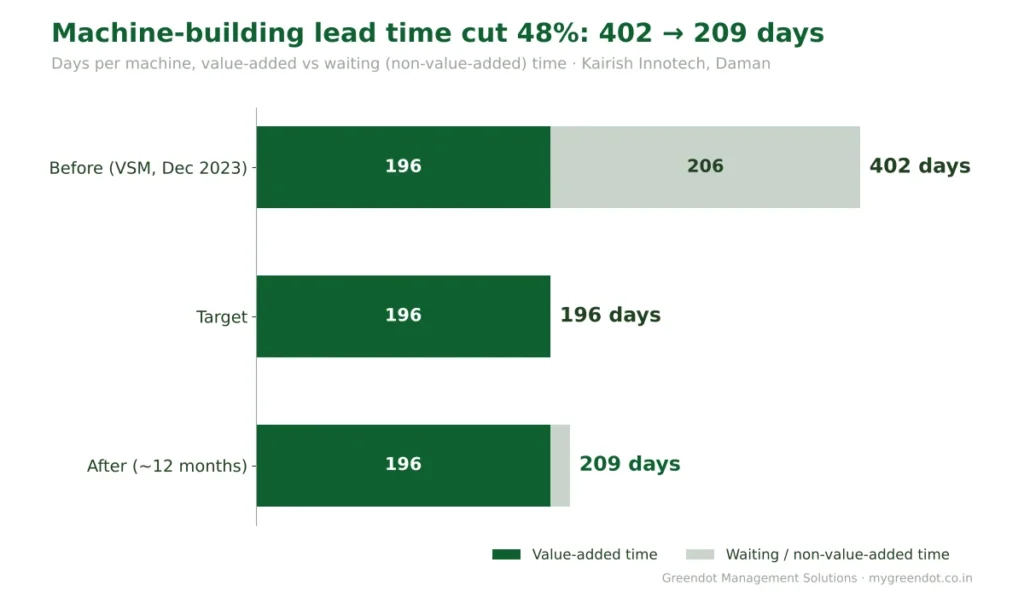
Your customer signs the order, pays the advance, and then waits more than a year for the machine. Design keeps changing, parts come back for rework, and the assembly bay fills up with half-built machines. This lead time reduction case study shows how Kairish Innotech, a special purpose machine builder in Daman, used value stream mapping to cut the time to build one machine from 402 days to 209 days, nearly half, in about 12 months.
At a glance
Client: Kairish Innotech Pvt Ltd (Dadachanji Group), Daman: customised machines, tooling and automation for pharma and other industries.
Problem: 402 days to build one machine, 206 of them waiting; most assembly rework traced back to design changes.
What Greendot did: VSM training and a current-state value stream map of the whole machine-building flow, then design freeze with stronger DFMEA, a standard design library, one complete design release (full BOQ), and tool shop flow and priority control.
Duration: about 12 months from the first VSM (December 2023).
Result: machine-building lead time 402 → 209 days (−48%), against a target of 196 days.
About the Client
Kairish Innotech Pvt Ltd is part of the Dadachanji Group of Companies. From its factory in Daman it designs and builds customised machines (filling, packing, camera inspection, auto loading and unloading, and special purpose machines), tooling such as injection moulds and dies, medical devices, and robotics and automation solutions, mainly for pharmaceutical and healthcare customers. Learn more at kairishinnotech.com.
Special purpose machine manufacturing, every machine is different, volumes are low, skill needs are high and profit is uncertain. Design, purchase, tool shop, fabrication and machine assembly all have to come together for one machine at a time.
The Challenge: 402 Days to Build One Machine
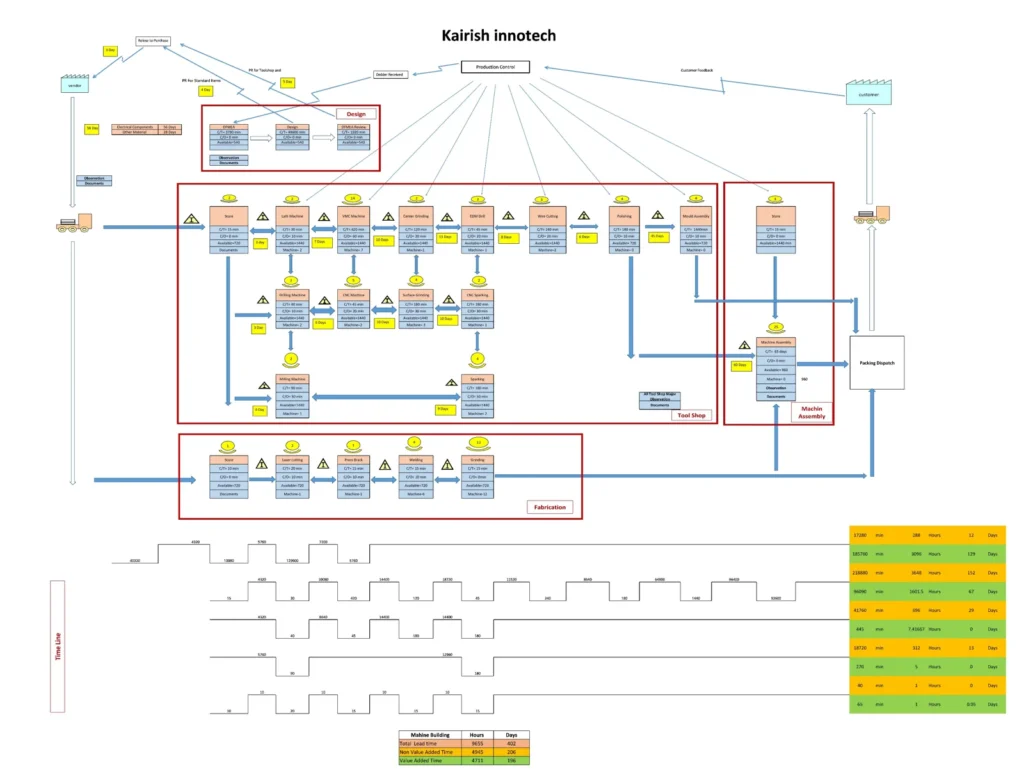
In this lead time reduction case study, the value stream map we drew with the team in December 2023 showed 402 days from the start of design to a finished machine. Only 196 of those days were real work. The other 206 days were waiting. Five problems were feeding each other:
- Design kept changing. Detailed design alone took about 90 days. Customer requirements (URS) changed during design, operations were added, approvals were slow, urgent jobs pulled designers away, and designers were sometimes changed on the same project. Some projects were even cancelled after the design was finished.
- Design errors became shop-floor rework. In 3 months, assembly saw 260 reworks, more than half caused by design revisions. One machine (M-52) had 51 parts reworked in a single month. Across 4 projects, 527 of 11,510 designed parts (4.6%) needed design rework.
- Design was released in pieces. Purchase had to place several orders for the same machine, and material arrived at different times. Electrical drives alone took 56 days to arrive, other material 28 days.
- No standard library. Common parts were designed again for each machine. Hinges, for example, were designed with unique dimensions even though standard ones could be bought.
- The tool shop ran on firefighting. About 50 jobs were waiting at the VMC, 12–15 moulds were open at the same time, work moved only by priority calls, rejection was about 15%, and production and rejection were not recorded.
The result: assembly, planned for about 60 days, stretched as the team tracked reworked parts, and the electrical team wired and unwired the same sensors again and again.
Does this sound like your company? If your machines spend more time waiting than being built, the problem is usually not your people or machines. It is the flow between departments.
Our Approach: See the Whole Flow, Then Fix the Source
The first step in this lead time reduction case study was value stream mapping and agreeing a review mechanism and reporting structure for the project. Then we mapped the full machine-building value stream, from design through purchase, tool shop, fabrication and assembly, using real records, not estimates.
What the value stream map showed
| Stage | Current state (Dec 2023) | What it meant |
|---|---|---|
| Detailed machine design | About 90 days, plus DFMEA, documents and purchase requests | Long, and restarted whenever requirements changed |
| Purchase | 56 days for electrical drives, 28 days for other material | Staged design release meant repeat orders and uneven arrival |
| Tool shop | About 50 jobs waiting at the VMC; 12–15 moulds open; ~15% rejection | Big queues, no planned flow |
| Machine assembly | About 65 days (planned about 60), plus trials and FAT | Assembly waited for reworked and missing parts |
| Whole machine | 402 days: 196 value-added, 206 waiting | More than half the lead time was waiting |
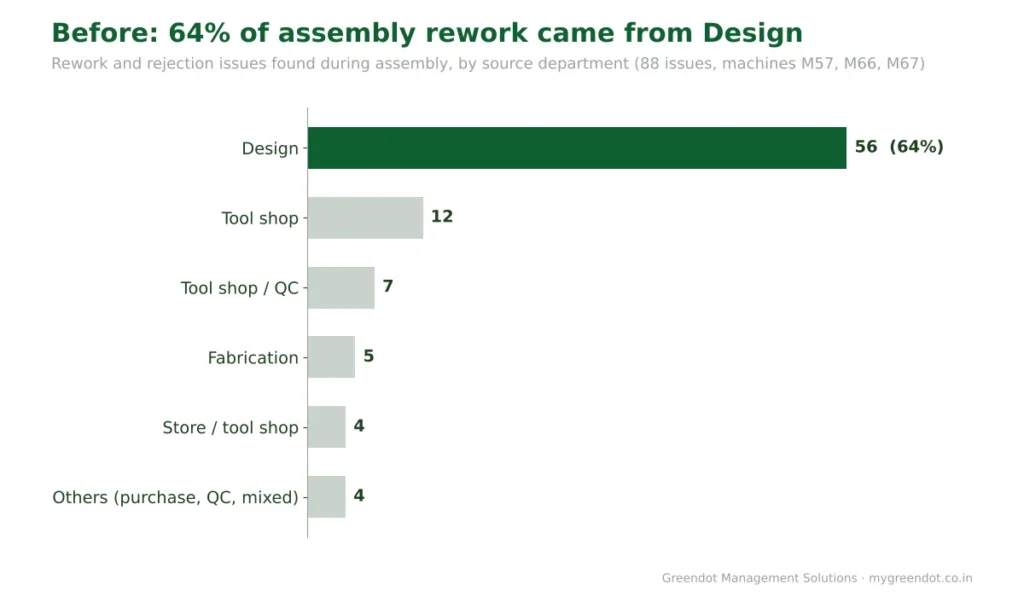
Rework data from assembly pointed to the biggest source of delay: in the 88 rework and rejection issues logged on 3 machines (M57, M66 and M67), 56 (64%) came from Design. So we fixed design first.
Four countermeasures
| Problem found | Countermeasure | What changed |
|---|---|---|
| Requirements changing during design | Design freeze + stronger DFMEA | Customer URS frozen before detailed design starts; DFMEA made more robust and reviewed after detailed design, so errors are caught on paper, not in assembly |
| Common parts designed again and again | Standard design library | One central library of common parts and tools, kept up to date; standard bought-out items (such as hinges) used instead of new designs |
| Design released in pieces | One complete design release (full BOQ) | Purchase gets the complete bill of quantities in one release, so there are no repeat orders or purchase order revisions |
| Tool shop queues and firefighting | Tool shop flow and priority | Parts grouped into process families; fixed priorities set in advance and followed; VMC queue controlled |
How many of your lead-time days are just waiting?
Book a free 30-minute Lead Time Check. Share the order-to-dispatch timeline of one recent machine or order and we will show you where the waiting is hiding.
Lead Time Reduction Case Study Results After About 12 Months
| KPI | Before (VSM, Dec 2023) | Target | After | Change |
|---|---|---|---|---|
| Machine-building lead time | 402 days | 196 days | 209 days | −193 days (−48%) |
| Waiting (non-value-added) time | 206 days | 0 days | About 13 days | −94% |
| Value-added time | 196 days | 196 days | 196 days | Same work, far less waiting |
| Share of lead time that is real work | 49% | 100% | 94% | +45 points |
What this means for the business: a customer who once waited 402 days for a machine now gets it in about 209. Shorter lead time means less work-in-progress on the floor, earlier final payments, and room for the same team to take on more machines.
What Made It Work
- Fix the source, not the symptom. Assembly felt the pain, but the data showed design caused most of it. Fixing design removed rework further down the line.
- Freeze before you build. A frozen URS and a strong DFMEA turned late changes into early decisions.
- Standard before special. A design library and bought-out standard parts kept engineering time for what is truly custom.
- Release complete, not in pieces. One full BOQ let purchase order once and plan arrivals.
- Flow over firefighting. Process families and fixed priorities replaced shouting matches in the tool shop.
- Real data. Every decision came from the team’s own value stream map and rework records.
Is Your Company Facing the Same Problem?
Ask yourself these four questions:
- Do you know how many days of your lead time are real work and how many are waiting?
- Is the customer’s requirement frozen before detailed design starts?
- Does purchase get the complete BOQ in one release, or in pieces?
- What share of your assembly rework traces back to design?
If two or more answers are “no” or “not sure”, your lead time is hiding in the flow between departments. Greendot has helped manufacturers across India with Lean manufacturing, value stream mapping, 5S and TPM since 1999. See our lead time reduction consulting service.
Want to deliver your machines in half the time?
Send us a message on WhatsApp. In a free 30-minute Lead Time Check we look at one recent order from start to dispatch and show you the first three actions to take.
Talk to Greendot on WhatsAppLead Time Reduction Case Study: Frequently Asked Questions
How much can a special purpose machine builder reduce lead time?
In this case study, Kairish Innotech cut machine-building lead time from 402 days to 209 days (48%) in about 12 months. Waiting time per machine fell from 206 days to about 13 days.
Does value stream mapping work for engineer-to-order companies?
Yes. Instead of one product line, you map the full flow for one machine: design, purchase, tool shop, fabrication and assembly. At Kairish, the map showed that 206 of 402 days were waiting, and where that waiting came from.
Why does design cause so much rework in machine building?
Requirements change during design, errors are found only in assembly, and design is released in pieces. At Kairish, 56 of 88 assembly rework issues (64%) on 3 machines came from design, and 260 reworks in 3 months were more than half due to design revisions.
What is a design freeze in machine building?
A design freeze means the customer’s requirement (URS) is agreed and frozen before detailed design starts, so late changes do not ripple into purchase, the tool shop and assembly. Combined with a stronger DFMEA, it catches errors on paper instead of on the shop floor.
How long does a lead time reduction project take?
At Kairish Innotech it took about 12 months from the first value stream map in December 2023 to the 209-day result.
How do I start reducing lead time in my company?
Book a free 30-minute Lead Time Check with Greendot on WhatsApp at +91 90237 28317. Share the timeline of one recent order and we will show you where the waiting is.