
Your EU buyer has asked: ‘Does your machine carry a CE mark?’ If your answer is anything other than ‘Yes, with a full technical file and Declaration of Conformity’ — you may be unable to ship to the European market.
CE marking is the single most critical product compliance requirement for Indian engineering companies exporting machinery, equipment, electrical products, or safety devices to the European Union or European Economic Area (EEA). Without it, your products cannot legally be placed on the EU market — regardless of quality, price, or buyer relationship.
Yet for many Indian MSME engineering exporters in Pune, Rajkot, Coimbatore, and Ludhiana, CE marking remains poorly understood — often confused with a quality certificate, a product rating, or even ISO certification. This guide from Greendot Management Solutions provides a complete, practical understanding of what CE marking is, which products need it, how to get it, and what the 2023 EU Machinery Regulation change means for Indian exporters.
Key Fact: CE stands for Conformité Européenne (European Conformity). It is mandatory for products exported to the EU/EEA that fall within the scope of specific EU Directives and Regulations. It is not a quality mark — it is a legal declaration that your product meets EU essential safety requirements.
1. What is CE Marking?
CE marking is a manufacturer’s declaration — supported by documented technical evidence — that a product conforms to all applicable EU legal requirements covering safety, health, and environmental protection. It is required before a product can be marketed or put into service in the EU/EEA.
CE marking was established to allow the free movement of goods within the EU’s single market. The CE mark signals to EU customs authorities, buyers, end-users, and regulators that the product has been assessed against all relevant EU Directives and meets the essential requirements — without needing country-specific approvals in each EU member state.
For Indian engineering exporters: you affix the CE mark yourself, as the manufacturer. But you must have the documented technical evidence to back that declaration. If you cannot produce that evidence on demand from EU authorities or a buyer, the declaration is invalid.
2. Which Indian Engineering Products Require CE Marking?
| Product Category | Applicable EU Directive/Regulation | Common Indian Export Examples |
| Machinery & Equipment | EU Machinery Regulation 2023/1230 (replaces Machinery Directive 2006/42/EC from Jan 2027) | Pumps, conveyors, presses, CNC machines, mixers, packaging machinery |
| Electrical Equipment (Low Voltage) | LVD — 2014/35/EU | Switchgear, control panels, transformers, motors under 1000V AC |
| Electromagnetic Compatibility | EMC Directive 2014/30/EU | Any electrical/electronic equipment that may cause or be affected by electromagnetic disturbance |
| Pressure Equipment | PED — 2014/68/EU | Pressure vessels, boilers, heat exchangers, piping systems |
| Personal Protective Equipment | PPE Regulation 2016/425 | Safety helmets, gloves, safety harnesses, protective footwear |
| Lifts & Elevators | Lifts Directive 2014/33/EU | Industrial lifts, passenger lifts, service lifts |
| ATEX (Explosive Atmospheres) | ATEX Directive 2014/34/EU | Equipment used in explosive or flammable environments — critical for chemical plant equipment |
| Medical Devices | MDR 2017/745 | Surgical instruments, diagnostic equipment, medical implants |
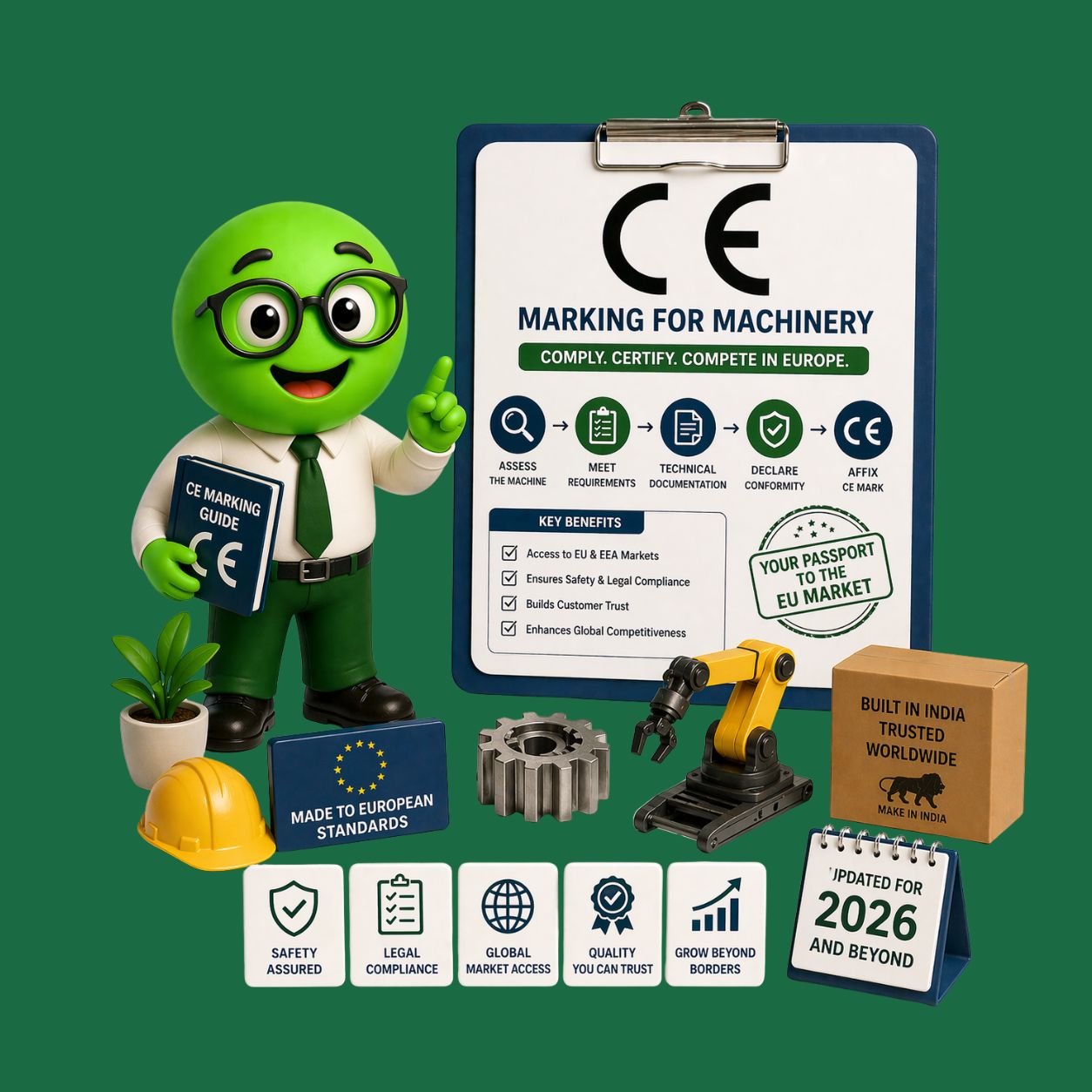
3. The CE Marking Process — Step by Step for Indian Manufacturers
- Identify all applicable EU Directives: one product may fall under multiple directives simultaneously — identify all that apply before starting
- Determine conformity assessment route: most machinery can use the ‘self-declaration’ route (Module A), but high-risk machinery requires a Notified Body to conduct the assessment
- Conduct a Risk Assessment: identify all hazards associated with your machine’s intended use and reasonably foreseeable misuse — and document how each hazard is eliminated or controlled
- Build the Technical File: compile all technical documentation — design drawings, calculations, material specifications, test reports, risk assessment, instructions for use
- Verify compliance with harmonised standards: EU harmonised standards (EN series) provide the presumption of conformity with directive essential requirements — use them
- Engage a Notified Body if required: for Annex IV (high-risk) machinery, you must use a Notified Body — an EU-approved third-party conformity assessment body
- Translate the Instructions for Use: must be in the language(s) of the EU country where the machine will be used — not just English
- Sign the EU Declaration of Conformity (DoC): a formal, legally binding document signed by an authorized person within your company
- Affix the CE mark: the mark must meet specific dimensional and placement requirements; it cannot be placed before the DoC is signed
- Maintain the Technical File for 10 years: EU authorities can request to inspect it at any time during this period
4. The New EU Machinery Regulation 2023 — What Changes for Indian Exporters
The EU replaced the Machinery Directive 2006/42/EC with the new EU Machinery Regulation 2023/1230. While the Directive required national transposition into each EU member state’s law, the new Regulation applies directly across all 27 EU member states simultaneously — creating greater consistency and stricter enforcement.
Key changes Indian exporters must know:
- Effective date: The new Machinery Regulation becomes mandatory from 14 January 2027. Products placed on the EU market after this date must comply with the new Regulation, not the old Directive.
- Software and AI: For the first time, software that performs safety functions and autonomous/learning machines are explicitly brought within the scope of CE marking requirements.
- Cybersecurity: New essential requirements cover cybersecurity risks for machinery with remote access, connected operation, or software interfaces.
- Online marketplaces: Products sold through digital platforms to EU customers are now explicitly covered — relevant for Indian exporters using B2B e-commerce to reach EU buyers.
5. Common CE Marking Mistakes Indian Manufacturers Make
- Assuming ISO certification = CE marking: they are completely separate — ISO 9001 has no relationship to CE compliance
- Copying a CE mark from a similar product without building your own technical file
- Missing directives: underestimating how many directives apply — a machine with electrical components needs both Machinery and LVD compliance
- Instructions for Use in English only: required in the language(s) of the end-user country — a German buyer needs German-language instructions
- No risk assessment: the risk assessment is the technical foundation of CE marking — without it, the CE mark has no legal standing
- Using an Indian test certificate as EU compliance proof: Indian BIS or NABL certificates do not substitute for EU harmonised standard conformity
FAQs — CE Marking India
Q1: Can an Indian company self-declare CE compliance, or do we need a European body?
For most standard machinery (non-Annex IV), you can self-declare CE compliance — meaning you build the technical file, conduct the risk assessment, and sign the Declaration of Conformity yourself, without a third-party Notified Body. However, for high-risk machinery (Annex IV of the Machinery Regulation — including woodworking machines, presses, and specific safety components), a Notified Body must be involved in the conformity assessment.
Q2: Does CE marking replace BIS (Bureau of Indian Standards) certification for domestic sales?
No. CE marking is for EU/EEA market access only. BIS certification (IS marks and compulsory BIS products) is India’s domestic mandatory certification scheme. If you sell both in India and export to the EU, you need both — they are independent of each other.
Q3: How long is a CE mark valid?
CE marking does not expire. However, if your product design changes, or if new harmonized standards are published that change the compliance requirements, you must review and update your technical file and potentially re-sign the Declaration of Conformity. It is good practice to review CE compliance every 2–3 years.
Q4: Is CE marking the same as UKCA (UK Conformity Assessed) marking after Brexit?
No. Since the UK left the EU, CE marking is no longer valid for the UK market (with limited transitional exceptions). Products for the UK market now require UKCA marking — a separate conformity assessment process managed by UK authorities. If you export to both EU and UK, you need both CE and UKCA.