
A chemical plant in Surat had a critical batch reactor that experienced an unexpected pressure build-up twice in one year — each time resulting in emergency shutdown, production loss, and a near-miss safety incident. When Greendot consultants facilitated an FMEA workshop, the team identified 14 failure modes in the reactor system — 3 of which had Risk Priority Numbers (RPNs) above 200, indicating critical risk. None of them had been formally documented or addressed before.
This is FMEA’s fundamental value: it makes invisible risk visible — before an incident occurs, before a customer complaint arrives, before an auditor finds it. It is the difference between reactive and proactive risk management.
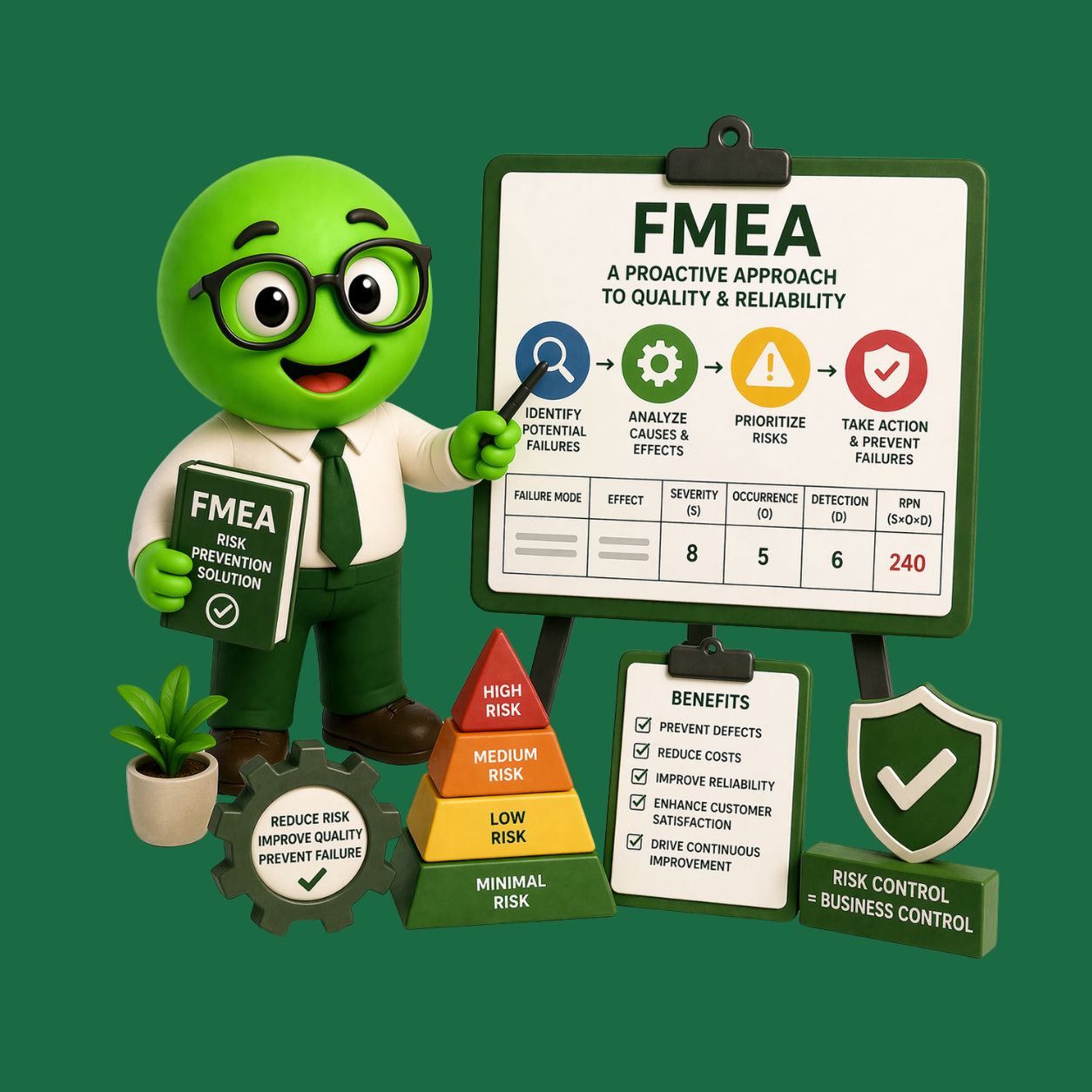
FMEA (Failure Mode and Effect Analysis) is a systematic, structured methodology for identifying potential failures in a product, process, or system — and prioritizing corrective actions before those failures occur. Originally developed by the US military in the 1940s and widely adopted by the automotive industry, FMEA is now a core tool in ISO 9001, IATF 16949, pharmaceutical cGMP (ICH Q9 Quality Risk Management), and chemical process safety management.
FMEA in One Sentence:
FMEA asks three questions about every potential failure: How likely is it to occur? How severe are the consequences? How likely is it to be detected before reaching the customer? The product of these three answers — the RPN — tells you where to focus your prevention effort.
1. The Three Types of FMEA
| FMEA Type | Also Known As | When to Use | Indian Application |
| Design FMEA (DFMEA) | Product FMEA | During product design or redesign — before manufacturing begins | New product development in pharma formulation, engineering product design, chemical process design |
| Process FMEA (PFMEA) | Manufacturing FMEA | For existing or new manufacturing processes — analysing every process step | Production line risk assessment in pharma, chemical batch processes, auto component machining, assembly |
| System FMEA (SFMEA) | System-level FMEA | For complex systems with multiple interacting subsystems | Chemical plant process safety, pharmaceutical filling line systems, utility systems (boilers, compressed air, effluent) |
For most Indian MSME manufacturers, Process FMEA (PFMEA) is the highest-priority starting point — it directly assesses the risk in your current production processes and generates actionable risk reduction plans.
2. The FMEA Worksheet — Step by Step
| # | Column | What to Fill In | Example (Pharma Tablet Press) | S | O | D | RPN |
| 1 | Process Step | Each step in the process | Tablet Compression | ||||
| 2 | Potential Failure Mode | How could this step fail? | Tablet weight out of specification | ||||
| 3 | Potential Effect of Failure | What happens downstream if this fails? | Subtherapeutic dose — patient risk | 10 | |||
| 4 | Severity (S) | Rate the severity of the effect (1–10) | 10 = patient safety risk | 10 | |||
| 5 | Potential Cause of Failure | Why could this failure mode occur? | Worn punch tooling; incorrect granule flowability | ||||
| 6 | Occurrence (O) | How often could this cause occur? (1–10) | 5 = occasional occurrence without controls | 10 | 5 | ||
| 7 | Current Controls | What is currently in place to detect or prevent this? | In-process weight checks every 30 minutes | ||||
| 8 | Detection (D) | How effective are current controls at detection? (1–10) | 3 = likely to detect before release | 10 | 5 | 3 | |
| 9 | RPN | Severity × Occurrence × Detection | RPN = 10 × 5 × 3 = 150 | 10 | 5 | 3 | 150 |
| 10 | Recommended Action | What additional action will reduce the RPN? | Install automatic weight monitoring with SPC alarms |
3. The RPN Rating Scales — How to Score Correctly
| Score | Severity (S) | Occurrence (O) | Detection (D) |
| 9–10 | Catastrophic — patient harm, safety incident, regulatory action | Almost certain — failure happens regularly without controls | Almost impossible to detect — no controls in place |
| 7–8 | High — major production loss, product recall, serious customer complaint | High — failure happens frequently | Very difficult to detect — current controls unlikely to catch it |
| 5–6 | Moderate — some production disruption, customer dissatisfied | Moderate — occasional failures | Moderate — controls may detect it |
| 3–4 | Low — minor disruption, minor customer inconvenience | Low — isolated failures | Likely to detect — controls usually effective |
| 1–2 | Negligible — barely noticeable effect | Remote — failure very unlikely | Almost certain to detect — controls very effective |
RPN Threshold Guidance for Indian Manufacturers:
RPN > 200: Critical — immediate corrective action required before continued production RPN 100–200: High risk — corrective action plan required within 30 days RPN 50–99: Moderate risk — action plan required within 90 days RPN < 50: Low risk — document and monitor, no immediate action required Important: A high Severity score (9 or 10) requires action regardless of RPN — even if Occurrence and Detection bring the RPN below 100.
4. FMEA in Pharma and Chemical Industries — Why It Is Non-Negotiable
In pharmaceutical manufacturing, FMEA is not just a lean tool — it is a regulatory requirement. ICH Q9 (Quality Risk Management), which governs pharmaceutical quality risk assessment globally, explicitly recommends FMEA as a primary risk assessment tool. Indian pharma manufacturers supplying to US FDA, EU EMA, or UK MHRA-regulated markets are expected to demonstrate FMEA-based risk management in their Quality Management Systems.
In chemical process manufacturing, Process Hazard Analysis (PHA) and HAZOP studies are the primary process safety tools — but PFMEA at the operational level provides the complementary quality risk layer. Responsible Care implementation (Blog 9) and SMETA 4-Pillar audits both assess the maturity of risk identification systems — FMEA directly supports both.
| Industry | Where FMEA Is Most Critical | Common High-RPN Failure Modes Found |
| Pharmaceutical Manufacturing | Filling & packaging, granulation, tablet compression, labelling | Missing tablet, wrong label, incorrect fill weight, cross-contamination, incorrect batch coding |
| Chemical Batch Processing | Charging, reaction, distillation, drying, packaging | Wrong raw material charged, incorrect quantity, temperature excursion, pressure build-up, incorrect product transfer |
| Auto Component Manufacturing | Machining, heat treatment, assembly, inspection | Dimensional non-conformance, surface defect, missing operation, incorrect torque, wrong part number |
| Engineering Fabrication | Cutting, welding, surface treatment, assembly | Dimensional error, weld defect, wrong material, missing inspection step, inadequate surface finish |
5. The New AIAG-VDA FMEA Format — What Indian Auto Suppliers Must Know
From 2019, the automotive industry globally moved to the AIAG-VDA FMEA methodology — a harmonised format developed jointly by the Automotive Industry Action Group (AIAG) and the German Association of the Automotive Industry (VDA). Indian auto component manufacturers supplying to Tier 1 and OEM customers who require IATF 16949 certification must now use this updated FMEA format.
Key changes from the old FMEA format to AIAG-VDA:
- 7-step FMEA process — replaces the old linear worksheet approach with a structured 7-step methodology
- Action Priority (AP) replaces RPN as the primary risk prioritisation tool — using High/Medium/Low priority rather than a single number
- Structure Tree — a visual decomposition of system, subsystem, and component before FMEA analysis begins
- Collaboration focus — FMEA is now explicitly a cross-functional team activity, not a single engineer’s document
FAQs — FMEA India
Q1: How often should FMEA be reviewed and updated?
FMEA is a living document — not a one-time exercise. It should be reviewed whenever: a new failure mode is discovered; a significant process change occurs; a customer complaint reveals an unaddressed failure mode; corrective actions from a previous FMEA review have been implemented and their effectiveness needs verification. For high-risk processes, annual review is recommended as a minimum.
Q2: What is the difference between FMEA and HAZOP?
FMEA (Failure Mode and Effect Analysis) is a bottom-up analysis — it starts with individual component failures and analyses their effects on the system. HAZOP (Hazard and Operability Study) is a guide-word based analysis that examines deviations from design intent at each node of a process. Both are risk assessment tools, but HAZOP is preferred for continuous chemical and process systems, while FMEA is preferred for discrete manufacturing processes. Many chemical plants use both — HAZOP for process safety, FMEA for quality risk.
Q3: Do Indian MSMEs with ISO 9001 need to conduct FMEA?
ISO 9001:2015 does not explicitly mandate FMEA by name, but Clause 6.1 (Actions to address risks and opportunities) and Clause 8.5.1 (Control of production) require documented risk management and process controls that are typically implemented through FMEA. In practice, ISO 9001 auditors increasingly expect to see structured risk assessment tools like FMEA — especially for high-risk manufacturing processes.