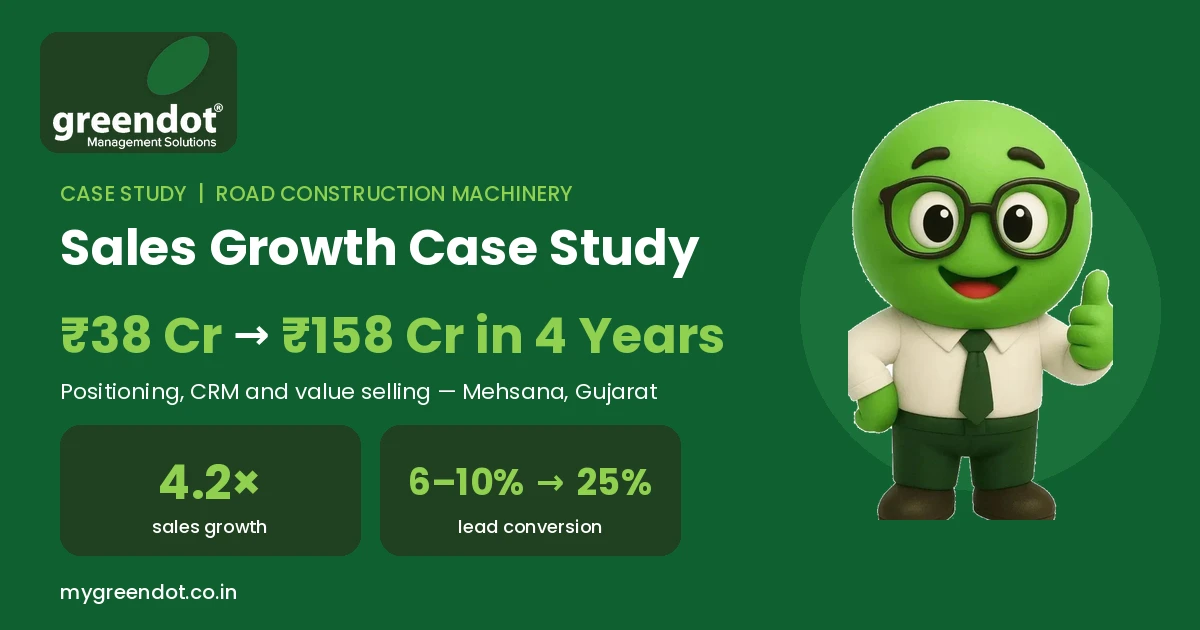

Looking for a sales consultant for manufacturing companies who works on the ground, not just on paper? This sales growth case study shows how Alltech India Limited, a road construction machinery manufacturer in Mehsana, Gujarat, grew annual sales from ₹38 Cr to ₹158 Cr in four years. Greendot did not hand over a report and leave. We fixed positioning, built a complete sales system and worked on site with the team every month until the system ran on its own.
At a glance
- Client: Alltech India Limited, Mehsana, Gujarat — road construction machinery manufacturer
- Problem: Sales stuck at ₹38 Cr, lead conversion only 6–10%, price war with competitors, exhibitions eating the marketing budget
- What Greendot did: Market intelligence, positioning in its own segment, CRM and sales targets, value selling, make-to-stock, monsoon plan, buyback and resale, digital and LinkedIn marketing
- Duration: 4 years, about 4 days a month on site (nearly 200 consulting days)
- Result: Sales ₹38 Cr → ₹158 Cr (4.2×), conversion 6–10% → 25%, sales team 6–9 → 15
About the Client
Alltech India Limited makes road construction machinery in Mehsana, Gujarat. The company is led by Managing Director Rakesh Patel with Directors Janak, Paresh and Vedant Patel. Its buyers range from large infrastructure contractors to small, mostly unorganised operators.
The Challenge
The product was good. The sales engine was not. When Greendot started, we found these problems:
- No sales strategy. Growth depended on the effort of a few individuals.
- No market data. Decisions were based on opinion, not on what operators, dealers and customers were saying.
- Poor customer profiling. The team chased every enquiry, including buyers who only wanted the lowest price.
- Weak brand positioning. The market did not see Alltech’s real strengths.
- Price competition. Discounts were squeezing margins.
- Lost and seasonal sales. Make-to-order meant buyers walked away in peak season, and sales dropped in the monsoon.
- Wasted marketing. Most of the budget went to exhibitions with weak returns.
The result: lead-to-order conversion was stuck at 6–10% and sales were flat at ₹38 Cr.
Does this sound like your company? Read on — every step below can be copied.
Our Approach: 3 Phases, 4 Years
We followed one rule: fix the positioning before spending more on marketing, then build a system the client’s own team can run.
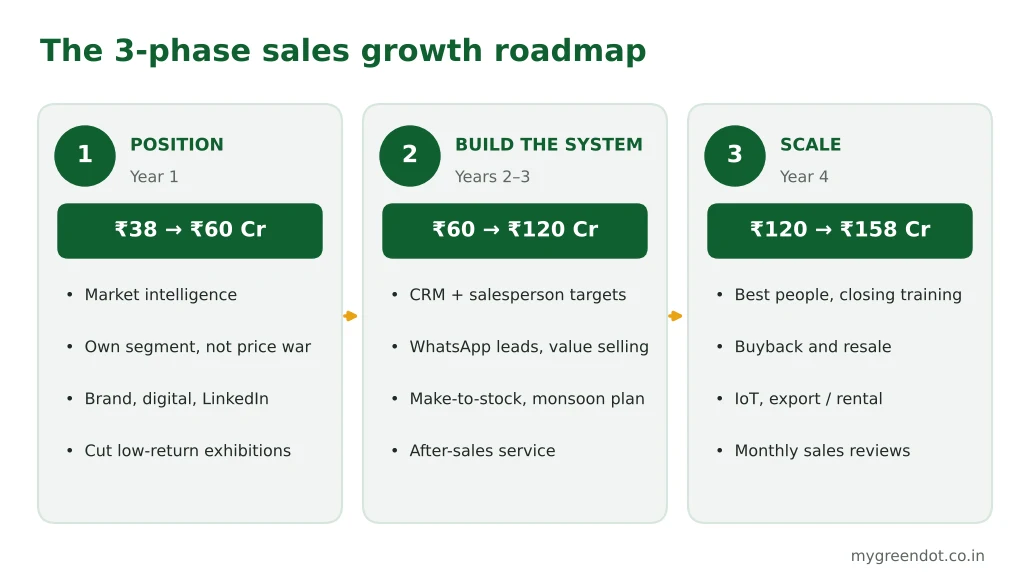
Phase 1 — Position (Year 1): ₹38 Cr → ₹60 Cr
| What we changed | What we did | Why it mattered |
|---|---|---|
| Market intelligence | Collected feedback from machine operators, dealers, customers and Alltech’s own sales team, and built a customer database. | Decisions were based on market facts, not opinions. |
| Customer profiling and segments | Defined the customer types and segments where Alltech wins, instead of chasing every enquiry. | The team stopped wasting time on buyers who only wanted the lowest price. |
| Own-segment mindset | Changed the thinking from “we compete with everybody” to “we have our own segment and our own customers”. | Confidence in price discussions and no more panic discounting. |
| Brand positioning and building | Positioned Alltech as robust, reliable and cost-effective; improved website and digital presence; started LinkedIn marketing. | Buyers knew Alltech’s strengths before the first call. |
| Marketing budget shift | Cut low-return exhibitions and moved the money to channels that bring leads. | More enquiries for less money. |
Phase 2 — Build the sales system (Years 2–3): ₹60 Cr → ₹120 Cr
| What we changed | What we did | Why it mattered |
|---|---|---|
| CRM software implementation | Introduced a sales CRM and trained every salesperson to manage a pipeline from lead to order. | No lead was lost; the owner could see the whole pipeline. |
| Targets for each salesperson | Set clear monthly targets for every salesperson and reviewed them regularly. | Everyone knew what was expected; performance became visible. |
| WhatsApp marketing with AI tools | Started WhatsApp campaigns for contractors and small buyers, who are mostly unorganised. | A steady flow of about 100 leads a month. |
| Value selling | Trained the team to sell on value — uptime, running cost, service, resale — instead of price. | Moved from low-price competition to value-based selling; margins protected. |
| Make-to-stock | Moved fast-moving models from make-to-order to make-to-stock. | No lost orders in peak season; faster delivery. |
| Monsoon / off-season plan | Targeted buyers who work in the monsoon — infra projects, southern states, mining — with finance and payment options. | Sales kept moving in the slow months. |
| After-sales service | Made service a selling point with clear service standards. | Happy customers came back and referred others. |
Is your conversion still below 10%?
Send us one message. We will look at your leads, pricing and sales process and show you where orders are being lost — free.
Get a free Sales Gap CheckPhase 3 — Scale (Year 4): ₹120 Cr → ₹158 Cr
| What we changed | What we did | Why it mattered |
|---|---|---|
| Recruit and train the best | Recruited strong salespeople and trained the whole team in closing skills; team grew from 6–9 to 15. | More conversations closed into orders. |
| Buyback and resale | Set up a buyback and resale funnel for used machines and used good resale value as a selling point. | Customers upgraded sooner and trusted the long-term value. |
| IoT / telematics | Introduced machine tracking (telematics) so customers can see working hours and uptime. | Sold on proven productivity, not on price. |
| Export / rental model | Opened export sales and a rental option for customers who prefer not to buy. | New markets beyond India. |
| Monthly sales reviews | Regular reviews of every stage from lead to repeat customer. | Problems fixed early; growth kept going. |
Results
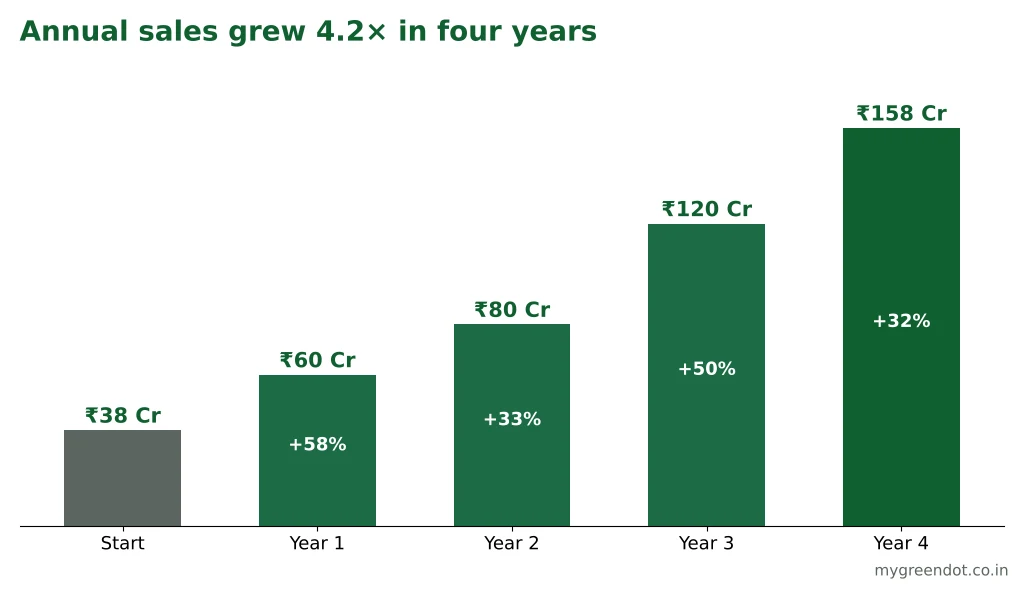
Year-on-year sales
| Year | Annual sales | Growth |
|---|---|---|
| Start | ₹38 Cr | — |
| Year 1 | ₹60 Cr | +58% |
| Year 2 | ₹80 Cr | +33% |
| Year 3 | ₹120 Cr | +50% |
| Year 4 | ₹158 Cr | +32% |
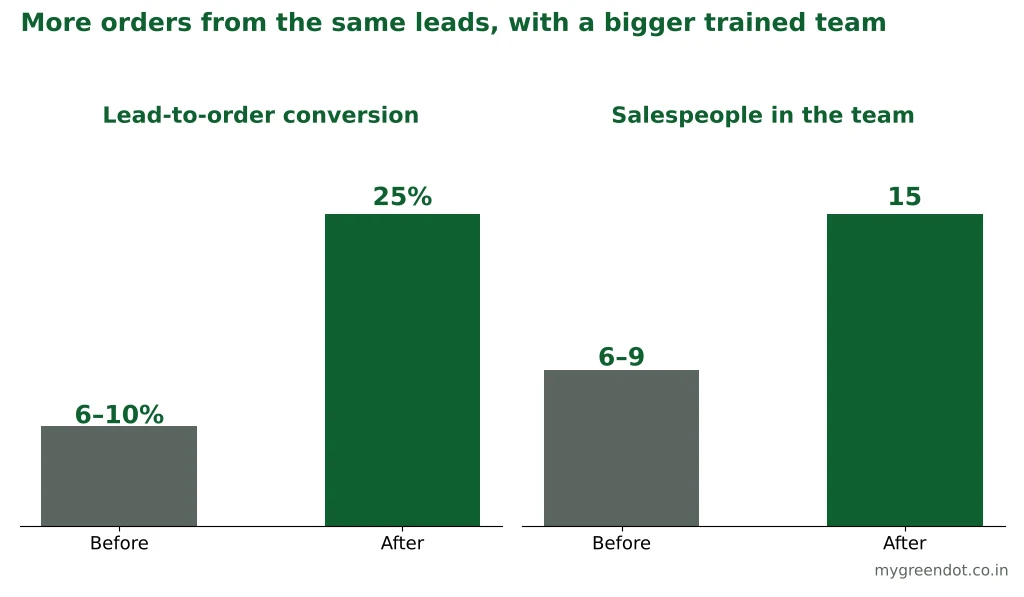
Before and after
| Area | Before | After |
|---|---|---|
| Annual sales | ₹38 Cr | ₹158 Cr |
| Lead-to-order conversion | 6–10% | 25% |
| Sales team | 6–9 people | 15 people |
| Leads per month | Irregular | About 100 |
| Pricing | Price competition, discounts | Value selling |
| Marketing | Exhibitions with poor return | Digital, LinkedIn and WhatsApp |
| Sales process | No strategy, depends on individuals | CRM pipeline, targets, monthly reviews |
| Stock policy | Make-to-order only | Make-to-stock for fast-moving models |
How we counted. Sales figures are Alltech’s annual sales as shared by its management. Conversion is orders divided by leads, taken from the CRM. Team size is the number of salespeople on the rolls.
Sales grew 4.2× in four years, and every single year was a growth year. This is what a sales consultant for manufacturing companies should deliver: numbers you can see every year, and a system your own team keeps running.
What the Client Says
“Costliest among all the consultants, but WORTH IT!”
— Vedant Patel, Director, Alltech India Limited
“Had a very good experience working with Greendot Consultancy, we have been resulted into skill improvement.”
— Janak Patel, Director, Alltech India Limited
What a Sales Consultant for Manufacturing Companies Should Build
Greendot didn’t just advise; we built systems that Alltech’s own team now runs every day:
- CRM pipeline with targets for every salesperson
- WhatsApp and LinkedIn lead generation bringing about 100 leads a month
- Value selling instead of price fights
- Make-to-stock and a monsoon plan so no season is wasted
- Service standards, buyback and resale that turn buyers into repeat customers
- Monthly sales reviews from lead to repeat order
This is the difference between advice and a sales consultant for manufacturing companies who stays until the system works.
That’s why growth continued for four straight years.
Key Takeaways
- Fix positioning and customer profiling before spending more on marketing.
- A CRM pipeline, clear targets and regular reviews can lift conversion from under 10% to 25%.
- Value selling protects margins better than discounting.
- Stock fast-moving models and plan the slow season — lost orders are the most expensive kind.
- Service, buyback and resale value turn one-time buyers into repeat customers.
Is Your Company Facing the Same Problem?
Use this sales growth case study as a mirror. Ask yourself:
- Out of every 100 enquiries, how many become orders?
- Does every salesperson have a monthly target, and do you review it?
- Do you win orders on value, or only when you match the lowest price?
- Do you know which marketing channel brings your best customers?
If two or more answers worry you, talk to us about your sales system or read how we cut lead time in our machine-building case study.
Want the same growth for your company?
Greendot has helped 1,100+ manufacturers since 1999. Message us and get a free Sales Gap Check for your business.
Frequently Asked Questions
How did Alltech grow sales from ₹38 Cr to ₹158 Cr?
In this sales growth case study, Alltech fixed its positioning and customer profiling first, then built a sales system — CRM, salesperson targets, WhatsApp and LinkedIn lead generation, value selling, make-to-stock and a monsoon plan — and finally scaled the team to 15 with buyback, resale and monthly reviews. Sales grew 4.2× in four years.
How much did lead conversion improve?
Lead-to-order conversion went from 6–10% to 25%, with about 100 leads a month and a sales team that grew from 6–9 to 15 people.
What does a sales consultant for manufacturing companies actually do?
A good sales consultant for manufacturing companies studies your market and competitors, decides which customers you should chase, sets up a CRM and targets, trains the team in value selling and closing, and reviews the numbers with you every month until the system runs on its own.
How soon can a manufacturer see sales growth?
At Alltech, sales grew from ₹38 Cr to ₹60 Cr in the first year, mainly from better positioning and cutting low-return marketing. The full system took four years, with Greendot on site about four days a month.
Why value selling instead of giving discounts?
Discounts cut margin and teach buyers to wait for a lower price. Value selling shows the buyer what they gain — uptime, lower running cost, service and resale value — so the order is won without a price war.
Can other manufacturers use the same approach?
Yes. The same system works for manufacturers in other industries too. Other clients include Sahajanand Valves (₹7 Cr → ₹18 Cr), Trilok Infratech (₹48 Cr → ₹91 Cr) and Vidhyut Power (₹8 Cr → ₹16 Cr).