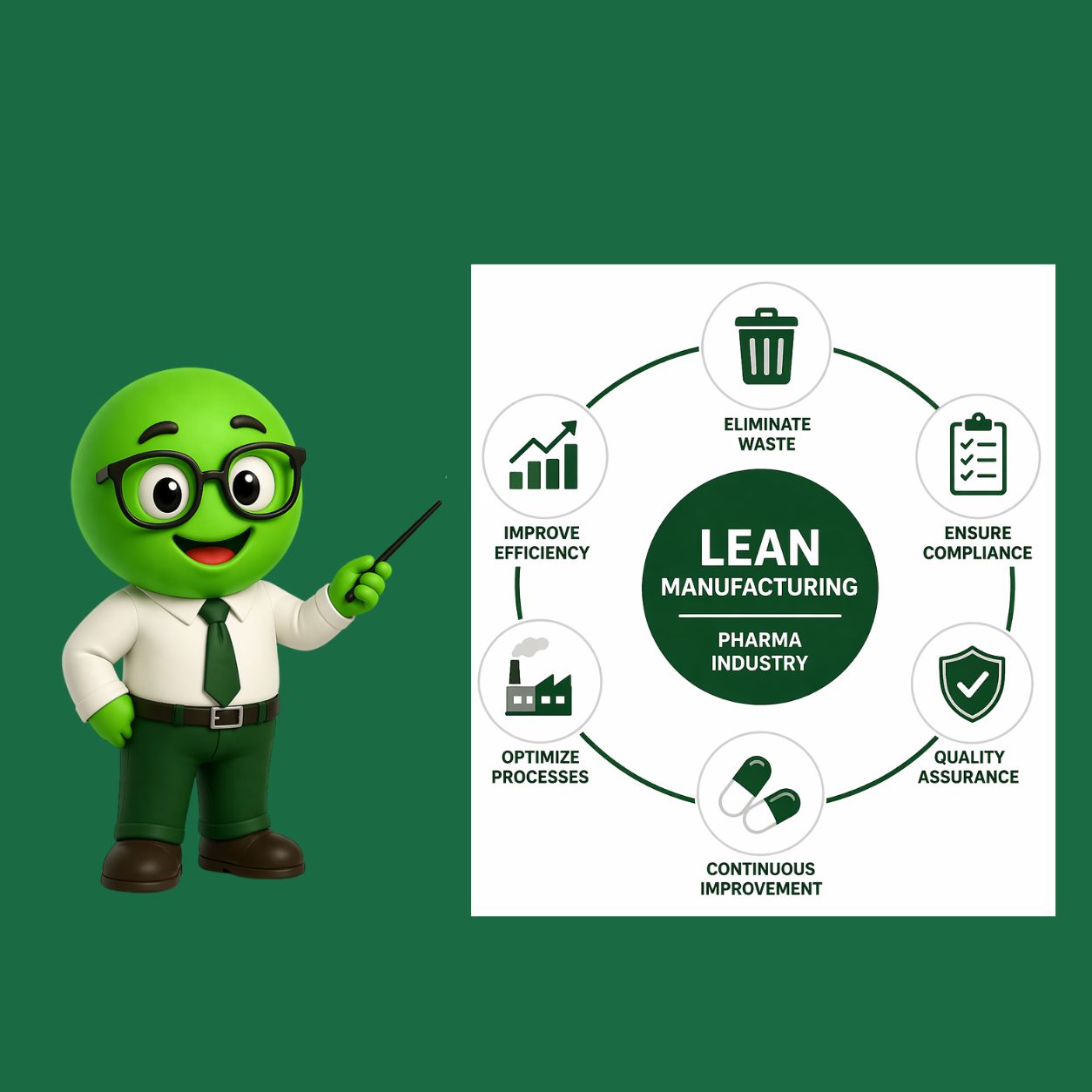

The most common objection Greendot consultants hear from Indian pharmaceutical factory managers when lean manufacturing is first introduced is: ‘We cannot apply lean here. We are GMP-regulated. We cannot change processes without validation.’
This objection is understandable — but it is wrong. Lean manufacturing and pharmaceutical GMP compliance are not opposing forces. They are deeply complementary. In fact, the principles that make a pharmaceutical factory lean — standardisation, error elimination, visual management, continuous improvement — are the same principles that make it GMP-compliant.
The distinction that matters: in pharmaceutical manufacturing, lean tools are applied to eliminate waste in the flow of materials, information, and people — not in the validated product quality parameters. GMP governs what the product must be. Lean governs how efficiently the process that makes it should run.
This guide from Greendot Management Solutions explains which lean tools are most applicable to Indian pharmaceutical manufacturers, how they align with GMP requirements, and what measurable results Indian pharma factories have achieved.
The Business Case:
Indian pharmaceutical companies that have implemented lean report: 30–50% reduction in batch cycle time, 20–40% reduction in manufacturing cost per batch, 40–60% reduction in WIP inventory, and significant improvements in OEE on filling and packaging lines — all without a single GMP deviation.
1. The 8 Wastes in Pharmaceutical Manufacturing
| Waste | Definition | Pharma-Specific Example |
| Overproduction | Producing more than the next step or customer needs | Manufacturing batch sizes based on equipment capacity rather than actual demand; producing API in excess of quarterly requirement |
| Waiting | Idle time for people, materials, or equipment | Batch waiting for QC release; operator waiting for yield reconciliation sign-off; equipment idle between cleaning and next batch |
| Transport | Unnecessary movement of materials | Intermediate product moved between buildings multiple times; raw material staged in three different locations before reaching dispensing |
| Over-processing | Doing more than what quality or the customer requires | Excessive in-process sampling beyond what ICH Q10 requires; triple-checking processes that have never failed |
| Inventory | Excess raw material, WIP, or finished goods | 3–6 months of raw material inventory; retained sample warehouses consuming expensive GMP space |
| Motion | Unnecessary movement of people | Analysts walking to retrieve standards from a different room multiple times per shift; operators collecting documentation from office during batch |
| Defects | Products not meeting specification — rework and rejection | OOS results requiring investigation and re-analysis; tablet coating rejections from unoptimised process parameters |
| Unused Talent | Not utilising people’s knowledge and experience | Shop-floor operators identifying quality problems but not empowered to raise them; QA analysts who see process improvements but are not included in CAPA teams |
2. The Lean Tools Most Applicable to Indian Pharma Factories
| Lean Tool | Application in Pharma | Typical Result |
| 5S | Organisation of dispensing areas, QC labs, filling lines, warehouses | 50% reduction in time spent searching for materials/equipment; visible GMP compliance to regulatory auditors |
| SMED | Changeover reduction on filling, coating, granulation, and packaging lines | 40–70% reduction in batch changeover time; 20–35% increase in equipment utilisation |
| VSM | End-to-end batch lead time mapping from dispensing to QC release | Identification of 40–60% of lead time as pure waiting — targets for pull system and batch scheduling improvement |
| Kanban | Raw material and packaging material replenishment; finished goods to warehouse | 30–40% reduction in raw material inventory; elimination of material shortages causing batch delays |
| OEE | Measurement and improvement of filling line and packaging line utilisation | Baseline OEE typically 45–60% in Indian pharma; improvement to 70–80% within 18 months of structured programme |
| Poka Yoke | Error-proofing in dispensing, labelling, filling, and packaging | Elimination of wrong material dispensed, incorrect label applied, missing insert — common GMP deviations |
| FMEA | Quality risk management for process validation and change control | ICH Q9 compliance; proactive identification of critical quality attributes (CQAs) and critical process parameters (CPPs) |
3. Lean and GMP — Where They Align
The most important insight for Indian pharma manufacturers: lean tools do not require GMP changes. They improve the efficiency of GMP-compliant processes. Here is how they align:
| Lean Principle | GMP Alignment | Practical Example |
| Standardisation (SOPs, work standards) | GMP Clause 4.8 — SOPs must be followed as written | Lean standard work and SOPs are the same document — lean ensures SOPs describe the optimal method, not just the historic method |
| Visual management | GMP labelling and identification requirements | Visual management systems (shadow boards, colour coding, status boards) are excellent GMP identification aids — auditors view them positively |
| Error-proofing (Poka Yoke) | GMP Clause 5.4 — prevention of mix-ups and contamination | Poka Yoke devices in dispensing (barcode verification), filling (weight checks), and packaging (vision inspection) directly fulfil GMP mix-up prevention requirements |
| PDCA / CAPA | GMP Clause 8 — quality improvement and CAPA | PDCA is the structure of every pharmaceutical CAPA. Lean PDCA skills accelerate CAPA quality and effectiveness |
| Waste elimination | GMP Clause 3 — premises and equipment must not compromise quality | Eliminating motion and transport waste reduces the handling of materials and products — directly reducing contamination and mix-up risk |
4. The Indian Pharma Lean Journey — Where to Start
For Indian pharma manufacturers beginning their lean journey, Greendot recommends this sequenced approach:
- Start with 5S in the dispensing area and QC laboratory — these are the highest-visibility areas for both lean impact and regulatory compliance
- Measure OEE on your bottleneck packaging or filling line — the baseline number will motivate the improvement programme
- Conduct a VSM for your highest-volume product — the lead time revelation is always a catalyst for action
- Apply SMED to your highest-downtime changeover — typically tablet coating or filling line changeovers in Indian pharma
- Implement Kanban for high-velocity excipients and primary packaging materials — two-bin Kanban is ideal for the GMP environment
- Build FMEA into your change control process — make risk-based thinking visible to regulators
FAQs — Lean Pharma India
Q1: Does implementing lean require re-validation of our processes?
Lean tools applied to material flow, scheduling, and information management (5S, Kanban, VSM, SMED on non-product-contact changeovers) typically do not require re-validation. Changes to product-contact processes, process parameters, or critical equipment require change control and potentially re-validation as per your quality system. A lean consultant with pharma GMP experience — like Greendot Management Solutions — ensures lean improvements are implemented within the change control framework.
Q2: Is lean manufacturing expected or required by US FDA or EU GMP?
Neither US FDA nor EU GMP explicitly mandates lean manufacturing. However, FDA’s Process Analytical Technology (PAT) guidance and ICH Q10 (Pharmaceutical Quality System) are philosophically aligned with lean principles — continuous improvement, risk management, and operational excellence. US FDA inspectors view factories with mature lean and continuous improvement systems favourably as evidence of a quality culture. Several FDA warning letters have cited lack of systematic root cause analysis and corrective action — problems that lean tools directly address.
Q3: We are a small pharma company with 50 employees. Is lean applicable to us?
Yes — in fact, lean delivers proportionally greater impact in smaller pharma facilities. With limited staff and tight capacity, eliminating waste from batch changeovers, QC waiting time, and dispensing inefficiency has immediate, visible financial impact. Start with 5S and OEE measurement — both can be implemented with minimal cost and no consultant support if your team has basic lean awareness.