
A quality manager at an engineering company in Pune had two problems on her plate simultaneously. The first: a recurring packaging defect that appeared every few weeks, without a clear root cause. The second: a chronic 15% scrap rate on a CNC machining line that had been running for three years.
Her instinct was to apply the same problem-solving approach to both. Her consultant told her she was wrong. The first problem needed PDCA — fast, iterative, hypothesis-driven. The second needed DMAIC — structured, data-intensive, statistically validated. Using the wrong tool for either would waste time and fail to solve the problem.
PDCA and DMAIC are the two most widely used structured problem-solving methodologies in Indian manufacturing. Understanding when to use each — and why — is one of the most practical skills any quality or operations professional can develop. This guide from Greendot Management Solutions provides a complete, decision-ready comparison.
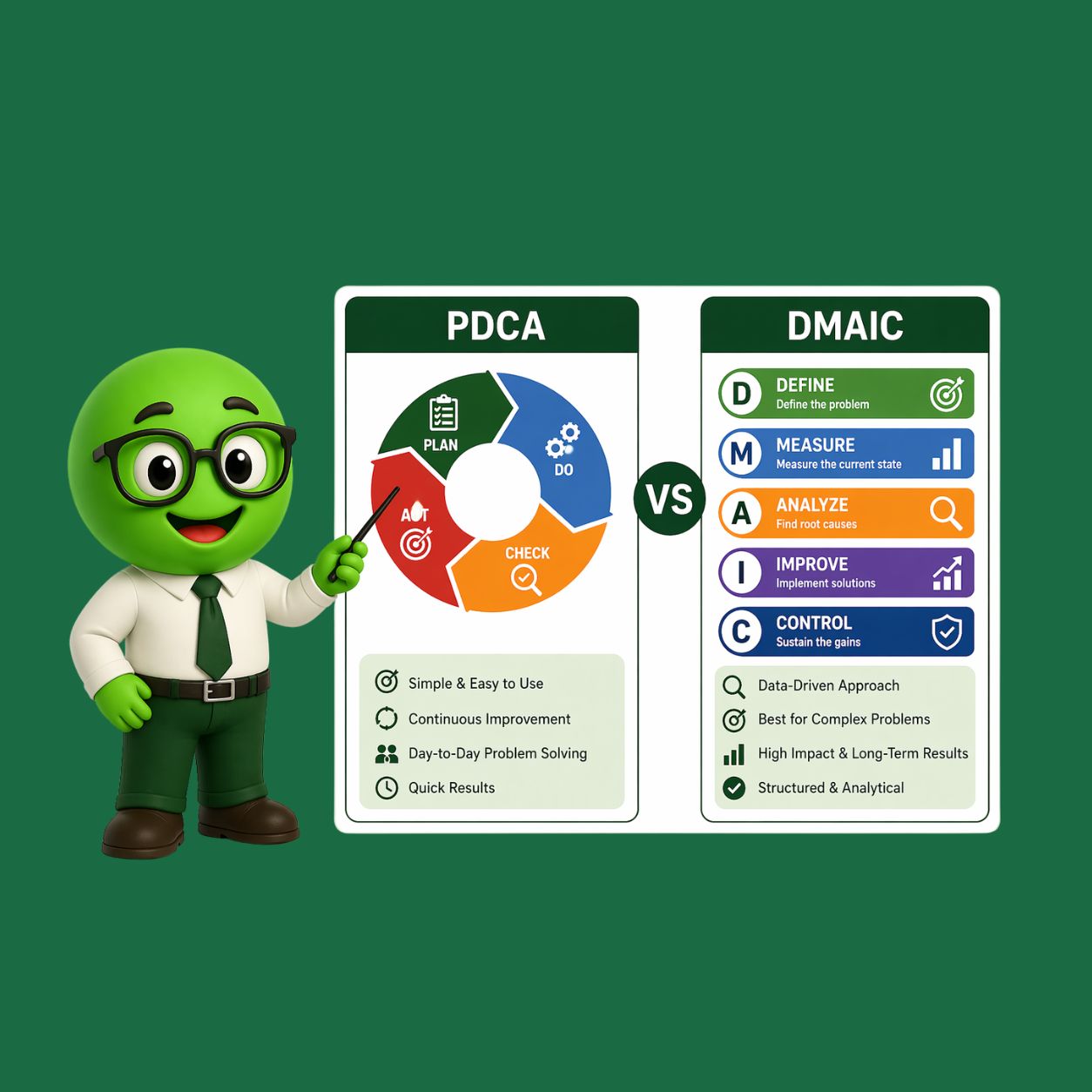
1. PDCA — Plan, Do, Check, Act
PDCA (also called the Deming Cycle or Shewhart Cycle) is a four-stage iterative model for continuous improvement. It was developed by Walter Shewhart and popularised globally by W. Edwards Deming — the quality pioneer whose principles transformed Japanese manufacturing after World War II.
| Stage | Name | What You Do | Indian Factory Example |
| Plan | Plan | Define the problem, analyse current state, identify root cause hypothesis, design the improvement action | Machine downtime is too high. Hypothesis: preventive maintenance intervals are too long. Plan: reduce PM frequency from monthly to weekly for 3 machines |
| Do | Do | Implement the planned change — on a small scale, in a controlled test | Run weekly PM on the 3 selected machines for 4 weeks. Track downtime data carefully. |
| Check | Check | Measure the results. Did the change produce the expected improvement? Was the hypothesis correct? | Compare downtime for the 3 PM machines vs. the control group. Is there a measurable improvement? |
| Act | Act | If the change worked — standardise it across all machines. If it didn’t — revise the hypothesis and repeat the cycle. | If downtime dropped — update PM schedule for all machines. If not — investigate another root cause hypothesis. |
When PDCA Works Best:
Problems with a suspected but unconfirmed root cause Process improvements where you can test a hypothesis quickly (days to weeks) Operational problems that operators and supervisors can investigate directly ISO 9001 corrective action cycles — PDCA is the model explicitly embedded in the standard Daily management and Kaizen activities on the shopfloor
2. DMAIC — Define, Measure, Analyze, Improve, Control
DMAIC is the core problem-solving methodology of Six Sigma. It was developed at Motorola in the 1980s, refined at GE in the 1990s, and is now a global standard for data-driven process improvement. DMAIC requires more rigorous data collection and statistical analysis than PDCA — and delivers proportionally more robust, validated solutions.
| Stage | Name | What You Do | Indian Factory Example |
| Define | Define | Formally define the problem using a project charter. Define scope, customer requirements (CTQs), team, timeline, and expected business benefit. | CNC scrap rate is 15%. Customer specification requires < 2% scrap. Project scope: 4 CNC lathes, 3-month project timeline. Target: reduce scrap to < 3%. |
| Measure | Measure | Collect baseline data on the current process. Measure process capability. Validate measurement systems (MSA/Gauge R&R). | Collect 30 days of scrap data by machine, shift, operator, and product. Run Gauge R&R on measurement tools. Calculate current Cpk. |
| Analyse | Analyse | Use statistical tools to identify the true root causes of the problem from the data. Fishbone, regression analysis, hypothesis testing. | Regression analysis reveals that scrap rate correlates strongly with coolant temperature and tool wear interval. Root causes confirmed statistically. |
| Improve | Improve | Design and implement the optimal solution. Pilot on a small scale, validate results, then deploy. | Implement automated coolant temperature control. Reduce tool change interval from 8 hours to 5 hours. Pilot for 4 weeks — scrap drops to 2.8%. |
| Control | Control | Build controls into the process to sustain the improvement. SPC charts, updated procedures, operator training, handoff to process owner. | Install SPC chart on coolant temperature. Update standard operating procedure. Train all shift operators. Hand off to production supervisor with monthly review. |
When DMAIC Works Best:
Chronic, complex problems that have resisted previous improvement attempts Problems where the root cause is genuinely unknown and requires statistical investigation High-stakes improvements with significant financial or quality impact (scrap, rework, yield) Problems requiring Gauge R&R to validate measurement systems before analysis Six Sigma certification projects and formal Green Belt / Black Belt projects
3. PDCA vs DMAIC — Direct Comparison
| Feature | PDCA | DMAIC |
| Origin | Shewhart / Deming — 1950s quality movement | Six Sigma — Motorola / GE 1980s–90s |
| Complexity | Simple — 4 stages, accessible to all staff | Structured — 5 stages, requires statistical training |
| Data requirement | Moderate — observational and operational data | High — requires baseline measurement, capability analysis, statistical tools |
| Speed | Fast — cycle can complete in days to weeks | Slower — typically 3–6 months for a full project |
| Best for | Operational improvements, Kaizen events, daily management | Complex chronic problems, process design, Six Sigma projects |
| Team required | Any operator or supervisor with basic training | Cross-functional team, ideally with a trained Green/Black Belt |
| Statistical tools needed | Basic (run charts, Pareto, 5-Why) | Advanced (regression, hypothesis testing, Gauge R&R, SPC, Cpk) |
| ISO 9001 alignment | PDCA is the ISO 9001 improvement model | DMAIC aligns with ISO 9001 risk-based thinking and measurement clauses |
| Result | Validated improvement, standardised in SOP | Sustained, statistically validated process capability improvement |
4. Decision Guide — Which Tool to Use?
| Situation | Recommended Tool |
| Root cause is suspected and can be tested quickly | PDCA |
| Problem recurs despite previous fixes — root cause unknown | DMAIC |
| Problem was just discovered — first improvement attempt | PDCA |
| Problem has been running for 1+ year with no sustainable fix | DMAIC |
| Team has no statistical training — basic quality staff | PDCA |
| Trained Six Sigma Green/Black Belt is available | DMAIC |
| ISO 9001 corrective action cycle | PDCA — it is the ISO model |
| Scrap or yield improvement with financial justification required | DMAIC |
| Daily Kaizen or shopfloor improvement activity | PDCA |
| Process capability (Cpk) is below 1.33 and must be improved | DMAIC |
FAQs — PDCA vs DMAIC India
Q1: Can PDCA and DMAIC be used together?
Yes — they are complementary, not competing. Many Six Sigma practitioners use PDCA within the Improve stage of DMAIC to test and iterate on potential solutions before full-scale implementation. At an organizational level, DMAIC projects improve specific processes, while PDCA drives continuous daily improvement across all operations. The most mature Indian manufacturing organizations use both simultaneously — DMAIC for complex projects, PDCA for everyday kaizen.
Q2: Which tool is better for Indian pharma companies?
Both are used extensively in Indian pharma. PDCA is the backbone of daily deviation management and CAPA (Corrective and Preventive Action) processes — which directly map to ISO 9001 and cGMP requirements. DMAIC is used for complex process improvement projects, yield improvement, and OOS (Out of Specification) reduction. Pharmaceutical companies targeting US FDA or EU GMP compliance are increasingly expected to demonstrate structured DMAIC capability for major quality improvement projects.
Q3: Does Greendot Management Solutions provide PDCA and DMAIC training?
Yes. Greendot offers both PDCA/Kaizen facilitation for shopfloor teams and structured Six Sigma DMAIC training and project facilitation for quality and engineering professionals. We have delivered Green Belt and DMAIC project work across pharma, chemical, and engineering sectors in India for over 25 years.