
A pharmaceutical packaging line in Ahmedabad was rejecting 2.3% of blister packs due to missing tablets — caught only at final inspection, after the entire batch had been produced. One engineer suggested mounting a simple vision sensor at the blister-filling station that halted the line when any cavity was detected empty. The rejection rate dropped to zero within two weeks. The sensor cost less than the labour cost of one day’s inspection.
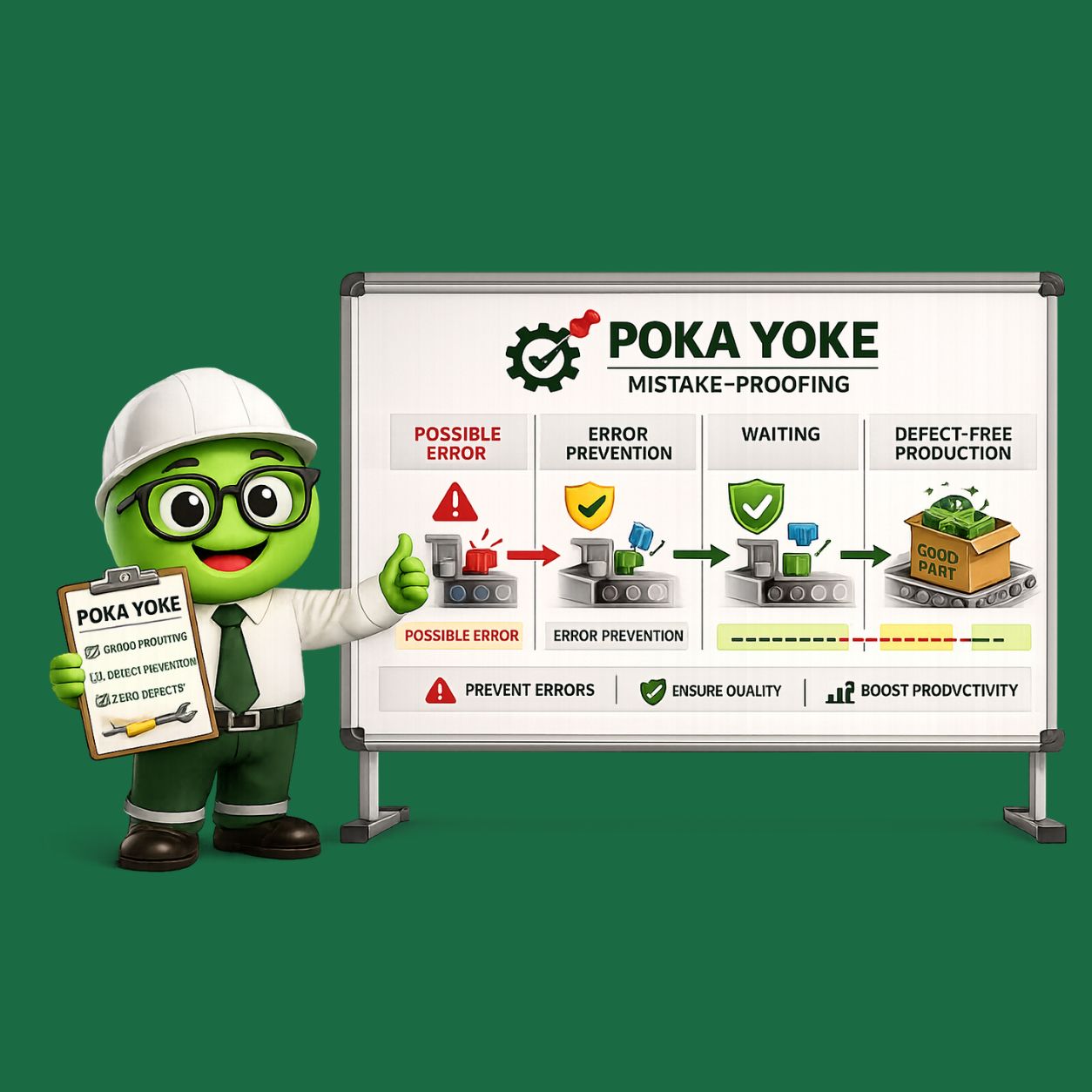
This is Poka Yoke in its purest form: a simple, low-cost mechanism that makes it physically impossible — or instantly detectable — for a defect to occur or pass unnoticed. It is one of the most powerful and underutilized lean tools in Indian manufacturing.
Developed by Shigeo Shingo as part of the Toyota Production System in the 1960s, Poka Yoke (Japanese: ‘mistake-proofing’) has since been adopted across every manufacturing sector globally. Yet in the Indian MSME landscape, most factories still rely on end-of-line inspection to catch defects — which is expensive, slow, and always too late. This guide from Greendot Management Solutions explains what Poka Yoke is, how it works, and how to implement it in your factory.
The Poka Yoke Principle:
Inspection finds defects AFTER they are made. Poka Yoke prevents defects BEFORE they can occur. The cost of preventing a defect at the source is 1/10th the cost of detecting it at inspection, and 1/100th the cost of a customer finding it.
1. The Two Types of Poka Yoke Mechanisms
| Type | Definition | Examples in Indian Factories |
| Control (Prevention) Device | Physically prevents the error from occurring at all — the process cannot continue if the mistake is made | A fixture that only accepts a part in the correct orientation; a filling machine that stops if a bottle is absent; a cap that cannot be applied to the wrong container size |
| Warning (Detection) Device | Detects when an error has occurred and alerts the operator immediately — before the defect passes downstream | A sensor alarm when a label is missing; a light that flashes when the wrong torque is applied; a weighing check that alerts when fill weight is outside tolerance |
Control devices are always preferred — they prevent the defect entirely. Warning devices are used where prevention is technically impossible or cost-prohibitive. Both are vastly superior to detection at final inspection.
2. The Three Poka Yoke Methods
| Method | How It Works | Indian Factory Example |
| Contact Method | Uses the physical shape, size, or electrical property of the product to detect errors | A pharmaceutical tablet punch that physically cannot accept a tablet of incorrect diameter; a connector that only fits one way; colour-coded nozzles that prevent wrong chemical connections |
| Fixed-Value Method | Checks that a specific number of actions, parts, or steps have been completed | A press tool that counts and confirms exactly 8 rivets before releasing the assembly; a dispensing machine that confirms the correct number of capsules per blister before sealing |
| Motion-Step Method | Confirms that each required step in a sequence has been completed in the correct order | A PLC that requires confirmation of Step 1 completion before Step 2 can begin; a sequential tool that unlocks the next operation only after the previous check passes |
3. Poka Yoke in Indian Industry — Sector-by-Sector Examples
| Industry | Common Defect / Error | Poka Yoke Solution |
| Pharmaceutical Packaging | Missing tablet in blister pack | Vision sensor at filling station halts machine on empty cavity |
| Pharmaceutical Packaging | Wrong batch number label applied | Barcode scanner verifies label code matches current batch before application |
| Chemical Manufacturing | Wrong raw material charged to reactor | Colour-coded and shape-coded inlet valves prevent incorrect material connection |
| Chemical Manufacturing | Incorrect quantity charged | Load cell with interlock — process cannot proceed until correct weight is confirmed |
| Auto Component (Machining) | Component loaded in wrong orientation | Fixture with guide pins that physically prevent backward loading |
| Auto Component (Assembly) | Missing bolt / incomplete fastening | Torque wrench with count sensor — assembly moves forward only when correct number of bolts torqued |
| Engineering Fabrication | Wrong material thickness used | Go/no-go gauge at material issue — incorrect thickness cannot be drawn from stores |
| Food & FMCG Packaging | Underfilled or overfilled pack | Checkweigher with automatic diversion of out-of-tolerance packs before sealing |
| Textile / Garment | Wrong colour component sewn | Colour-sensor on feeding mechanism alerts operator when wrong colour thread or fabric fed |
| Electrical / Electronics | Wrong polarity component placed | Polarised socket design prevents reverse component insertion on PCB |
4. The 6-Step Poka Yoke Implementation Process
- Identify and prioritise your highest-frequency defects — use Pareto analysis (80% of defects come from 20% of causes). Focus Poka Yoke effort on the top 3 defect types first.
- Use Root Cause Analysis (5-Why or fishbone) to understand WHY each defect occurs — Poka Yoke must address the root cause, not the symptom.
- Design the Poka Yoke device or mechanism — choose Control over Warning wherever feasible. Involve the operators who work at that station — they know the process best.
- Test the Poka Yoke rigorously — deliberately introduce the error and verify the device catches or prevents it 100% of the time. Also verify it does not cause false stops or production slowdowns.
- Implement and train — install the device, document the standard, train operators. Start with one machine or one line and validate before scaling.
- Measure and verify effectiveness — track defect rate before and after for minimum 4 weeks. If the defect rate has not dropped significantly, the root cause analysis was incorrect — repeat from Step 2.
5. Poka Yoke vs. Inspection — The Business Case
| Comparison Factor | Traditional Inspection | Poka Yoke |
| When defect is detected | After it is produced (end of line, or worse — at customer) | At the point of creation, or before it can occur |
| Cost of detection | High — dedicated inspection labour, rework cost, scrap | Low — one-time device cost, minimal ongoing cost |
| Reliability | Human inspectors miss 10–30% of defects under normal conditions | Device-based detection is 100% consistent (no fatigue, no variation) |
| Impact on customer | Defects reach customers if inspection misses them | Zero defects reach downstream — prevention is absolute |
| Operator morale | Operators blamed for defects caught at inspection | Operators empowered — process protects them from making errors |
| ISO / SMETA impact | Reactive quality — NCRs at audit for recurring defects | Proactive quality — demonstrates robust process control to auditors |
FAQs — Poka Yoke India
Q1: Does Poka Yoke require expensive automation or sensors?
No. Many of the most effective Poka Yoke devices are entirely mechanical — guide pins, shaped fixtures, go/no-go gauges, colour coding. These often cost a few hundred to a few thousand rupees to implement. Sensor-based systems add cost but also add reliability for high-speed or high-volume lines. Always start with the simplest solution that reliably prevents the defect.
Q2: How does Poka Yoke relate to ISO 9001 requirements?
ISO 9001:2015 Clause 8.3 (Design and Development) and Clause 8.5 (Production and Service Provision) both address error prevention and process controls. Poka Yoke devices are direct evidence of risk-based thinking applied to process design — a core requirement of ISO 9001:2015. Well-documented Poka Yoke implementations consistently impress ISO auditors as evidence of a mature quality management system.
Q3: Can Poka Yoke be applied to administrative or office processes?
Yes. Poka Yoke principles apply to any process where errors are possible. Examples: a purchase order system that cannot be submitted without a required approver’s digital signature (control device); a sales order form that alerts when the customer’s credit limit will be exceeded (warning device); a document management system that prevents overwriting without version control (control device).