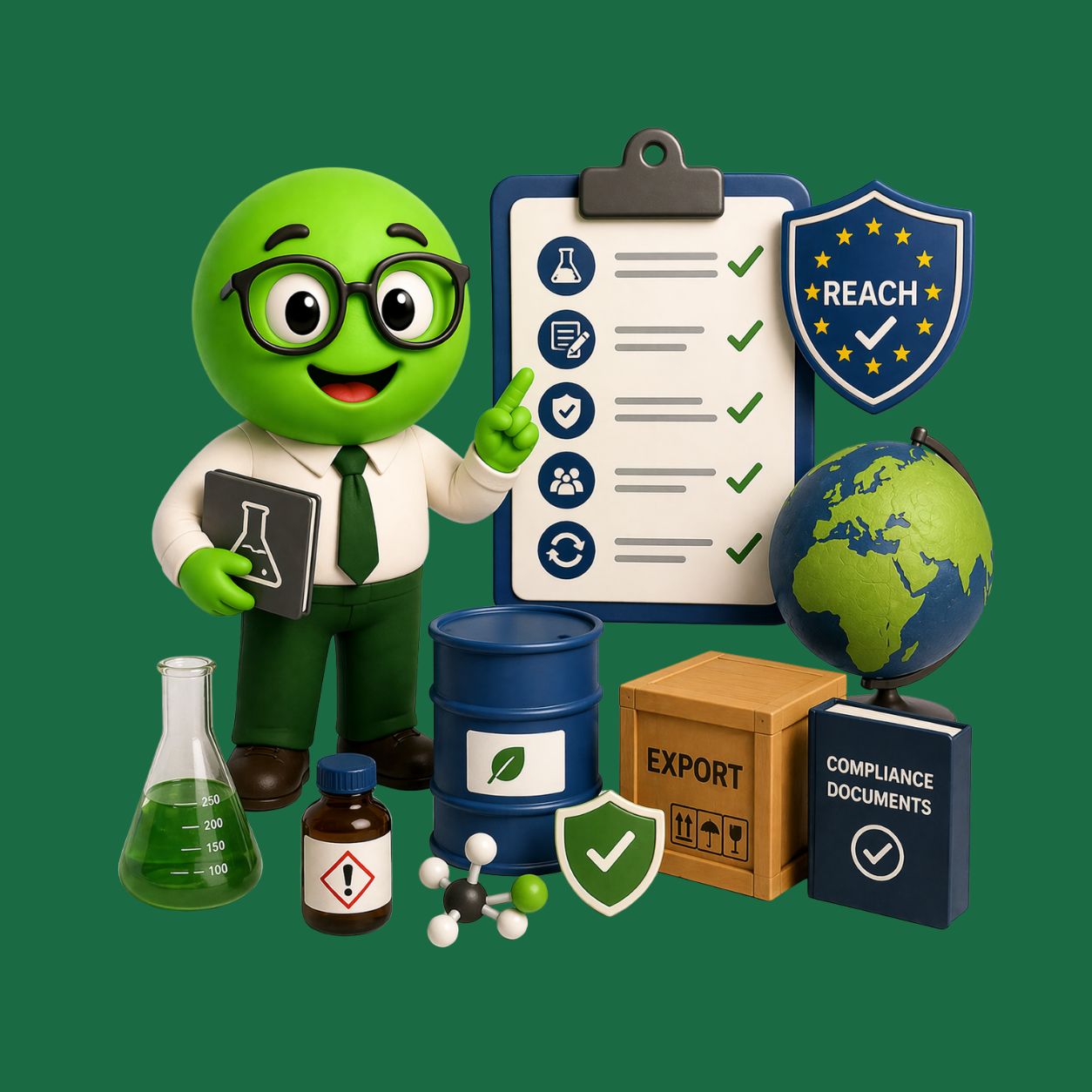

If your company exports any chemical substance to the European Union — even as part of a finished product — and the quantity exceeds 1 tonne per year, REACH compliance is not optional. It is a legal requirement. Non-compliance can result in your company being permanently banned from EU markets.
Yet the majority of small and mid-size Indian chemical exporters either have incomplete REACH compliance, rely entirely on their EU importer to manage it, or are simply unaware of where their obligations begin and end. In 2025, with the Indian government’s Export Promotion Mission directly funding REACH compliance support, and with EU regulatory enforcement intensifying, the window for complacency has closed.
This guide from Greendot Management Solutions gives you a complete, plain-language understanding of REACH — what it is, who it applies to, what you must do, and how to build a compliance system that protects your EU market access.
Key Fact: REACH is the most comprehensive chemicals regulation in the world. The European Chemicals Agency (ECHA) has registered over 22,000 chemical substances under REACH. Indian exporters who export chemical substances directly or as components of articles above 1 tonne per year per substance are required to comply.
1. What is REACH?
REACH stands for Registration, Evaluation, Authorization and Restriction of Chemicals. It is an EU regulation (EC No 1907/2006) that entered into force in 2007. Its core purpose is to protect human health and the environment from chemical risks by requiring businesses to understand and manage the hazards posed by the substances they manufacture, import, or use.
REACH works on a simple principle: no data, no market. If a chemical substance has not been properly registered with ECHA, it cannot be legally placed on the EU market. This applies to chemicals manufactured in the EU — and to chemicals imported into the EU from countries like India.
2. Does REACH Apply to Indian Exporters?
Yes — but the compliance obligation sits with the EU importer, not the Indian exporter directly. However, in practice, this distinction has important implications for Indian factories:
| Scenario | REACH Implication for Indian Exporter |
| You export a pure chemical substance to the EU | Your EU importer must register it with ECHA — or appoint you/your Only Representative to do so. Without registration, your substance cannot enter the EU. |
| You export a finished article containing chemicals | You must ensure SVHC (Substances of Very High Concern) present above 0.1% w/w are communicated to your EU customer. If SVHC > 0.1% and annual volume > 1 tonne, notification to ECHA is required. |
| Your EU importer handles all REACH compliance | You are still responsible for providing accurate chemical composition data, Safety Data Sheets (SDS), and SVHC declarations to your importer. Incomplete data from you = non-compliance for them. |
| You appoint an Only Representative (OR) in the EU | The OR registers your substances with ECHA on your behalf. Your EU customers are then treated as ‘downstream users’ rather than importers — which simplifies their compliance burden and strengthens your relationship. |
3. The 4 Core REACH Obligations for Indian Exporters
3.1 Registration
Any substance manufactured in or imported into the EU above 1 tonne per year per manufacturer/importer must be registered with ECHA. Registration requires a technical dossier covering substance properties, hazard data, risk assessment, and safe use information. All registration deadlines for existing substances have now passed — new substances must be registered before import begins.
3.2 Safety Data Sheets (SDS)
For every chemical substance or mixture you export to the EU that is classified as hazardous (or contains SVHCs above 0.1%), you must provide an up-to-date SDS to your EU customer. The SDS must comply with EU CLP (Classification, Labelling and Packaging) regulation — it cannot simply be your domestic Indian SDS. Key requirements: 16-section format, EU language(s), EU regulatory references.
3.3 SVHC Communication (Articles)
If your exported product (article) contains an SVHC — from ECHA’s Candidate List of over 240 substances — at a concentration above 0.1% w/w, you must proactively communicate this to your EU business customer. If total EU import volume exceeds 1 tonne/year, ECHA notification is required.
3.4 Restrictions
REACH Annex XVII restricts or bans the manufacture, use, or placing on the EU market of certain substances. Before exporting to the EU, verify that your product does not contain any restricted substances. Common restricted substances include certain azo dyes (textile sector), polycyclic aromatic hydrocarbons (rubber/plastics), and specific heavy metals.
4. The Only Representative (OR) — Why Indian Exporters Should Appoint One
The Only Representative system is the most practical tool available to Indian chemical exporters to manage REACH compliance effectively. An OR is a legal entity established in the EU that acts on your behalf — registering your substances with ECHA, maintaining your compliance files, and managing communication with EU authorities.
| Feature | Without an OR | With an Only Representative |
| Who bears compliance burden | Your EU importer — they carry legal risk | You (via OR) — you own and control your compliance |
| Customer relationships | EU importers are exposed to risk from your gaps | EU importers are ‘downstream users’ — easier business relationship |
| Market access risk | Single importer failure = total loss of EU market | Your OR manages all EU customers under one registration |
| Transparency | Limited — importer manages data | Full — you see your own ECHA dossier |
| Cost | Borne by importer, often passed back to you | Direct cost, but often lower than importer-managed approach |
| Control | None — importer controls your EU compliance | Full — you choose and manage your own OR |
5. India REACH (CMSR) — The Domestic Equivalent Coming Soon
India is developing its own REACH-like regulation: the Chemical Management and Safety Rules (CMSR), sometimes called ‘India REACH.’ It will replace the existing Manufacture, Storage and Import of Hazardous Chemical Rules (1989) and the Chemical Accidents Rules (1996). The CMSR will apply to all chemical substances manufactured, imported, or placed on the Indian market above 1 tonne per year.
While the CMSR is still in draft stage as of 2025, its development signals a clear regulatory direction: Indian chemical companies will need to build robust chemical substance management systems — whether for EU REACH compliance today, or for India CMSR compliance in the near future. Building these systems now gives Indian factories a significant first-mover advantage.
FAQs — REACH Compliance India
Q1: Our EU customer says they handle REACH compliance. Do we need to do anything?
Yes — you must still provide accurate, current Safety Data Sheets (SDS) in EU format, disclose all SVHC content in your products above 0.1% w/w, and ensure your product is free from REACH-restricted substances. ‘Our customer manages REACH’ does not exempt you from supplying correct compliance documentation.
Q2: What is the SVHC Candidate List and how does it affect us?
The ECHA Candidate List currently contains over 240 Substances of Very High Concern — including carcinogens, reproductive toxins, and persistent pollutants. If your product contains any of these above 0.1% w/w, you must communicate this to EU business customers upon request (and proactively for B2C supply). The Candidate List is updated twice yearly — review it regularly.
Q3: Is there a government subsidy available for REACH compliance for Indian exporters?
Yes. The Indian government’s Export Promotion Mission (EPM), launched in 2025 with a ₹25,060 crore outlay over 6 years, includes specific support for REACH and CBAM compliance costs for Indian exporters. Contact your industry association or DGFT office for current subsidy details.
Q4: How does REACH compliance relate to SMETA 4-Pillar audits?
REACH compliance overlaps significantly with the Environment pillar of SMETA 4-Pillar audits. SMETA auditors assess chemical management, SDS availability, and hazardous substance controls — all of which are also REACH requirements. Building REACH-compliant chemical management systems simultaneously strengthens your SMETA Environment pillar readiness.