
Your buyer has sent two requests: one for a SMETA audit, and one asking whether your factory is SA8000 certified. You are familiar with SMETA. But SA8000 is less well-known in the Indian MSME space — and yet it is increasingly appearing in supplier questionnaires, especially for buyers in the apparel, pharma, retail, and food sectors.
This guide from Greendot Management Solutions explains everything you need to know about SA8000 — what it is, what it covers, how it differs from SMETA, who needs it, and how to pursue certification in India. Including the important update: SA8000 is currently being revised toward a 2026 edition.
1. What is SA8000?
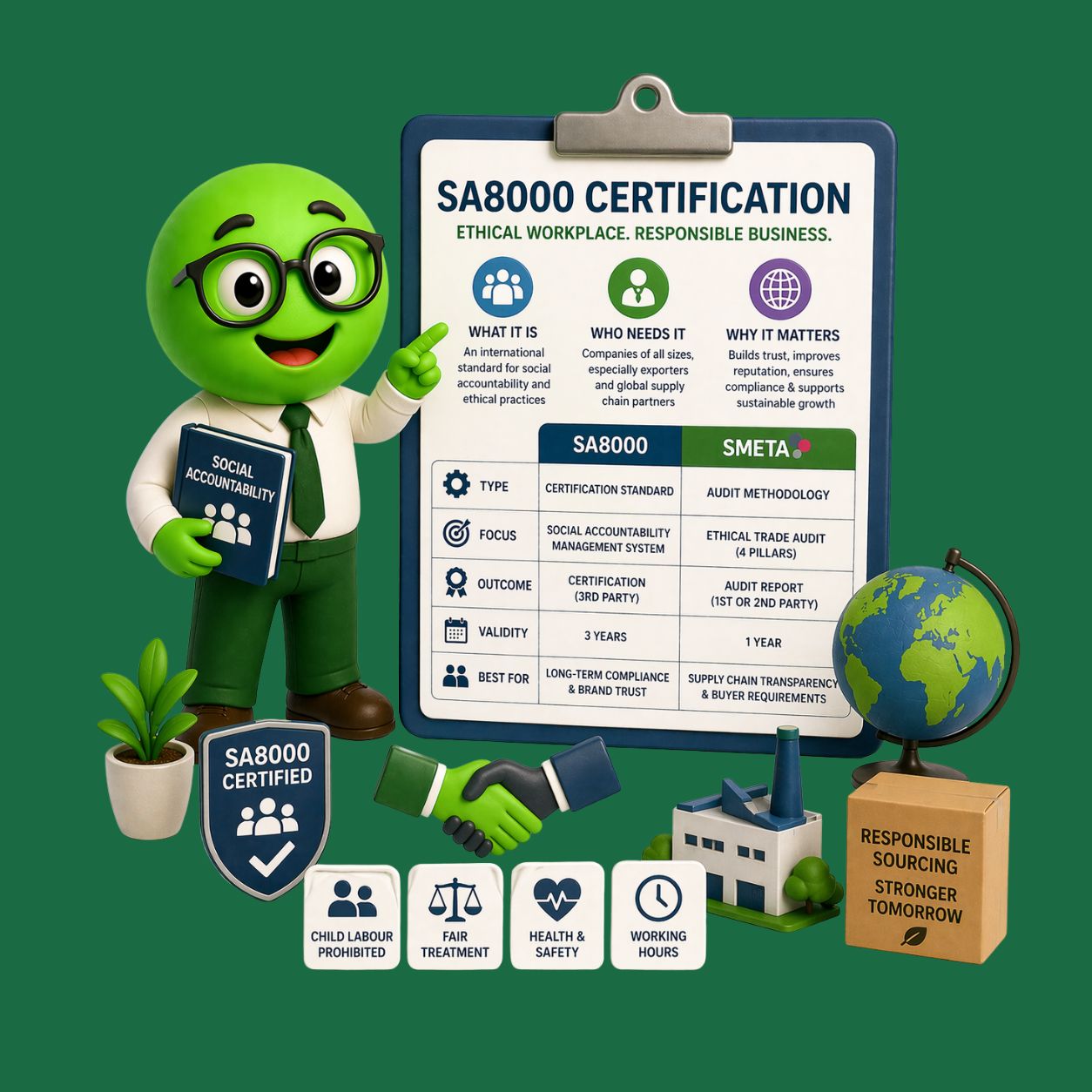
SA8000 stands for Social Accountability 8000. It is an internationally recognized, auditable certification standard for social accountability in the workplace. It was developed in 1997 by Social Accountability International (SAI) — a non-profit organization based in New York — and is now on its 2014 version, with a 2026 revision actively in development.
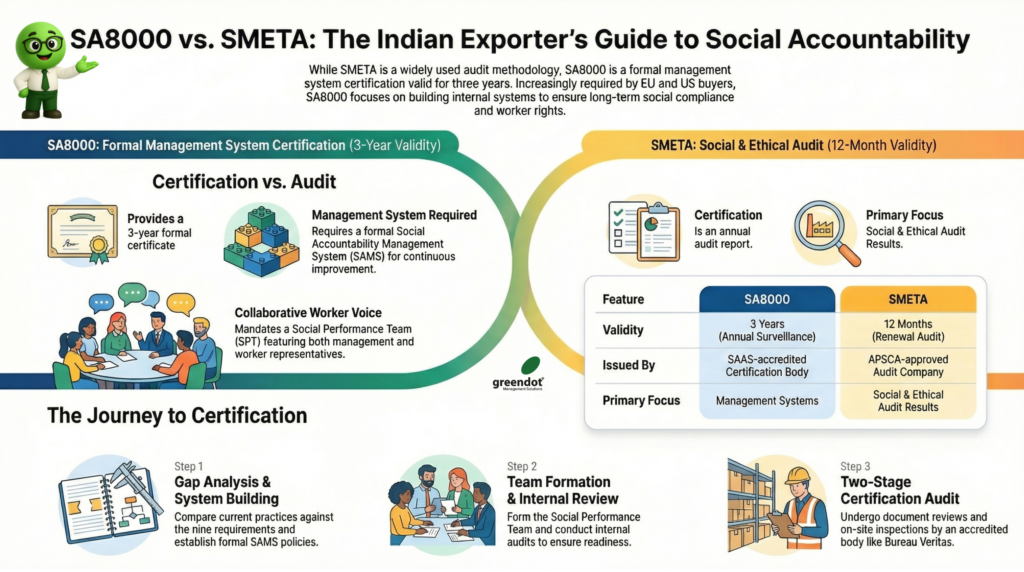
Unlike SMETA — which is an audit methodology — SA8000 is a certifiable management system standard. This means companies do not just get audited against SA8000; they get certified. A valid SA8000 certificate is issued by an SAAS-accredited Certification Body and is valid for 3 years (with annual surveillance audits).
SA8000 is based on the principles of:
- ILO (International Labour Organization) Conventions
- UN Convention on the Rights of the Child
- Universal Declaration of Human Rights
- Local labour laws of the country where the factory operates
2. What Does SA8000 Cover? The 9 Requirements
| # | Requirement | What Is Assessed |
|---|---|---|
| 1 | Child Labor | No workers under 15 years of age; no hazardous work for those under 18; remediation policy for any child found working |
| 2 | Forced & Compulsory Labour | No forced, bonded, prison or trafficked labour; workers free to leave premises; no deposits or document retention |
| 3 | Health & Safety | Safe working conditions; H&S management system; accident prevention; PPE; trained H&S manager; regular drills |
| 4 | Freedom of Association | Workers’ right to form/join trade unions and bargain collectively; or alternative worker representation where legally restricted |
| 5 | Discrimination | No discrimination in hiring, pay, training, or promotion on basis of gender, caste, religion, race, disability, or union membership |
| 6 | Disciplinary Practices | No corporal punishment, mental coercion, verbal abuse, or deduction from wages as disciplinary measure |
| 7 | Working Hours | Maximum 48 regular hours per week; OT voluntary and compensated; minimum 1 rest day in 7; humane working hours |
| 8 | Remuneration | Wages meet legal minimum or industry benchmark; full payment in legal tender; no illegal deductions; living wage aspiration |
| 9 | Management System | Formal SAMS (Social Accountability Management System): policy, planning, implementation, monitoring, review, and continuous improvement |
The ninth requirement — Management System — is what distinguishes SA8000 from most other social compliance standards. SA8000 doesn’t just check that you comply today; it requires you to build a management system that continuously monitors and improves your compliance over time.
3. SA8000 vs SMETA — The Critical Differences
| Feature | SA8000 | SMETA |
| Type | Certification standard — you get a certificate | Audit methodology — you get an audit report |
| Issued by | SAAS-accredited Certification Body | APSCA-approved Audit Company |
| Validity | 3 years (with annual surveillance) | 12 months (then renewal audit needed) |
| Shared via | Certificate — shared directly with buyers | Sedex platform — visible to all linked buyers |
| Management System Required | Yes — SAMS is a core requirement | No — but SMETA 7.0 MSA assesses systems |
| Environmental Assessment | Not directly included | Included in 4-Pillar SMETA |
| Business Ethics | Partially (anti-discrimination, disciplinary) | Fully covered in Pillar 4 |
| Cost (approximate) | Higher — certification + annual surveillance | Lower — audit fee only |
| Global reach | ~7,000 certified facilities globally | 65,000+ companies on Sedex |
| India adoption | Strong in apparel, pharma, retail | Widest adoption across all export industries |
| 2026 Update | SA8000 2026 revision in development | SMETA 7.0 — already launched Jan 2025 |
4. Who in India Actually Needs SA8000?
SA8000 is not universally required. It is most commonly asked for by specific buyer types and sectors. Use this guide to assess whether your buyer requires it:
| Buyer / Sector | SA8000 Required? | Notes |
| EU/UK Apparel & Garment Brands | Often Yes | Many UK/European fashion brands specifically request SA8000 alongside or instead of SMETA |
| US Pharma & Healthcare Buyers | Sometimes | Perrigo, Cardinal Health, and similar buyers may require SA8000 for Indian pharma suppliers |
| Retail & FMCG (Tesco, Marks & Spencer) | SMETA preferred | Most UK retailers prefer SMETA via Sedex, but may accept SA8000 as complementary evidence |
| German Buyers (LkSG compliance) | SA8000 accepted | SA8000 aligns strongly with the German Supply Chain Act and satisfies LkSG social criteria |
| Chemical & Engineering Exporters | SMETA preferred | Most chemical/engineering buyers use SMETA. SA8000 may be added for specific EU buyers. |
| Domestic Indian Companies | Rarely | SA8000 is primarily an export-facing requirement. Domestic buyers rarely mandate it. |
| NGO/Aid Sector Buyers | Often Yes | International NGOs and aid procurement organisations frequently require SA8000 |
Key Principle: Ask Your Buyer First
Before investing in SA8000 certification, confirm with your specific buyer what they require.
If they accept SMETA: proceed with SMETA. It is faster, less expensive, and reaches the widest range of buyers.
If they require SA8000: pursue SA8000. You can maintain both SMETA and SA8000 simultaneously. If they require both: SA8000 and SMETA complement each other well — many of the documentation and system requirements overlap.
5. The SA8000 Certification Process in India — Step by Step
- Study the SA8000:2014 standard — understand all 9 requirements in detail
- Conduct an internal gap analysis — compare your current practices against each requirement
- Build your Social Accountability Management System (SAMS) — policies, procedures, training, monitoring, and worker representation
- Form your Social Performance Team (SPT) — must include both management and worker representatives
- Conduct internal audits and management review — as required by the management system clause
- Select a SAAS-accredited Certification Body (CB) operating in India — such as Bureau Veritas, SGS, TUV, or Eurocert
- Stage 1 Audit — document review and readiness assessment by the CB
- Stage 2 Audit — full on-site certification audit including worker interviews and facility inspection
- Receive certification — valid for 3 years, with annual surveillance audits in Years 2 and 3
- Maintain and improve — conduct annual internal audits, management reviews, and update your SAMS continuously
6. The SA8000 2026 Revision — What Indian Factories Should Know
As of early 2025, SAI has a working draft of the SA8000 2026 standard under development. While the final version is not yet published, the known areas of focus for the revision include:
- Enhanced climate justice provisions — linking social accountability to environmental impact
- Stronger diversity, equity, and inclusion (DEI) requirements
- More rigorous enforcement of labour rights in extended supply chains
- Greater emphasis on active worker participation and voice
- Digital and technology-enabled monitoring and reporting
For Indian factories currently certified to SA8000:2014, transition to the 2026 standard will be required within a defined transition period after the new standard is published. Greendot Management Solutions will publish a full SA8000 2026 transition guide once the final standard is released.
Frequently Asked Questions
Q1: Can SA8000 replace SMETA, or do I need both?
It depends entirely on your buyer. SA8000 is a certification standard; SMETA is an audit methodology shared via Sedex. They serve different purposes and are used by different types of buyers. Many factories in India maintain both — SA8000 for buyers who specifically require it, and SMETA for buyers who access data via Sedex. The documentation and management system work overlaps significantly, so maintaining both is less burdensome than it appears.
Q2: How long does SA8000 certification take in India?
From beginning your gap analysis to receiving your certificate, the SA8000 journey typically takes 3–6 months for a factory that commits seriously to the process. Factories with existing ISO management systems (ISO 9001, ISO 14001) will find the management system requirements of SA8000 much more familiar and can often move faster.
Q3: What is the Social Performance Team (SPT)?
The SPT is a core SA8000 requirement. It is an internal team that manages and monitors your social accountability management system. Critically, the SPT must include both management representatives AND worker representatives. This ensures workers have a genuine voice in the compliance process — not just a paper policy.