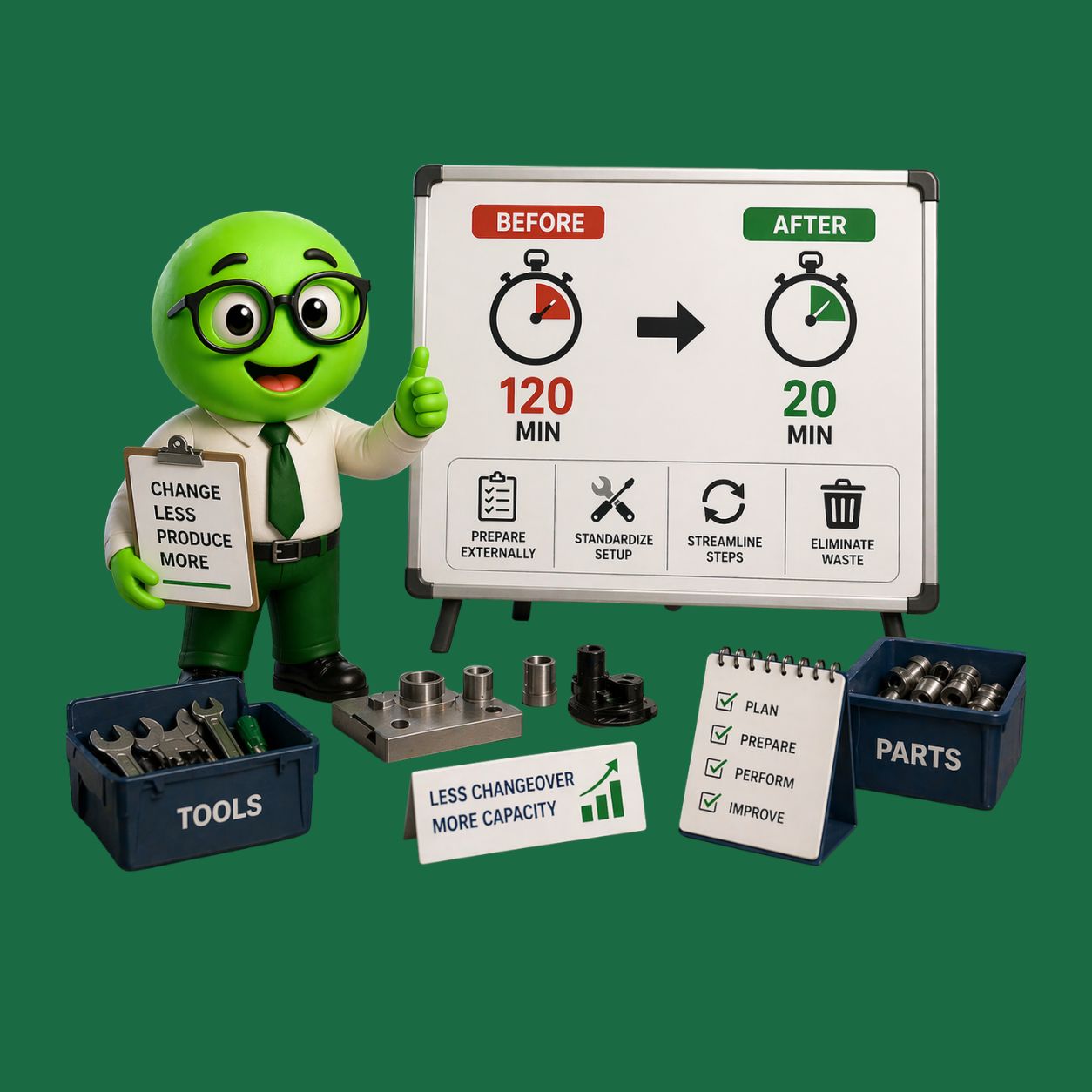

A pharma packaging line in Ahmedabad was spending 4.5 hours changing over between product batches. After a 3-month SMED project, the same changeover took 38 minutes. Output capacity increased by 35% — without adding a single machine or worker.
This is not an exceptional result. Across India’s manufacturing sector — from pharmaceutical fill-finish lines to chemical batch reactors, auto component pressing lines to food packaging machines — changeover time is one of the largest hidden sources of lost productivity. And SMED is the single most powerful tool to eliminate it.
SMED stands for Single Minute Exchange of Die — a lean manufacturing methodology developed by Shigeo Shingo that reduces machine setup and changeover time to under 10 minutes (single-digit minutes). In practice, even factories that do not reach the single-digit target typically achieve 50–80% reduction in changeover time — a transformation that has profound implications for capacity, flexibility, and profitability.
The SMED Principle in One Line: Anything that can be done while the machine is running should never be done while the machine is stopped. Anything that must be done while the machine is stopped should take the minimum possible time.
1. Why Changeover Time Matters More Than Most Indian Factories Realize
Traditional Indian manufacturing thinking treats changeover time as fixed and unavoidable — ‘that’s just how long it takes.’ But the hidden cost of changeover is enormous:
- Every hour of changeover = one hour of zero production, full operating cost
- Long changeovers force large batch sizes — because the changeover cost must be amortised over more units
- Large batch sizes mean more inventory, more WIP, longer lead times, and reduced flexibility to respond to customer orders
- In multi-product plants (common in Indian pharma and chemical factories), long changeovers are the primary bottleneck limiting production variety and order fulfilment speed
The relationship is powerful: a factory that reduces changeover time by 75% can produce the same quantity in smaller, more frequent batches — reducing inventory by 50–60%, improving delivery lead time, and increasing the ability to accommodate urgent customer orders.
2. The 4 Stages of SMED Implementation
| Stage | Name | What You Do | Expected Outcome |
| 1 | Observe & Document | Video-record the current changeover in its entirety. Time every element. List every task performed during the changeover. | Baseline data — the real picture, not the assumed one |
| 2 | Separate Internal vs External | Internal = tasks that can ONLY be done when machine is stopped. External = tasks that CAN be done while machine runs. Classify every task. | Typically 30–50% of ‘internal’ tasks are actually external and can be moved out immediately |
| 3 | Convert Internal to External | Move as many tasks as possible to External (pre-changeover and post-changeover). Prepare materials, tools, and settings while the previous batch is still running. | 20–50% reduction in changeover time from this step alone — with zero capital investment |
| 4 | Streamline All Activities | Improve both internal and external tasks: standardise fasteners, use quick-release clamps, pre-set tooling, create changeover kits, train dedicated changeover teams, implement visual management for settings. | Further 30–50% reduction. Total improvement often exceeds 70–90% from baseline |
3. SMED in Indian Industry — Sector-Specific Examples
| Industry | Typical Before SMED | Typical After SMED — What Changed |
| Pharmaceutical Packaging | 3–6 hours batch changeover on filling/packaging lines | 45–90 minutes — pre-kitted change parts, standardised cleaning verification, trained changeover teams |
| Chemical Batch Reactors | 8–12 hours vessel cleaning and product changeover | 2–4 hours — parallel cleaning protocols, pre-prepared charge materials, standardised inspection checklists |
| Auto Component Pressing | 90–180 minutes die change on mechanical presses | 8–22 minutes — dedicated die change trolleys, pre-set die heights, standardised clamping systems |
| Food & Beverage Filling | 2–4 hours product/packaging format changeover | 25–45 minutes — size part kits pre-staged, CIP pre-programmed, operator changeover checklists |
| Injection Moulding | 60–120 minutes mould change | 12–25 minutes — pre-heated moulds, standardised mould mounting, dedicated changeover technician |
4. Implementing SMED in an Indian MSME — Practical Guidance
Where to Start
Begin with your bottleneck machine — the machine that most limits your overall production output. SMED improvement here delivers the highest system-wide impact. Use OEE data if available; if not, spend one week observing and timing changeovers on your top 3 production lines.
The Changeover Video Analysis
Video-recording changeovers is the most powerful step. It reveals activities that operators and supervisors are completely unaware of — searching for tools, waiting for approvals, re-adjusting after a poor first setup, rework because the cleaning wasn’t completed properly. Most Indian factories that do this for the first time are genuinely shocked by what the video reveals.
Building the Changeover Team
SMED is not a one-person project. The highest-performing changeover implementations assign a dedicated changeover team — operators whose primary role during changeover is the changeover itself, with clear role assignments and a sequence card to follow. This replaces the typical Indian factory model where the machine operator does everything alone, often improvising.
Quick Wins Without Capital Investment
- Shadow boards for tools — everything has a designated place, nothing is searched for
- Changeover kits — all required parts, tools, and cleaning materials pre-staged before the machine stops
- Standardise fasteners — replace diverse bolt types with a single standard across all dies/moulds
- Pre-setting — adjust tool heights, temperatures, and pressures on the incoming setup before the machine stops
- Operator sequence cards — laminated visual step-by-step instructions at each machine
FAQs — SMED India
Q1: Does SMED require expensive equipment or automation?
No — this is one of the most common misconceptions. The majority of SMED gains come from organisational changes: separating internal and external activities, pre-staging materials, and standardising procedures. Capital investment (quick-release clamps, dedicated trolleys, pre-setting tools) adds further improvement but is not necessary for initial gains.
Q2: Is SMED applicable to Indian pharma factories where GMP must be maintained?
Yes — SMED is entirely compatible with GMP requirements. In fact, SMED often improves GMP compliance by standardizing changeover procedures, documenting cleaning verification steps, and reducing improvisation during changeover. Many Indian pharma factories have successfully implemented SMED within their GMP framework with Greendot’ s support.
Q3: How long does a SMED project typically take in an Indian factory?
A focused SMED project on one production line typically takes 8–12 weeks from observation to first implementation. Full-scale deployment across multiple lines takes 6–12 months. Immediate gains are typically visible within the first 4 weeks of the observation and classification stages.