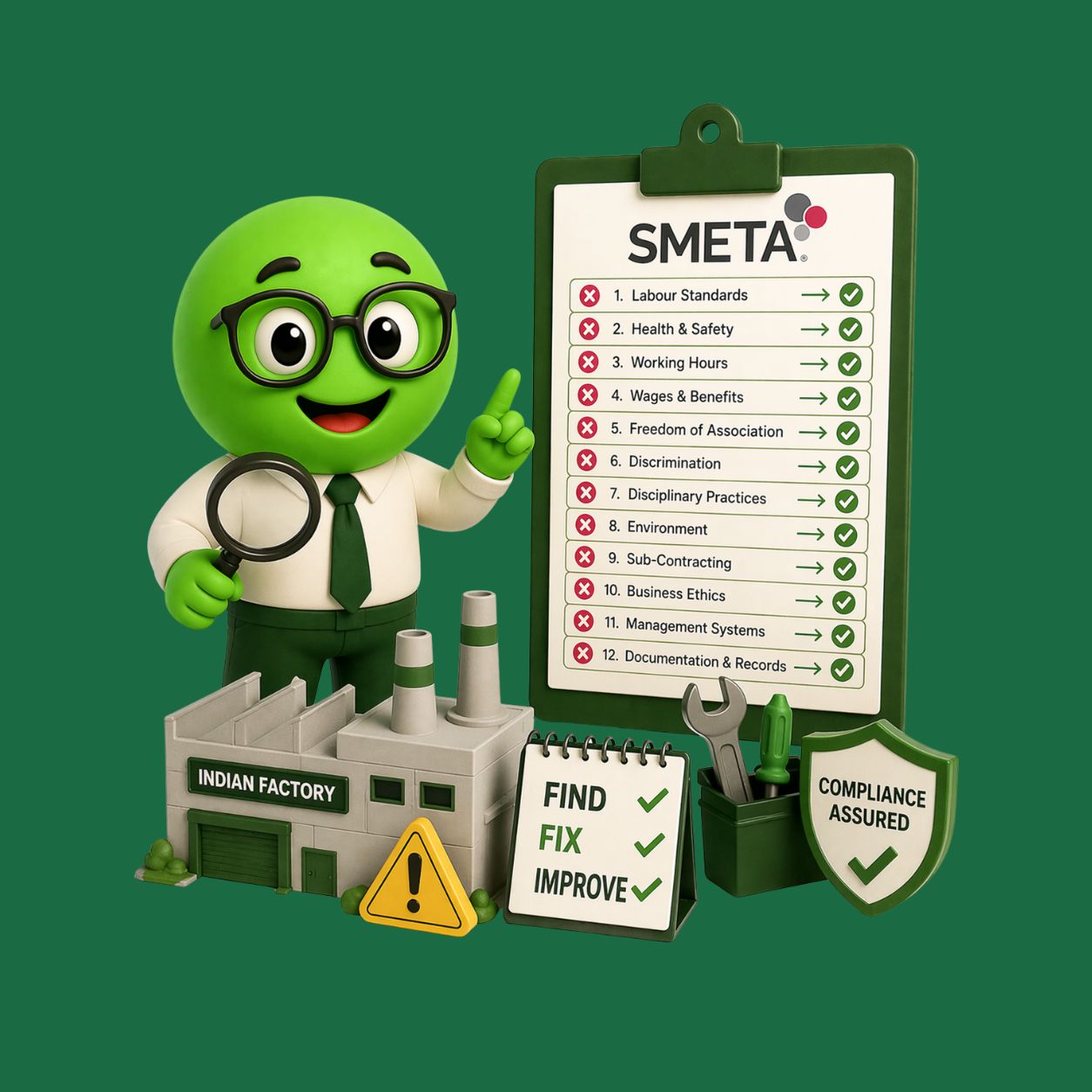

Every SMETA audit tells a story. And across hundreds of audits in Indian factories — from pharmaceutical plants in Hyderabad to chemical units in Vapi and engineering workshops in Pune — certain findings appear again and again.
These are not unique failures. They are systemic patterns rooted in how Indian manufacturing has traditionally operated: informal labor practices, paper-based documentation, reactive safety management, and compliance systems that exist on paper but not in practice.
Understanding the most common non-conformances before your audit is not just useful — it is the difference between passing on the first attempt and facing costly re-audits. This blog, based on Greendot Management Solutions‘ 25+ years of hands-on experience, documents the 12 findings we see most frequently — and exactly how to fix them.
How SMETA Non-Conformances Are Classified
Critical: Immediate risk to workers or a fundamental violation of human rights. Must be resolved before the audit report is accepted by buyers.
Major: Significant non-compliance with SMETA standards or local law. Must be corrected within 30–60 days.
Minor: A gap in implementation or documentation. Must be corrected within 90 days. CAR (Collaborative Action Required): A systemic issue requiring buyer-supplier cooperation to resolve (e.g., living wages, responsible recruitment).
Non-Conformance 1: Working Hours Exceeding Legal Limits
Severity: Major
Pillar: Labor Standards
What auditors find: Attendance records showing workers routinely working more than 9 hours per day or 48–54 hours per week (depending on state). Overtime records that are missing, unsigned, or show suspiciously round numbers. Workers who report working additional hours that are not recorded.
How to Fix It:
- Implement a biometric or electronic attendance system that automatically calculates daily and weekly hours
- Set a hard cap in your HR policy: no worker to exceed the legal limit without written individual consent
- Create an OT register with actual hours, rate paid, and worker signature — cross-check against payroll monthly
- Build a monthly working hours audit into your HR calendar — review before the cumulative violations become critical
Non-Conformance 2: Wages Below Minimum Wage or Incorrect OT Calculation
Severity: Major/Critical
Pillar: Labour Standards
What auditors find: Basic wages at or below the state minimum wage with no employer PF/ESI contribution factored in. Overtime calculated at basic rate rather than double rate as required under the Factories Act. Inconsistencies between what payslips show and what workers report receiving.
How to Fix It:
- Review every worker’s net take-home against the applicable state minimum wage — including all mandatory statutory deductions
- Recalculate OT at 2x the basic rate as required — and correct payslips retroactively if needed
- Issue itemised payslips to every worker every month — digital or paper, but detailed enough to verify compliance
- Conduct a wage compliance review every time the state government revises minimum wages (usually twice a year)
Non-Conformance 3: No Valid Written Employment Contracts for All Workers
Severity: Major
Pillar: Labor Standards
What auditors find: Permanent workers have contracts but contract labourers, temporary workers, and daily wage workers do not. Contracts exist but are unsigned, undated, or do not contain all required terms. Contracts are in English only, even when workers are not English literate.
How to Fix It:
- Issue formal appointment letters to every worker — permanent, contract, temporary, and trainee — on Day 1 of employment
- Contracts must be in a language the worker understands — Hindi, Gujarati, Tamil, or other applicable regional language
- Ensure contracts include: designation, pay structure, working hours, leave entitlement, notice period, and grievance mechanism
- Maintain a signed copy in the employee file and give the worker a copy of their own contract
Non-Conformance 4: Inadequate Fire Safety — Equipment, Exits, and Drills
Severity: Major/Critical
Pillar: Health & Safety
What auditors find: Fire extinguishers that are expired, discharged, or inaccessible. Emergency exits that are locked, blocked, or unmarked. Fire drills that were last conducted 18+ months ago or have no documentation. Workers who cannot identify the fire assembly point.
How to Fix It:
- Engage a licensed fire safety vendor for annual inspection and certification of all firefighting equipment
- Conduct fire drills minimum twice per year — document with date, attendees, duration, and any findings. File the records.
- Inspect all emergency exits monthly — lock-free, unblocked, clearly marked with glow-in-dark signage in local language
- Conduct a 5-minute fire safety briefing at every new worker induction — document it
Non-Conformance 5: No Functional Grievance Mechanism
Severity: Major
Pillar: Labor Standards
What auditors find: A grievance procedure exists in the policy manual, but there is no physical mechanism for workers to use it. No grievance register. Workers unaware that a grievance process exists. Workers afraid to raise complaints due to fear of management retaliation.
How to Fix It:
- Install a physical grievance box in a visible, accessible, neutral location — and give workers the key to deposit complaints anonymously
- Designate a named Grievance Officer who is not in the worker’s direct line of management
- Maintain a grievance register: complaint date, nature (not name), action taken, resolution date
- Communicate the grievance process during every induction and quarterly worker awareness session
- Ensure zero retaliation policy: workers must feel safe — auditors will probe this in confidential interviews
Non-Conformance 6: Machine Guarding Removed or Bypassed
Severity: Major/Critical
Pillar: Health & Safety
What auditors find: Guards removed from moving machine parts to allow easier access or faster production. Bypass switches taped over. Workers operating machinery without PPE. No lockout/tagout procedure for maintenance.
How to Fix It:
- Conduct a full machine guarding audit — identify every machine where guards have been removed or modified
- Reinstall all guards. If guards reduce production efficiency, engineer a solution — never the worker’s safety
- Implement a formal Lockout/Tagout (LOTO) procedure for all maintenance activities
- Post PPE requirements at every machine in local language — and enforce usage daily, not just on audit day
Non-Conformance 7: Incomplete or Falsified Records
Severity: Major/Critical
Pillar: Labor Standards
What auditors find: Attendance records with visible corrections or white-out. Wage registers with round numbers that don’t match any realistic calculation. Training records with the same handwriting throughout. Records that were clearly created recently for the audit.
How to Fix It:
- This non-conformance cannot be fixed retroactively. Prevention is the only solution.
- Implement digital record-keeping systems where corrections create audit trails rather than physical alterations
- Train HR staff that records must reflect reality — any discovered falsification results in Critical audit findings that buyers take extremely seriously
- If historical records are inaccurate, begin fresh from today — document the start date — and do not attempt to reconstruct fictional history
Non-Conformance 8: No Chemical Safety Data Sheets (SDS) or MSDS Accessible
Severity: Major
Pillar: Health & Safety / Environment
What auditors find: SDS documents exist but are filed in the manager’s office rather than at the point of use. SDS are in English only; workers speak Hindi, Gujarati, or other regional languages. Workers cannot explain what chemicals they work with or what to do in case of exposure. (Particularly common in pharma, chemical, and engineering factories.)
How to Fix It:
- Post the SDS for every chemical at the location where that chemical is stored or used
- Translate key safety information (hazards, first aid, disposal) into the working language of your factory
- Conduct quarterly chemical safety training — document with attendance sheet and worker signatures
- Maintain a chemical inventory register — every chemical onsite, quantity, SDS reference, and disposal method
Non-Conformance 9: Environmental Licenses Expired or Missing (4-Pillar)
Severity: Major/Critical
Pillar: Environment
What auditors find: Consent to Operate under Water/Air Act expired. Hazardous Waste Authorization from State Pollution Control Board not renewed. No ETP (Effluent Treatment Plant) records. Waste manifests missing. (Most common in chemical and pharma factories.)
How to Fix It:
- Create a licence renewal calendar — list every environmental licence with its expiry date and assign a renewal owner
- Set calendar reminders 3 months before each expiry — begin renewal process immediately
- Maintain all waste manifests for minimum 3 years — create a dedicated file for each waste type
- Ensure ETP/STP operation logs are maintained daily and are available for auditor review
Non-Conformance 10: No Anti-Bribery or Business Ethics Policy (4-Pillar)
Severity: Minor/Major
Pillar: Business Ethics
What auditors find: No formal Anti-Bribery and Corruption policy exists. The company has no Code of Conduct for employees. There is no defined process for managing gifts or hospitality from suppliers or customers. No whistleblowing mechanism exists.
How to Fix It:
- Draft a 1-page Anti-Bribery & Anti-Corruption Policy — signed by the MD, dated, posted on the notice board
- Create a simple Code of Conduct for employees covering: honesty, conflicts of interest, gifts, and reporting violations
- Establish a confidential reporting mechanism — even a dedicated email address or suggestion box suffices initially
- Train all management and purchase/sales staff on these policies annually
Non-Conformance 11: Sub-contractors and Labor Contractors Not Disclosed
Severity: Major
Pillar: Labor Standards / Business Ethics
What auditors find: The factory uses contract labor from a labor contractor but has no written agreement with the contractor. Contract workers are not included in the headcount or wage records. Sub-suppliers or home workers are used but have not been disclosed on the SEDEX platform.
How to Fix It:
- Maintain formal written contracts with all labour contractors — including their licence number, scope, wage rates, and compliance obligations
- Include all contract workers in your attendance and wage records — even if managed by a contractor
- Disclose all sub-suppliers and subcontractors in your SEDEX account under the facility details section
- Verify that your labor contractor complies with minimum wage and H&S requirements — you are responsible for their compliance within your premises
Non-Conformance 12: Workers Cannot Articulate Their Rights in Interviews
Severity: Minor/Major
Pillar: Labor Standards
What auditors find: Workers cannot state their basic pay, OT rate, or leave entitlements. Workers are unaware of the grievance mechanism. Workers report fear of raising complaints. Multiple workers give suspiciously identical answers — suggesting coaching. Workers from different departments or shifts give contradictory information.
How to Fix It:
- Conduct quarterly worker awareness sessions — minimum 30 minutes — covering wages, working hours, leave, grievance, H&S, and worker rights
- Post key information on all notice boards in local languages: shift timings, OT rate, minimum wage, leave calendar, emergency contacts
- Test your own system before the audit: ask 5 random workers to explain their grievance process — if they cannot, you have a gap
- Never coach workers — fix the actual conditions so workers can speak truthfully with confidence