
Why “How to Implement 5S” Is the Wrong Starting Question
Most articles on 5S implementation start by explaining what 5S is. This one won’t — because if you’re searching for implementation guidance, you probably already know what 5S stands for.
The more useful question is: why do most 5S programmes fail within six months of launch?
In over 25 years of implementing Lean Manufacturing and 5S systems across manufacturing plants in Gujarat, Maharashtra, and Rajasthan — in sectors ranging from chemicals and pharma to textiles and engineering — I have seen the same pattern repeat itself. Companies launch 5S with enthusiasm. The shop floor looks visibly better after the first Sort event. Leadership celebrates the photos. And then, gradually, the tools drift back to the wrong places. The red tags get ignored. The audit scores stop being tracked. Within a season, the workplace looks exactly as it did before.
This guide is written to help you avoid that outcome. It covers not just the five steps, but the timeline, the roles, the audit system, the common failure points, and what 5S actually looks like on an Indian shop floor — with real examples from plants we have worked with, including Atul Limited’s Valsad facility.
The Japanese Foundation: What the Five Words Actually Mean
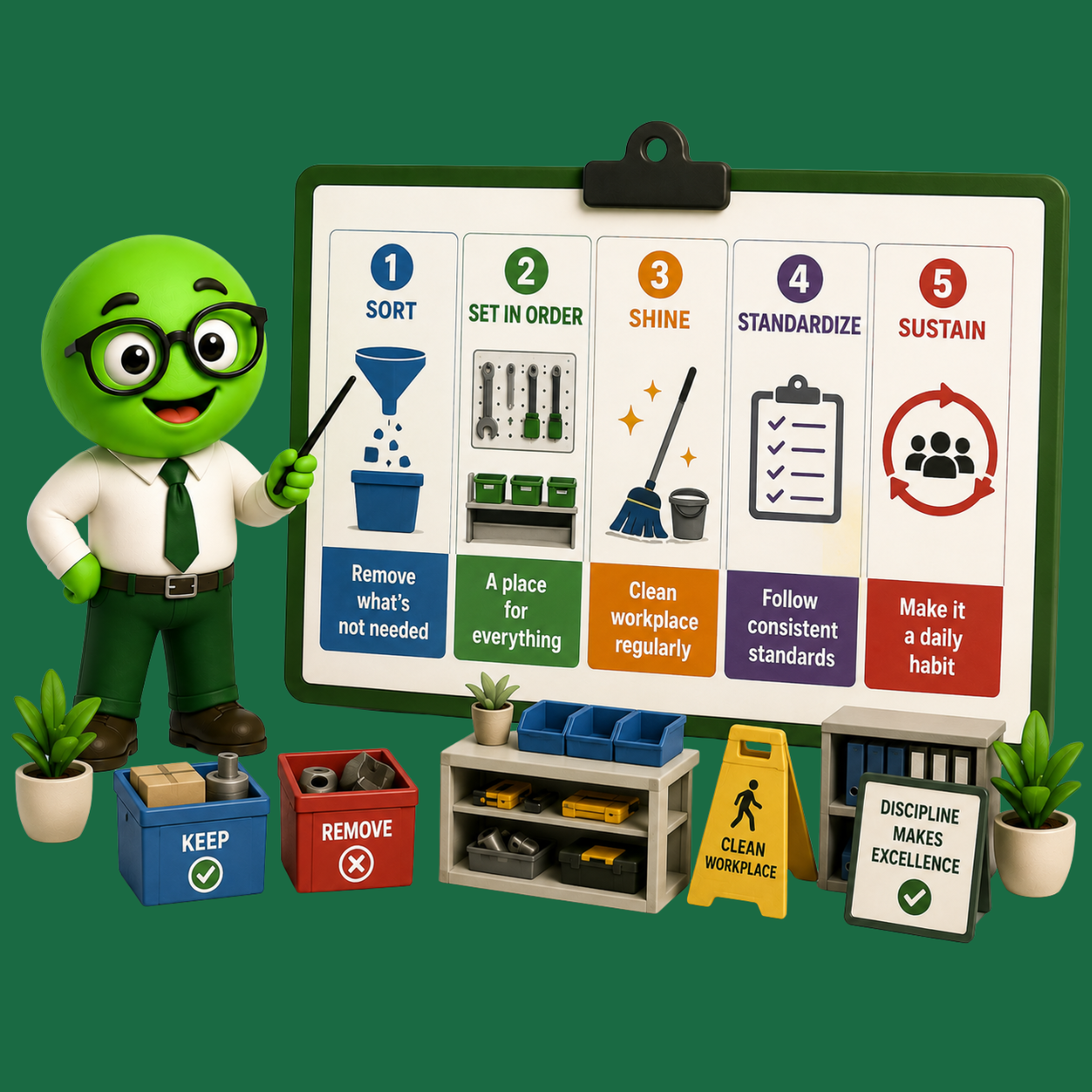
5S is rooted in five Japanese words. Understanding the original terms matters — not for academic reasons, but because each word carries a specific meaning that the English translations sometimes soften.
| Japanese Term | English Name | Literal Meaning | What It Actually Means in Practice |
|---|---|---|---|
| Seiri (整理) | Sort | “To organise / to put in order” | Remove everything from the workspace that is not needed for current work. Not “tidy it up” — physically remove it |
| Seiton (整頓) | Set in Order | “To arrange neatly” | Arrange what remains so that any item can be found and returned in under 30 seconds |
| Seiso (清掃) | Shine | “To clean / to sweep” | Clean the workplace thoroughly — and use the cleaning process as an inspection to detect problems early |
| Seiketsu (清潔) | Standardize | “To keep clean / to maintain cleanliness” | Create visual standards so that the first three S’s are maintained consistently across all shifts and all workers |
| Shitsuke (躾) | Sustain | “To discipline / to train” | Build habits and accountability systems so that 5S becomes the natural way of working, not a special event |
The word that is most commonly misunderstood in Indian manufacturing is Seiso. Most teams interpret “Shine” as a cleaning drive — sweeping the floor, wiping down machines. The deeper meaning is inspection through cleaning. When an operator cleans a machine with their own hands, they notice oil leaks, unusual vibrations, and loose fasteners that would otherwise go undetected. This is why 5S is the foundation step for TPM (Total Productive Maintenance) — it creates the conditions for operators to take ownership of their equipment.
Before You Begin: What a Non-5S Workplace Actually Looks Like
Implementation becomes easier when you can clearly see the problem you are solving. Here is what a typical manufacturing workplace looks like before 5S is introduced:
On the shop floor:
- Tools stored in no fixed location — workers spend 10–15 minutes per shift searching for the right spanner, jig, or measuring instrument
- Mixing of usable and defective parts in the same bin, leading to accidental use of defective material
- No visual separation between raw material, WIP, and finished goods zones
- Machine surfaces cluttered with items that belong elsewhere — lubricants, rags, spare parts, personal items
- Safety hazard zones unmarked or marked but ignored
In stores and inventory:
- Obsolete stock occupying floor space and hiding usable inventory
- No FIFO (First In, First Out) discipline — older stock buried under newer deliveries
- No visual minimum/maximum stock indicators
The cost of this disorganisation: It is not just the 10–15 minutes of search time per worker per shift. It is the defect that slips through because no one could find the right gauge. It is the machine breakdown that could have been caught during a proper cleaning round. It is the new employee who cannot figure out where anything goes, so they put things wherever is convenient. Over time, these small inefficiencies compound into significant operational losses.
5S addresses all of these — systematically, visibly, and sustainably.
Step-by-Step Implementation: The Five S’s in Depth
Step 1: Seiri — Sort (Remove the Unnecessary)
What it involves: The Sort step begins with a Red Tag event — a structured, time-bound exercise (typically 1–2 days) where every item in the target area is evaluated against one question: Is this item needed for the work done in this area, and if so, how often?
Items are classified and tagged:
- Keep in this area: Used daily or weekly, must be within arm’s reach
- Keep but relocate: Used monthly or less frequently — store in a central location
- Red-tagged (quarantine): Uncertain usefulness — moved to a designated Red Tag area for a defined evaluation period (typically 30 days)
- Dispose / sell / scrap: Not needed, not functional, or duplicated
What a Red Tag area is: A clearly demarcated holding zone — often a roped-off area near the exit — where red-tagged items are placed with their tag, the date they were tagged, and who tagged them. At the end of the evaluation period, items that no one has claimed are either sold as scrap, donated, or disposed of.
Common mistake at this step: Teams often sort within the clutter rather than removing items physically. “We’ll keep this here just in case” is the phrase that kills Sort. The discipline is to move items out first and reclaim them only with justification.
India-specific consideration: In many Indian factories, there is reluctance to red-tag items because workers worry about being held responsible for lost or disposed assets. This is a governance issue, not a 5S issue — and it should be resolved before the Red Tag event by clearly communicating that the process has management approval and that tagged items go to a quarantine zone, not the scrapyard.
What you should have at the end of Sort: A workplace where only items needed for current work remain in the work area. In most first-time implementations, this step alone recovers significant floor space — sometimes 10–20% of usable area.
Step 2: Seiton — Set in Order (A Place for Everything)
What it involves: Once the unnecessary has been removed, everything that remains needs a designated location — and that location needs to be logical, visual, and enforced.
The guiding principle: any person, including a new employee on their first day, should be able to find any item and return it to its correct location without asking anyone.
Practical tools used in this step:
- Shadow boards: Outlines of tools painted or marked on a board or pegboard, so the absence of any tool is immediately visible
- Floor markings: Coloured tape or paint defining zones (yellow for walkways, red for defect areas, blue for WIP, green for finished goods — conventions vary by plant)
- Labelled bins and shelves: Every bin has a label showing what goes in it, how much, and the minimum/maximum quantity
- Height and reach ergonomics: Most-frequently-used items at waist to shoulder height; less-used items lower or higher
What makes a good location decision: Frequency of use is the primary factor. Items used every hour should be within arm’s reach. Items used once a week can be in a nearby cabinet. Items used once a month can be in a central store. A common mistake is to organise by item category (all spanners together, all screwdrivers together) rather than by usage point — which means a worker doing a specific task still has to go to multiple locations.
India-specific consideration: In multi-shift operations (common in chemical plants, textile mills, and auto component units), Set in Order requires that the location system is visual enough that a worker coming in for the night shift can use it without any handover briefing. Bilingual labels (English + Hindi or English + Gujarati, depending on the region) significantly improve compliance in mixed-literacy workforces.
Step 3: Seiso — Shine (Clean to Inspect)
What it involves: This step is most commonly misunderstood as a cleaning drive. It is more accurately described as an inspection through cleaning exercise.
The structure:
- Assign specific cleaning responsibilities to specific people for specific areas — not “everyone cleans everything,” which means no one is accountable
- Set a cleaning frequency for each area and each piece of equipment
- During cleaning, actively look for: oil leaks, unusual wear, loose fasteners, cracks, missing guards, abnormal sounds or smells
- Document findings and raise maintenance requests immediately
Why this matters beyond cleanliness: A clean machine is easier to inspect visually. Leaks are visible on a clean surface; they are hidden on a dirty one. Cracks are visible on painted, clean metal; they disappear in grime. This is why the Shine step is the entry point into autonomous maintenance under TPM Consulting — operators who clean their own machines start to understand their machines, and that understanding is the foundation of equipment reliability.
What you should produce at the end of Shine: A cleaning responsibility matrix for each area (who cleans what, when, using what materials), a list of defects/abnormalities discovered during the first cleaning round (these become maintenance work orders), and a baseline cleanliness standard documented with photographs.
Step 4: Seiketsu — Standardize (Make It the Default State)
What it involves: The first three S’s get you to a good state. Standardize ensures that this state is maintained consistently — across shifts, across employees, and over time.
Without Standardize, 5S is an event. With Standardize, it becomes a system.
What standardization looks like in practice:
- Visual SOPs at each workstation: Not a binder in an office — a laminated one-page visual procedure at the point of use, showing the correct state of the workstation
- Checklists: Simple, visual checklists that workers complete at the start and end of each shift to confirm the workstation is in the correct state
- 5S audit forms: A scoring system (typically 0–4 or 0–5 per S, for a total out of 20 or 25) that is used by team leaders or a 5S committee to assess compliance on a regular basis
- Photographic standards: Before/after photographs posted at the workstation showing exactly what “correct” looks like
The 5S Audit Scoring Framework (simplified):
| Score | Criteria |
|---|---|
| 0 | No evidence of this S being applied |
| 1 | Some effort visible but inconsistent |
| 2 | Partially applied, significant gaps remain |
| 3 | Mostly applied, minor gaps |
| 4 | Fully applied and visually verifiable |
| Total per S: 0–4. Total for 5S: 0–20 |
Audit frequency: Weekly during the first 3 months of implementation. Monthly once the system is established. Quarterly as a formal management review.
Step 5: Shitsuke — Sustain (Build the Habit)
What it involves: Sustain is where most 5S programmes fail. The reason is almost never that people don’t understand 5S — it is that the organisation has not built the accountability structures to make 5S the path of least resistance.
What sustaining 5S requires:
- Leadership visibility: When senior managers and plant heads are seen participating in audits and acting on findings, the signal to the workforce is clear. When they stop, the workforce notices.
- Consequence management: 5S audit scores should be visible, team-by-team, on a public board. Consistently low-scoring areas need investigation — not punishment, but problem-solving (is the standard unclear? Is there a layout issue? Is there a shift-specific problem?)
- Recognition: Teams that maintain consistently high scores deserve public recognition. This does not have to be financial — a monthly 5S champion board, a mention in the plant meeting, a small certificate are often sufficient.
- Continuous improvement integration: 5S is not a one-time project. Each audit cycle should generate at least one improvement idea per area. Connect this to Kaizen implementation.
The honest reality of Sustain in Indian manufacturing: The biggest challenge is not resistance from operators — it is inconsistency from middle management. When a supervisor tells their team “we have an audit today, let’s clean up,” they are treating 5S as a performance for the auditor rather than a standard for the workplace. When this happens repeatedly, operators learn that 5S is optional on non-audit days. The solution is random audits (unannounced, by a cross-functional team) rather than scheduled ones.
5S Implementation Timeline: What to Expect and When
This is the timeline we follow at GreenDot for a typical manufacturing plant implementation. Timings vary based on plant size, existing baseline, and management commitment.
| Phase | Duration | What Happens | Key Milestone |
|---|---|---|---|
| Preparation | 2 weeks | Management alignment, 5S committee formation, baseline photography, pilot area selection | 5S charter signed by plant head |
| Training | 1–2 days | All employees in pilot area trained on 5S concepts, roles, and audit system | Everyone knows what is expected of them |
| Sort (Red Tag Event) | 1–2 days | Red Tag event in pilot area; quarantine zone established | Floor space recovered; list of red-tagged items created |
| Set in Order | 1–2 weeks | Locations defined, shadow boards made, floor marking done, labels applied | Visitor test passed — anyone can find anything in 30 seconds |
| Shine | 3–5 days | First deep clean + inspection; cleaning responsibility matrix created | Defect/abnormality list generated; cleaning schedule posted |
| Standardize | 2–3 weeks | SOPs written, audit forms designed, checklists posted, baseline photos taken | First formal audit completed with scores recorded |
| First audit cycle | End of month 1 | Pilot area audit; results shared publicly; improvement actions assigned | Audit scores visible on the factory board |
| Expand to next area | Month 2–3 | Pilot area team becomes internal trainers for next area | Rollout gaining momentum without full dependency on consultant |
| Plant-wide rollout | Month 3–6 | All areas complete at least one full cycle | Entire plant has a baseline 5S score |
| Sustain phase | Month 6 onwards | Monthly audits, quarterly management review, continuous improvement integration | 5S is part of daily management, not a separate project |
Roles and Responsibilities: Who Does What in a 5S Programme
One of the most common reasons 5S fails is that no one is clearly accountable. Here is the minimum role structure needed for a functioning 5S programme.
| Role | Who Holds It | Responsibilities |
|---|---|---|
| 5S Champion / Steering Lead | Senior Manager or Plant Head | Sets direction, secures resources, reviews monthly audit results, removes organisational barriers |
| 5S Coordinator | A dedicated person (part-time or full-time depending on plant size) | Plans and schedules audit cycles, maintains documentation, tracks improvement actions, coordinates training |
| Area 5S Leader | Team Leader or Supervisor for each zone | Responsible for daily 5S compliance in their area, conducts weekly self-audits, raises issues to coordinator |
| Operators | All shop floor employees | Follow 5S standards at their workstation, participate in cleaning routines, raise improvement ideas |
| Auditor Team | Cross-functional team (Production, Quality, Maintenance, Safety) | Conducts monthly audits, scores each area, provides improvement recommendations |
In smaller plants (fewer than 50 workers), the 5S Champion and Coordinator can be the same person, and the audit team can be just two or three people who rotate the responsibility.
5S in Practice: Industry-Specific Applications in Indian Manufacturing
5S looks different in different industrial environments. Here is what the key implementation considerations are across the sectors GreenDot works in most frequently.
Chemical and Process Industry (Gujarat: Vapi, Ankleshwar, Dahej)
The primary 5S priority in chemical plants is safety through organisation. Misplaced chemicals, unlabelled containers, and blocked emergency exits are not just productivity problems — they are regulatory and safety hazards. In chemical plant 5S:
- Hazardous material storage must comply with MSDS (Material Safety Data Sheet) requirements — 5S labelling should incorporate hazard classification
- Spill kits, fire extinguishers, and first aid equipment are given fixed, clearly marked locations as a non-negotiable first priority
- Seiso (Shine/Inspect) is particularly important — regular cleaning exposes leaks, corrosion, and seal failures before they become incidents
Textile Manufacturing (Surat, Ahmedabad, Rajkot)
In textile operations, the challenge is managing a large volume of materials (yarn, fabric, dyes, accessories) in often space-constrained environments:
- Colour-coded storage zones for different yarn types or fabric counts
- FIFO enforcement is critical — older dye lots must be consumed before newer ones to prevent colour variation in output
- Loom-side organisation (tools, shuttle stocks, templates) using shadow boards adapted for the specific loom type
Auto Components and Engineering (Pune, Rajkot, Ahmedabad)
- Tool shadow boards are the most impactful quick win — changeover time drops significantly when tools have fixed, visual locations
- WIP (Work in Process) zone management with clear quantity limits prevents overproduction build-up on the shop floor
- Gauge and measuring instrument management under Sort and Set in Order reduces the risk of unverified instruments being used in quality-critical operations
Pharmaceuticals (Ahmedabad, Baddi, Ankleshwar)
5S aligns closely with GMP (Good Manufacturing Practice) requirements:
- Documentation discipline under Standardize maps directly to GMP record-keeping requirements
- Dedicated gowning zones, equipment cleaning validation, and cross-contamination prevention are natural extensions of the Shine step
- 5S audit scores can be incorporated into internal GMP audits, creating a single compliance review cycle
Real Implementation: What Happened at Atul Limited, Valsad
Atul Limited, one of India’s leading specialty chemicals companies, engaged GreenDot for a Lean and 5S programme at their Valsad manufacturing facility.
The 5S implementation at the Anisole plant was part of a broader productivity improvement initiative. When the Sort and Set in Order steps exposed the actual process flow — physically, on the shop floor — the team identified that one of the process inputs (a byproduct from an adjacent process) was being manually handled and disposed of, when it could be redirected as a saleable input to the Anisole process.
The combined result of the 5S-driven process redesign was significant: production output in the Anisole plant increased from 67 kg per hour to 150 kg per hour, and the reorganised process required eight fewer operators than the previous layout.
This is the point that most generic 5S articles miss: Sort and Set in Order, done rigorously, often reveal process improvement opportunities that are invisible when the workplace is cluttered. The physical organisation of a workplace is a map of its process logic — and when that map is wrong, the losses are hiding in plain sight.
A senior engineer at Atul Limited noted in their feedback: “5S is not only housekeeping improvement — it helps in many other areas: productivity, inventory, money generation by identifying unwanted items, motivation, and many more.”
Why 5S Programmes Fail: The Honest List
Based on 25 years of implementations across Gujarat, Maharashtra, and Rajasthan, here are the most common reasons 5S consulting programmes in Indian manufacturing plants do not stick:
1. Treating Sort as a one-time cleaning drive The Sort step should produce a Red Tag register and a quarantine zone. When teams do a single “big clean” without the Red Tag system, there is no mechanism to actually remove items — they just get moved to a slightly better location within the same space. Within weeks, the area reverts.
2. No fixed ownership “Everyone is responsible for 5S” means no one is. Without a named 5S Area Leader for each zone, accountability is diffuse and compliance is inconsistent.
3. Scheduling audits rather than conducting random audits When audit dates are announced in advance, teams do a last-minute cleanup before the auditor arrives. The audit score reflects one day’s effort, not the daily standard. Unannounced cross-functional audits are far more revealing and far more effective at driving genuine compliance.
4. Middle management does not participate In many plants, 5S is seen as “an operator thing.” Supervisors and team leaders who do not actively participate — and who allow shortcuts — signal to their teams that 5S is optional. When the plant manager’s office is not 5S-compliant, the message to the shop floor is clear.
5. Sustain has no system — only intention “Let’s maintain this” is not a Sustain plan. Sustain requires: an audit schedule, a scoring system, a public display of scores, an action-tracking register, and a recognition mechanism. Without these, the intention fades within weeks.
6. 5S is launched without connecting it to the work people actually do When operators see 5S as an additional burden — something they do after their “real work” — it will always be deprioritised under production pressure. 5S must be presented and experienced as something that makes the real work easier, faster, and less frustrating. The time saved finding tools is time that does not feel like extra work.
7. Contract labour turnover is not managed In plants with high contract worker turnover (common in textile, packaging, and construction materials sectors), new workers arrive regularly with no 5S training and no understanding of the visual standards. A 5S programme that does not include an onboarding orientation for new workers will gradually erode as the workforce changes.
5S vs. 6S: Should You Add Safety as the Sixth S?
Some organisations implement a 6S system, adding Safety as the sixth element. Here is the practical comparison:
| 5S | 6S | |
|---|---|---|
| Origin | Toyota Production System | Adapted from 5S, particularly in Western manufacturing and high-hazard industries |
| Safety coverage | Safety is addressed within Sort (removing hazards), Shine (identifying hazards through cleaning), and Standardize (visual hazard markings) | Safety is made an explicit, separately audited element |
| When to use 5S | Most manufacturing environments where safety is managed through a separate EHS system | — |
| When to use 6S | — | High-hazard industries (chemicals, construction, heavy engineering) where safety discipline needs explicit reinforcement alongside housekeeping |
| Our recommendation for Indian SMEs | Start with 5S. Add the explicit Safety element once the 5S audit system is functioning — typically after 6–12 months | — |
For plants pursuing ISO 45001 (Occupational Health and Safety Management), a 6S approach aligns naturally with the standard’s requirements for hazard identification and risk control.
5S and Its Relationship to Other Lean Tools
5S is most powerful when it is not implemented in isolation. Here is where it sits in the broader Lean Manufacturing ecosystem:
5S is the foundation for TPM (Total Productive Maintenance): Autonomous Maintenance — where operators clean, inspect, and maintain their own equipment — is only possible when operators have taken ownership of their workspace through 5S. Without Seiso (cleaning as inspection), operators do not develop the intimate familiarity with their machines that makes TPM Consulting effective.
5S enables Kaizen: Kaizen improvement events require a stable baseline. When a workplace is disorganised, it is difficult to distinguish between a process problem and a housekeeping problem. 5S creates the stable, visible baseline that makes process improvement visible and measurable. We usually recommend starting with 5S to create the foundation, then layering Kaizen implementation on top so improvements actually stick.
5S supports ISO 9001 compliance: Document control, process standardization, and workplace organisation are all requirements that map to ISO 9001 clauses. A well-implemented 5S programme produces much of the evidence required for a QMS ISO 9001 audit — visual work instructions, checklists, calibrated instrument locations, and defined storage of records.
5S Audit Checklist: A Simplified Assessment Tool
Use this to conduct a quick self-assessment of your current state. Score each item 0 (not done), 1 (partial), or 2 (fully done).
Sort (Seiri)
- Only items needed for current work are present in the work area
- A Red Tag process exists and has been used recently
- There are no unneeded items, expired materials, or broken tools in the work area
Set in Order (Seiton)
- Every item has a designated location, clearly marked
- Items are returned to their location after use
- Any new employee could find any item without asking
Shine (Seiso)
- Cleaning responsibility is assigned by name, not by department
- Cleaning is used as an inspection activity (abnormalities are logged)
- Equipment and work surfaces are visibly clean at the start and end of each shift
Standardize (Seiketsu)
- Visual standards (photos or diagrams) are posted at each workstation
- Checklists exist and are completed each shift
- 5S audit scores are tracked and publicly displayed
Sustain (Shitsuke)
- Audits are conducted regularly (at minimum monthly)
- Audit results lead to documented action items with owners and deadlines
- 5S performance is reviewed in regular management meetings
Score: 0–10: Significant gaps. 11–20: Partially implemented. 21–26: Well-established. 27–30: Excellence.
Frequently Asked Questions
What is the difference between 5S and regular housekeeping? Housekeeping is cleaning. 5S is a management system. The difference is accountability, standardization, and sustainability. A housekeeping team cleans the workplace; 5S creates a system so that every employee maintains their own workspace to a defined standard, every day, without being asked.
How long does it take to implement 5S in a manufacturing plant? A pilot area (one department or production line) can show visible results within 2–4 weeks. Plant-wide implementation — where all areas have completed at least one full 5S cycle and the audit system is functioning — typically takes 3–6 months. True habit formation, where 5S is simply how the workplace operates, takes 12–18 months of consistent management engagement.
Can 5S be implemented in a small factory with fewer than 50 workers? Yes — and smaller plants often achieve results faster because communication is simpler and management can be directly involved. The core 5S structure (Sort, Set in Order, Shine, Standardize, Sustain) works regardless of factory size. The roles can be simplified — one person can be both 5S Champion and Coordinator in a small unit.
Does 5S require expensive equipment or special tools? No. The primary investment is time — specifically, management time and operator time during the Sort and Set in Order phases. Physical materials (coloured tape for floor markings, labels, shadow board materials) are minimal in cost. The total material cost for a pilot area implementation is typically in the range of ₹5,000–₹25,000 depending on the size of the area and the complexity of the tool organisation.
What is a Red Tag event and how long does it take? A Red Tag event is a structured, time-bound exercise — typically 1–2 days — where every item in a target area is evaluated and tagged as “keep,” “relocate,” or “quarantine.” Red-tagged items are moved to a designated holding zone and evaluated over a 30-day period before a disposal or relocation decision is made. It is not the same as throwing things away — it is a controlled process for making intentional decisions about what belongs where.
Why does 5S fail in most Indian plants within six months? The most common reason is the absence of a functioning Sustain system — specifically, the lack of random audits, public score tracking, and management accountability. When 5S is treated as a project with a start date and an end date rather than as an ongoing management standard, it naturally fades once the initial momentum is gone. The solution is to embed 5S audit scores into the regular management review cadence from the very beginning.
What is the difference between 5S and 6S? 6S adds Safety as an explicit sixth element. In a standard 5S implementation, safety is embedded within several steps (removing hazardous items during Sort, identifying hazards during Shine, marking danger zones during Set in Order). 6S makes safety a separately scored and audited element, which is appropriate for high-hazard industries or organisations pursuing ISO 45001 certification.
How does 5S relate to ISO 9001 certification? 5S is not a requirement of ISO 9001, but it creates many of the conditions that ISO 9001 auditors look for — documented procedures, visual work instructions, controlled storage of measuring instruments, and evidence of workplace organisation. Plants with a functioning 5S system typically find QMS ISO 9001 audits significantly easier to prepare for.
How do you manage 5S with contract workers who change frequently? This is a real challenge in Indian manufacturing. The solution is a short (30–60 minute) 5S orientation for every new worker before they begin work, combined with a highly visual workplace where the standards are obvious without verbal instruction. Shadow boards, floor markings, and labelled storage are particularly important in high-turnover environments because they communicate the standard visually, in any language.
What should the first step be for a plant that has never done 5S before? Start with a management walkthrough — a structured observation of the current state, with photographs and notes, covering every area of the plant. This creates a documented baseline and often generates enough visible evidence of waste and inefficiency to create genuine management commitment to the programme. The walkthrough should be followed by a one-day awareness training for all employees, and then the launch of a pilot in one well-defined area.
Next Steps: Working with GreenDot on Your 5S Implementation
GreenDot Management Solutions has been implementing Lean and 5S consulting systems across Gujarat, Maharashtra, and Rajasthan for over 25 years. Our team of 40 consultants operates from four branch offices across Gujarat, with on-site availability for plants across the Western India manufacturing corridor.
Our clients in 5S implementation include Atul Limited, Castrol, Pidilite, UPL, AYM Syntex, Haldyn Glass, Linde India, and many more across chemicals, textiles, engineering, pharma, packaging, and port logistics.
We offer:
- Free 5S consultation to assess your current state and define a realistic implementation roadmap
- Hands-on implementation support — we work alongside your team, not just advise from a distance
- 5S Train the Trainer programmes so your internal team can sustain and expand the programme independently
- 5S auditing services for plants that have self-implemented and want an external assessment