
A mid-size engineering components manufacturer in Rajkot was simultaneously experiencing two problems that seemed contradictory: critical raw materials running out and causing production stoppages, while their warehouse was overflowing with finished goods no one had ordered. The planning manager was scheduling based on forecasts. The warehouse team was building safety stock. And the result was waste and stockouts at the same time.
The root cause was a push-based production system — where every upstream process pushes material to the next stage regardless of what downstream actually needs. The solution was Kanban: a demand-driven pull system where production is triggered only by actual consumption, not by forecasts or schedules.
Kanban (Japanese: ‘signboard’ or ‘visual card’) is a lean inventory and production management system developed by Taiichi Ohno at Toyota in the 1950s. It is one of the most practical and immediately impactful lean tools available to Indian MSMEs — requiring minimal technology investment but delivering significant reductions in inventory, production stoppages, and working capital.
The Kanban Principle:
Nothing is produced or moved until a downstream signal requests it. The signal is the Kanban — a card, bin, or electronic signal — that authorises production or replenishment of exactly the quantity that was consumed.
1. Push vs. Pull — Understanding the Core Difference
| Aspect | Push System (Traditional) | Pull System (Kanban) |
| Trigger for production | Forecast or production schedule | Actual consumption — downstream demand |
| Inventory tendency | Over-production and excess WIP between stages | Minimal WIP — only what is authorised by Kanban |
| Response to demand change | Slow — schedule must be revised | Fast — Kanbans automatically adjust with actual demand |
| Visibility of problems | Problems hidden by excess inventory buffer | Problems become visible immediately — inventory is not a buffer |
| Working capital | High — inventory tied up throughout the system | Lower — inventory matched to actual need |
| Common in India | MRP/ERP schedule-based production in most MSMEs | Implemented by lean-mature factories; growing rapidly |
2. The Two Most Common Kanban Systems for Indian MSMEs
2.1 Two-Bin Kanban (Simplest — Recommended Starting Point)
Two-bin Kanban is the easiest Kanban system to implement and is ideal for most Indian MSME production and stores environments. It requires no technology — just two containers per item.
- Bin 1 (Active): The working supply of a component or raw material. Consumed first.
- Bin 2 (Reserve): The replenishment supply — contains exactly the quantity needed during the replenishment lead time plus a small safety stock.
- When Bin 1 is empty, it is sent to stores or the supplier as a replenishment signal. Bin 2 becomes the new active bin.
- When replenishment arrives, it fills the empty bin — restoring the system to two full bins.
- Result: you never run out, and you never hold more than you need.
2.2 Card Kanban (For Higher-Complexity Lines)
Card Kanban uses physical cards (or electronic signals in digital systems) attached to containers or pallets. When a container is consumed, the card is moved to a replenishment board or sent upstream as a production authorisation. This system provides:
- Production Kanban: authorises the upstream process to produce a specific quantity
- Withdrawal Kanban: authorises movement of material from stores to the production line
- Supplier Kanban: triggers a delivery from an external supplier
3. Calculating Kanban Quantity — The Formula
The number of Kanban cards (or containers) required for each component is calculated as:
Kanban Formula:
Number of Kanbans = (Daily demand × Lead time in days × (1 + Safety factor)) ÷ Container quantity
Example:
Daily demand = 200 units | Lead time = 2 days | Safety factor = 20% | Container size = 100 units
Number of Kanbans = (200 × 2 × 1.20) ÷ 100 = 4.8 → Round up to 5 Kanban cards
This means: 5 containers of 100 units each circulate in the system. No more, no less. Maximum inventory = 5 × 100 = 500 units. This is your authorized inventory level — any more is waste.
4. Implementing Kanban in an Indian Factory — Step by Step
- Select the pilot area: choose one production line or one group of components. Do not implement Kanban factory-wide on Day 1.
- Analyse demand and lead time data: collect 3 months of actual consumption data and supplier/internal lead time data for the selected items.
- Calculate Kanban quantities using the formula above. Start with a conservative safety factor (20–30%) — reduce it as the system matures.
- Design and create the physical Kanban: bins, cards, or signals. Colour-code by material type. Label clearly with part number, description, quantity, and source.
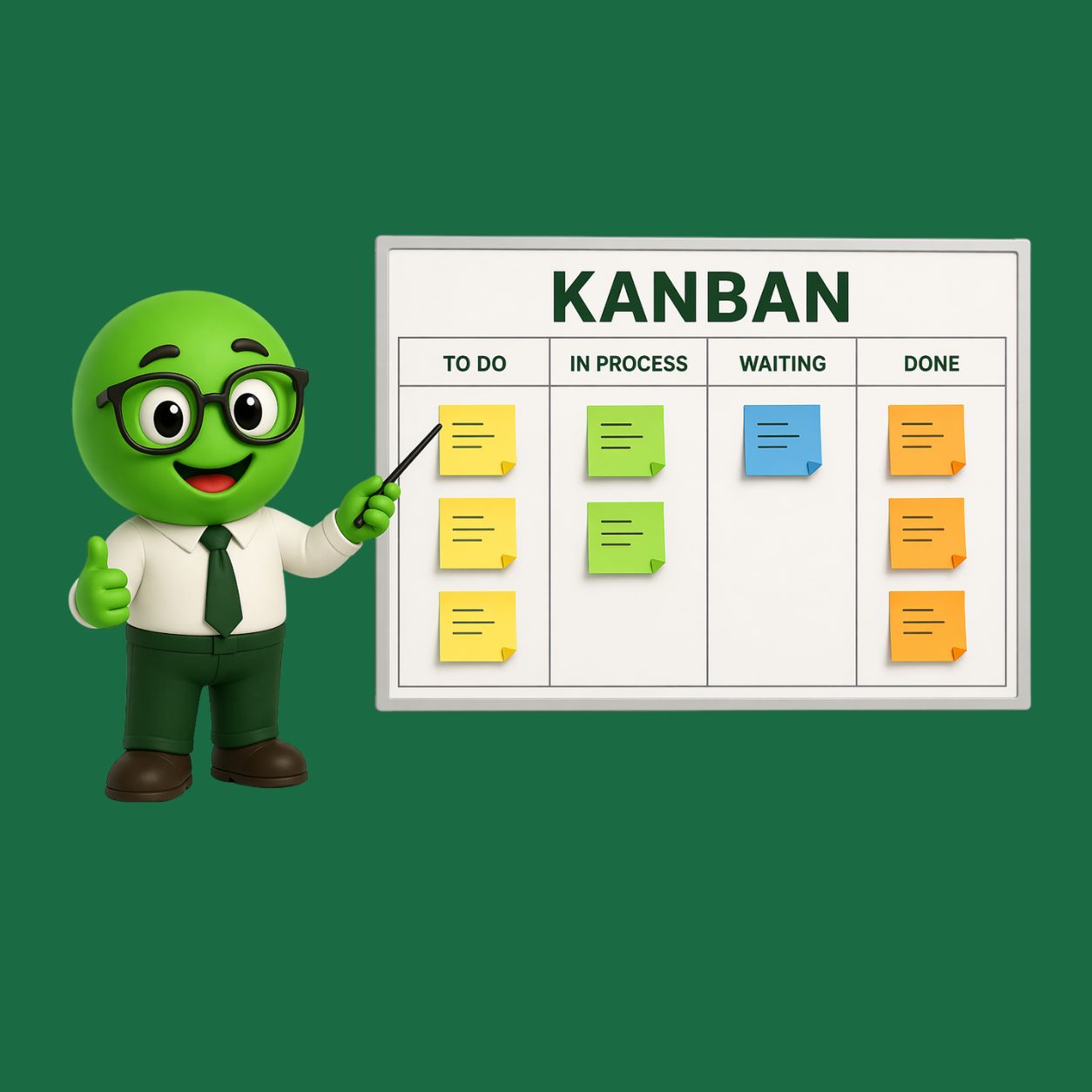
- Create the Kanban board: a visual board at each replenishment point that shows which Kanbans are active, which are in replenishment, and which are overdue.
- Train all operators, stores staff, and supervisors: everyone must understand the Kanban rules — consume Bin 1 before Bin 2; send the empty Kanban signal immediately; never override the system by pulling extra stock ‘just in case’.
- Run the pilot for 4–6 weeks: observe how the system performs. Adjust quantities if frequent stockouts or excess inventory appears. Document learnings.
- Expand to additional lines and components once the pilot is stable.
5. Common Kanban Implementation Mistakes in Indian Factories
| Mistake | How to Avoid It |
| Setting Kanban quantities based on forecast rather than actual demand | Use 3 months of actual consumption data — not the sales forecast which may include optimistic projections |
| Overriding the system ‘just in case’ — pulling extra stock outside Kanban authorization | Strict discipline: the Kanban signal is the only authorization to replenish. Extra pulling destroys the system’s integrity |
| Too many SKUs in the first implementation | Start with 10–20 high-velocity items in one area. Master the system with these before expanding |
| Kanban sizes too large — effectively continuing to overstock | Container size should match approximately 1–2 days of consumption, not 1–2 weeks |
| Not reviewing and adjusting Kanban quantities quarterly | Demand changes seasonally — Kanban quantities must be updated to reflect actual current demand, not past averages |
FAQs — Kanban India
Q1: Can Kanban work alongside our existing ERP/MRP system?
Yes — Kanban and ERP are complementary. ERP handles demand planning, procurement, and financial transactions. Kanban controls the physical flow on the shopfloor in real time. In most Indian factories, the ERP generates long-range procurement plans while Kanban manages day-to-day production replenishment. The two systems coexist without conflict when boundaries are clearly defined.
Q2: Is Kanban suitable for Indian pharma factories with batch production?
Yes — Kanban is widely used in pharmaceutical packaging and materials management, even in batch environments. Raw material staging (using two-bin Kanban for excipients and packaging materials) and finished goods replenishment Kanban are common applications. Kanban does not apply to batch reactor scheduling directly, but it transforms the material flow around the batch process.
Q3: How much inventory reduction can we expect from Kanban?
In Indian MSME implementations, Greendot Management Solutions typically sees 30–50% reduction in raw material and WIP inventory within 6 months of Kanban implementation. The exact reduction depends on initial inventory levels, lead time variability, and the discipline of system adherence. Working capital reduction is typically the most directly measurable financial benefit.