
What Is ISO 9001? Complete Guide to ISO 9001:2026 for Indian Manufacturers
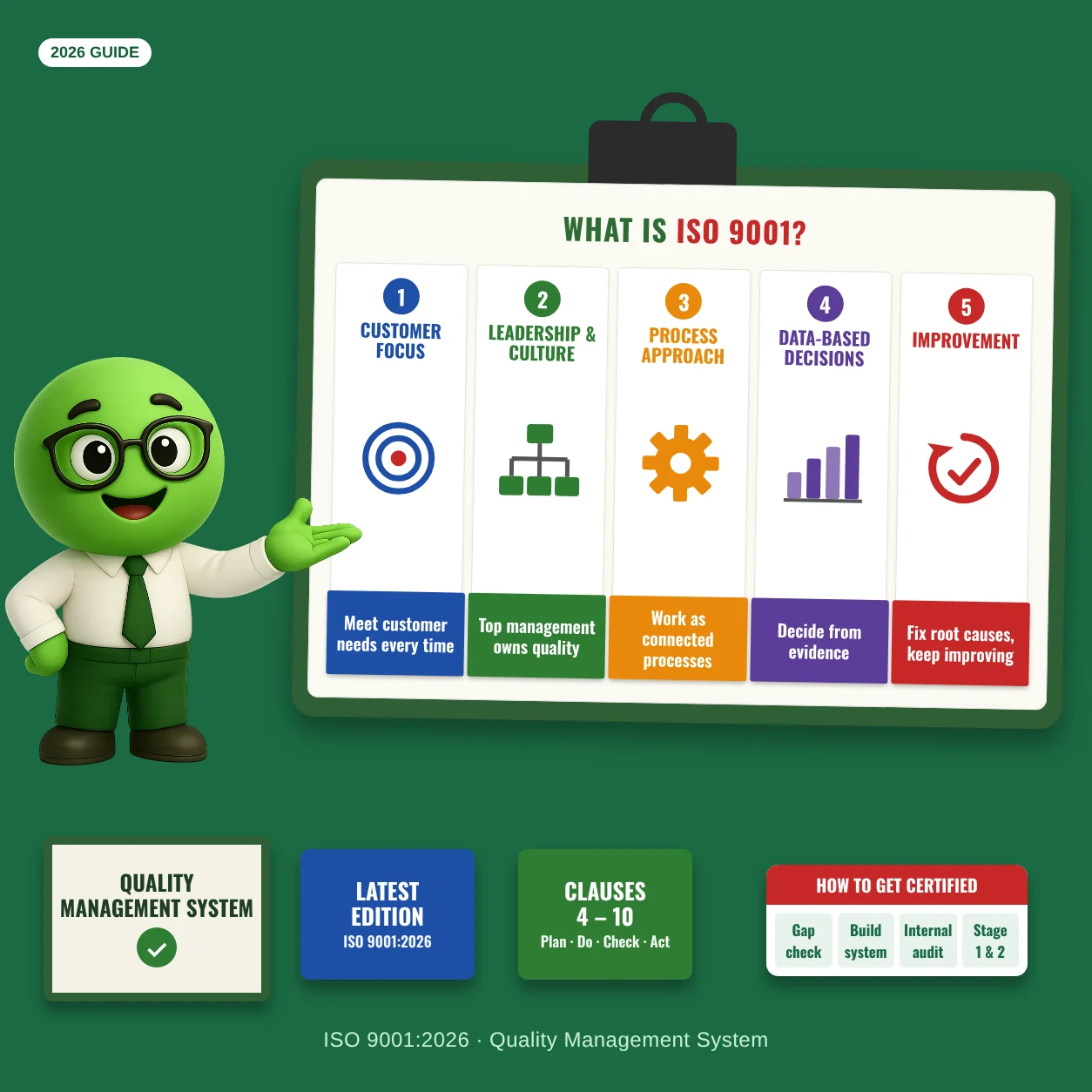
ISO 9001 is the international standard for quality management systems (QMS). It tells a company what it must do to deliver products and services that consistently meet customer and legal requirements — and to keep improving. It is published by the International Organization for Standardization (ISO); the latest edition is ISO 9001:2026, published in September 2026. Companies get certified by an accredited certification body after an audit, and more than a million organisations worldwide hold an ISO 9001 certificate.
ISO 9001 full form and meaning
- ISO = International Organization for Standardization, the global body (based in Geneva) that publishes international standards. The short name comes from the Greek ‘isos’ (equal).
- 9001 = the number of the standard within ISO’s quality family (ISO 9000 explains the terms; ISO 9001 contains the requirements you get certified to).
- QMS = Quality Management System — the way your company plans, runs, checks and improves its work so quality is consistent.
Editions of ISO 9001
| Edition | What it brought |
|---|---|
| 1987 | First edition |
| 1994 | Revision of the first edition |
| 2000 | Process approach and customer focus |
| 2008 | Clarifications |
| 2015 | High-level structure (clauses 4–10) and risk-based thinking |
| 2026 | Current edition: quality culture and ethics, separate risks and opportunities, planning of changes |
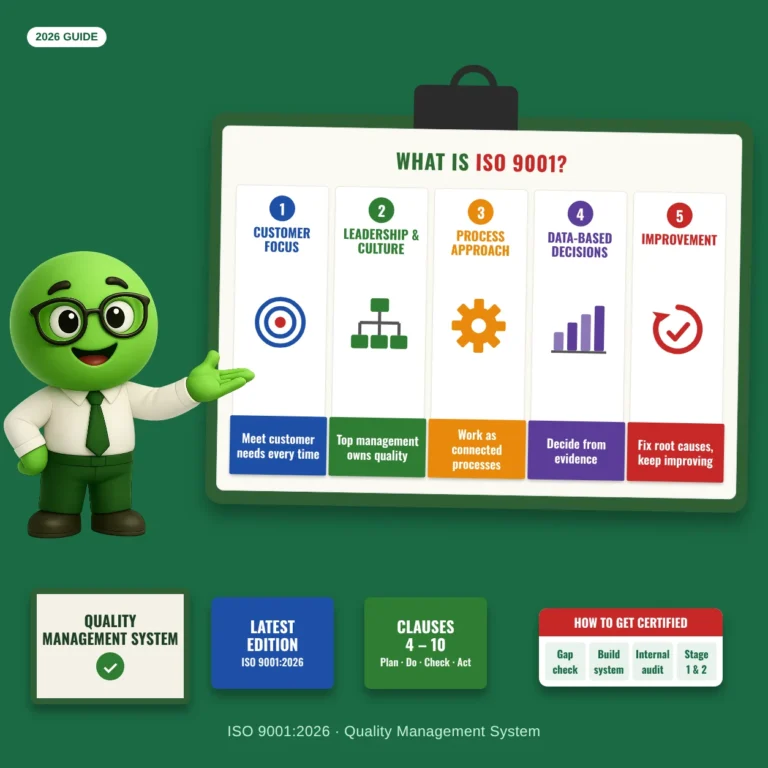
The 7 quality management principles behind ISO 9001
- Customer focus — understand and meet customer needs
- Leadership — top management sets direction and builds a quality culture
- Engagement of people — competent, involved people at every level
- Process approach — manage work as connected processes
- Improvement — keep getting better
- Evidence-based decision making — decide from data, not opinion
- Relationship management — work well with suppliers and partners
ISO 9001 structure: clauses 1 to 10
| Clause | Title | What it asks in plain words |
|---|---|---|
| 1–3 | Scope, references, terms | Introduction — no audit requirements |
| 4 | Context of the organisation | Understand your business, interested parties, scope and processes |
| 5 | Leadership | Top management owns the QMS, the quality policy and quality culture |
| 6 | Planning | Plan for risks and opportunities, set quality objectives, plan changes |
| 7 | Support | People, infrastructure, calibration, knowledge, competence, awareness, documents |
| 8 | Operation | Plan and control everything from enquiry to delivery, suppliers, production and nonconforming product |
| 9 | Performance evaluation | Measure, analyse, internal audit, management review |
| 10 | Improvement | Corrective action and continual improvement |
Who needs ISO 9001?
Any organisation, of any size or industry, can use ISO 9001. In India it matters most for manufacturers who:
- Supply OEMs, large buyers or multinational customers who ask for an ISO 9001 certificate
- Export, where foreign buyers expect a recognised quality system
- Bid for government or PSU tenders that list ISO 9001 as a condition
- Want consistent quality and fewer repeat problems as they grow
Benefits of ISO 9001 for manufacturers
- Wins buyer and tender approvals — a recognised certificate opens doors
- Consistent quality — the same process every time, not person-dependent
- Clear responsibilities — everyone knows who does what
- Fewer repeat problems — root-cause-based corrective action
- Better decisions — objectives and data reviewed by management
- Stronger supplier control — evaluated and monitored suppliers
- A base for more standards — ISO 14001, ISO 45001 and IATF 16949 build on the same structure
How ISO 9001 certification works — who does what
| Who | Role |
|---|---|
| ISO | Publishes the standard. Does not certify companies. |
| Accreditation body (NABCB in India, or another IAF member) | Checks that certification bodies are competent. |
| Certification body | Audits your system (Stage 1 and Stage 2), issues the certificate, then audits every year. |
| Consultant (e.g. Greendot) | Helps you build and implement the system and prepares you for the audit. Does not issue certificates. |
| Your company | Runs the system every day. |
Greendot works with any accredited certification body you choose and has no tie-ups.
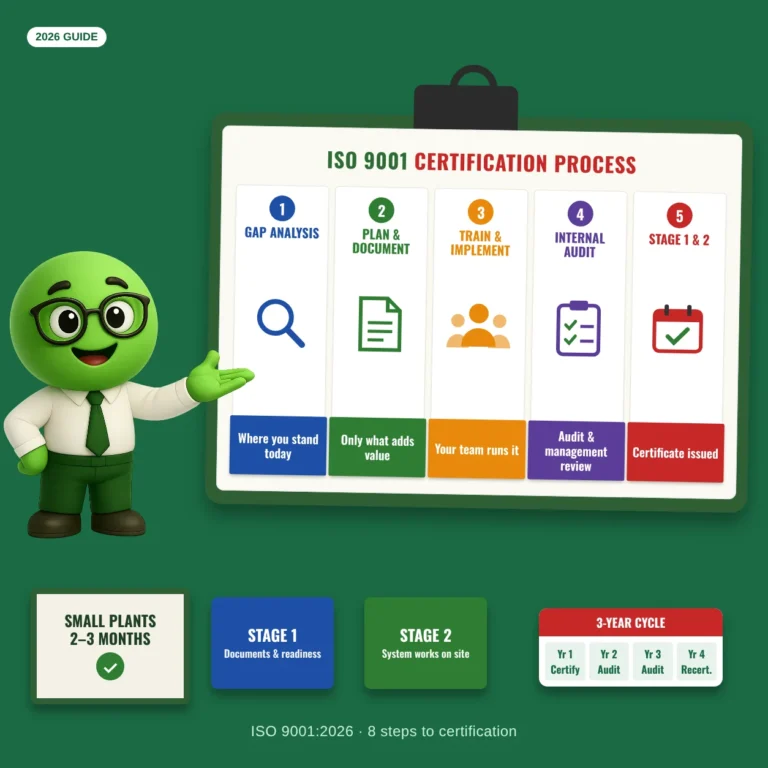
ISO 9001 certification in 8 steps
- Gap analysis against ISO 9001:2026
- Process mapping, risks and opportunities, quality objectives
- Practical documentation
- Training and awareness
- Implementation on the shop floor
- Internal audit and management review
- Stage 1 audit by the certification body
- Stage 2 audit and certificate
Small plants are typically certification-ready in 2–3 months; larger plants take longer depending on departments, processes and sites.
How much does ISO 9001 cost?
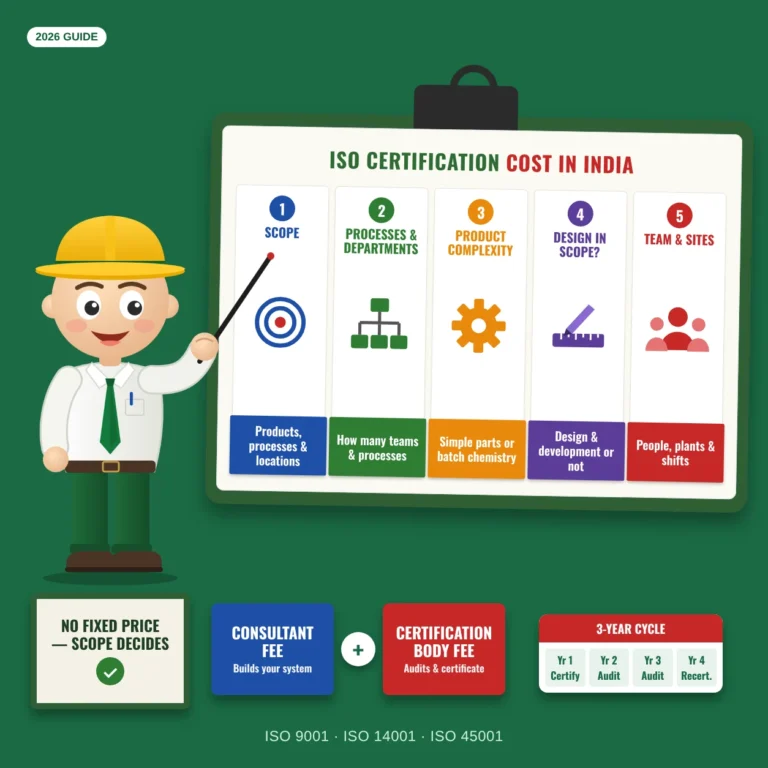
There are two parts: the consultant’s fee and the certification body’s audit fee. Both depend on your scope, processes, product complexity, design in scope, team size and sites. Read the full guide: ISO certification cost in India (2026).
5 myths about ISO 9001
| Myth | Fact |
|---|---|
| ISO 9001 is only paperwork | Auditors check what happens on the shop floor; documents only support it. |
| It is only for big companies | It works for any size; small plants usually certify faster. |
| You can buy a certificate online | A certificate without a real audit by an accredited body is rejected by serious buyers. |
| Once certified, you are done | Certification bodies audit every year and recertify every three years. |
| ISO 9001 guarantees product quality | It guarantees a system for consistent quality and improvement — results depend on how well you run it. |
ISO 9001 and other standards
| Standard | Focus | Learn more |
|---|---|---|
| ISO 9001 | Quality management | ISO 9001 consultant |
| ISO 14001 | Environmental management | ISO 14001 consultant |
| ISO 45001 | Occupational health and safety | ISO 45001 consultant |
| ISO 13485 | Quality for medical devices | ISO 13485 consultant |
| IATF 16949 | Quality for automotive suppliers (builds on ISO 9001) | ISO certification services |
Most of our clients implement ISO 9001, ISO 14001 and ISO 45001 together as one integrated management system.
How Greendot helps
Greendot Management Solutions has worked with 1,200+ mid and large-size companies since 1999. Our IRCA-certified Lead Auditors build practical ISO 9001:2026 systems on the shop floor for plants from Ahmedabad to Mumbai. → ISO 9001 consultant
· Learn online: ISO 9001:2026 — From Theory to Execution
· Train your team: ISO 9001:2026 Awareness Training
Frequently asked questions
Q: What is ISO 9001 in simple words?
ISO 9001 is an international standard that sets out how a company should run a quality management system, so it consistently delivers products and services that meet customer and legal requirements and keeps improving.
Q: What is the full form of ISO?
ISO stands for the International Organization for Standardization, based in Geneva, Switzerland. The short name ISO comes from the Greek word ‘isos’, meaning equal, so it is the same in every language.
Q: What is the latest version of ISO 9001?
ISO 9001:2026, the sixth edition, published in September 2026. ISO 9001:2015 certificates remain valid during the transition period, which certification bodies expect to end in September 2029.
Q: Is ISO 9001 mandatory in India?
No law makes ISO 9001 mandatory for most companies, but many buyers, OEMs, export customers and government tenders require it, so in practice it is often needed to win business.
Q: Who issues the ISO 9001 certificate?
An accredited certification body issues it after auditing your system. ISO itself does not issue certificates, and consultants such as Greendot do not either — they prepare you for the audit.
Q: How long does ISO 9001 certification take?
With a structured approach, small plants are typically certification-ready in 2–3 months. Larger plants take longer depending on the number of departments, processes and sites.