
The complete guide to workplace organisation, with Indian case studies.
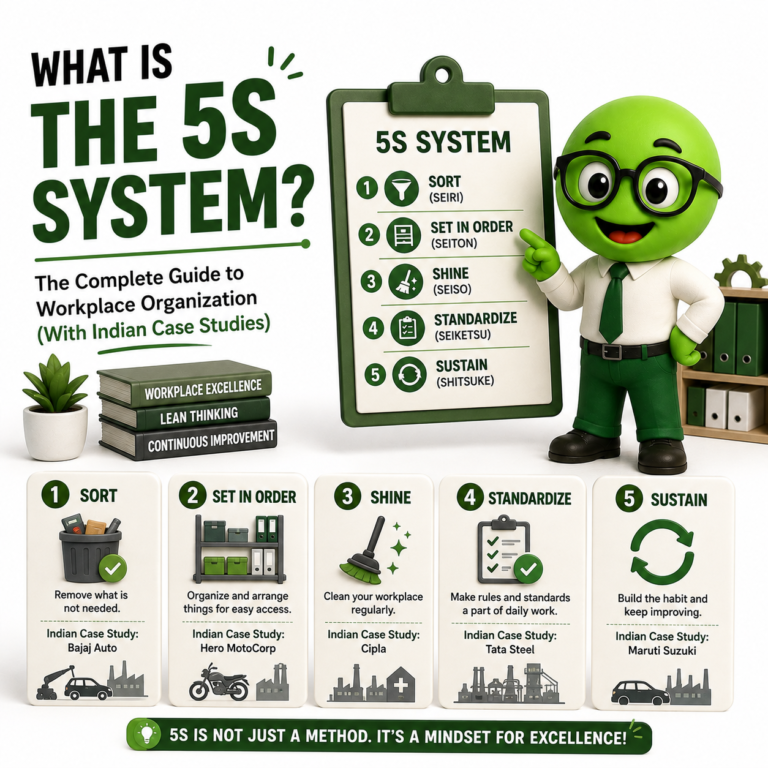
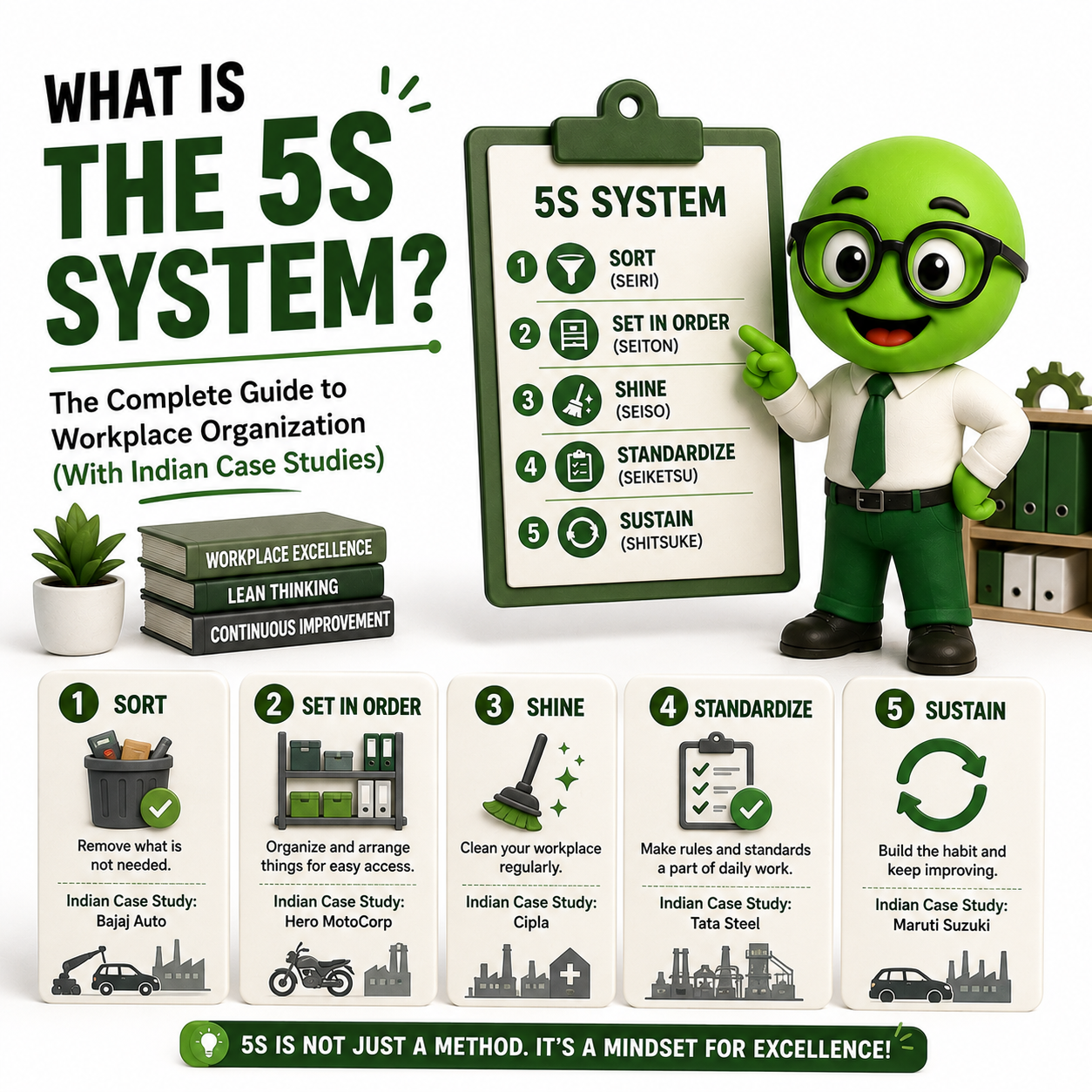
What is 5S? The 5S system is a Japanese workplace organisation method with five steps: Sort, Set in Order, Shine, Standardize and Sustain (Seiri, Seiton, Seiso, Seiketsu, Shitsuke). The 5S methodology removes what is not needed, gives everything a fixed place, uses cleaning as inspection, writes the standard, and keeps it alive through audits. It is the base of Lean manufacturing, TPM and Kaizen.
This guide is written by Greendot Management Solutions. Since 1999 we have implemented 5S on the shop floor for 1,200+ companies, including Atul Ltd, Coptec, Heranba and RBD Engineers.
What Is 5S? Meaning and Definition
5S is a method for organising a workplace so that it stays clean, safe and efficient, and so that problems become visible at a glance. It is called 5S because each of its five steps starts with the letter S, in Japanese and in English. The 5S methodology is simple to learn and hard to sustain, which is why most plants that try it once see it slip within months.
5S is not a cleaning programme. It decides what belongs in an area, where each item goes, how the area is checked and how the standard is kept alive. In simple words, 5S means a place for everything and everything in its place, checked every week. In a company or factory, 5S is the first step of any improvement programme, because you cannot improve a process you cannot see.
5S Full Form: Japanese, English, Hindi and Gujarati
The full form of 5S is Sort, Set in Order, Shine, Standardize and Sustain. Each S comes from a Japanese word:
| S | Japanese | English | Hindi | Gujarati | What it means on the shop floor |
|---|---|---|---|---|---|
| 1st S | Seiri (整理) | Sort | छँटाई (Chhantai) | છટણી (Chhatni) | Keep only what is needed; red-tag the rest |
| 2nd S | Seiton (整頓) | Set in Order | व्यवस्थित करना (Vyavasthit karna) | ગોઠવણી (Gothavni) | A fixed, marked place for every item |
| 3rd S | Seiso (清掃) | Shine | सफाई (Safai) | સફાઈ (Safai) | Clean and inspect at the same time |
| 4th S | Seiketsu (清潔) | Standardize | मानकीकरण (Maanakikaran) | માનકીકરણ (Maanakikaran) | Write and show the standard so everyone follows it |
| 5th S | Shitsuke (躾) | Sustain | अनुशासन (Anushasan) | શિસ્ત (Shist) | Make it a habit through audits and leadership |
Where 5S Came From: The Japanese 5S Concept and Toyota
5S grew out of Japanese manufacturing after the Second World War and became a foundation of the Toyota Production System. Toyota used it to make waste and abnormalities visible on the shop floor, so that they could be fixed before they caused defects or breakdowns.
5S reached the rest of the world through Hiroyuki Hirano’s book 5 Pillars of the Visual Workplace (English edition, 1995). Henry Ford had run a similar programme decades earlier, called CANDO: Cleaning up, Arranging, Neatness, Discipline and Ongoing improvement.
In India, automotive and engineering companies were the first to adopt 5S widely. Today chemical, pharma, textile and food plants use it to prepare for customer and ISO audits. BIS has published Indian Standard IS 15171:2002, Guidelines for Establishing and Implementing 5-S Concept.
The 5 Principles of 5S Explained With Factory Examples
The five principles of 5S always run in this order: Sort, Set in Order, Shine, Standardize, Sustain. Each step depends on the one before it.
Sort (Seiri)
Sort means keeping only what the area needs for today’s work and removing everything else. The team runs a red tag event: every item that may not be needed gets a red tag and goes to a marked red tag area for a fixed holding period. If no one needs it in that time, it is scrapped, sold or moved to stores.
Example: In a chemical plant store, the red tag area held old drums, spare parts for machines long gone, and empty bags. Clearing it freed racks for live stock. At Heranba, this step alone surfaced ₹43 lakh of material lying idle.
Set in Order (Seiton)
Set in Order gives every remaining item one fixed, labelled place, chosen by how often it is used. Items used every hour sit within arm’s reach; items used weekly go to a nearby rack. Shadow boards, floor marking, labels and colour codes are the visual management tools of this step.
Example: A maintenance workshop moved its tools to a shadow board, with an outline for each tool. A missing spanner is now visible from ten feet away.
Shine (Seiso)
Shine means cleaning the area and the machines, and inspecting them while cleaning. When operators clean by hand, they find oil leaks, loose bolts and worn parts before these cause breakdowns. The source of recurring dirt is found and fixed, not just cleaned again.
Example: While cleaning a gearbox, an operator found an oil leak and a loose bolt. Cleaning is inspection: dirt hides problems that later stop the machine.
Standardize (Seiketsu)
Standardize turns the first three steps into the normal condition of the area. Each area gets a one-page 5S standard with a photo of the correct condition: what goes where, who cleans what, and how often. These 5S standards are what new and contract workers learn from.
Example: Every area at the entry of the shop has its standard photo displayed. Anyone can compare the area with the photo and see what is out of place.
Sustain (Shitsuke)
Sustain is the discipline of following the standard every day. It is kept alive by area owners, short weekly audits on random days, visible scores and regular leadership walks.
Example: The area owner runs a 10-minute 5S audit every week, scores it and puts the score on the board. Management reviews the scores in the daily meeting. Read more on how to sustain 5S.
5S Tools: Red Tags, Shadow Boards, Floor Marking and More
These are the 5S tools used in almost every plant. None of them is expensive; what makes them work is daily use.
| 5S tool | Used in which S | What it does |
|---|---|---|
| Red tag and red tag area | Sort | Marks items that may not be needed and holds them for a decision |
| Shadow board | Set in Order | Shows the outline of each tool, so a missing tool is seen at once |
| Floor marking tape and paint | Set in Order | Marks aisles, work zones, WIP and scrap areas |
| Labels and colour codes | Set in Order, Standardize | Tell anyone what goes where without asking |
| Cleaning schedule and inspection points | Shine | Fixes who cleans what, how often, and what to check |
| One-point lesson and area standard photo | Standardize | Shows the correct condition on one page |
| 5S audit sheet and score board | Sustain | Scores each area every week and shows the trend |
All of these are covered in our 5S training for employees.
5S vs 6S, Kaizen, Lean, TPM and Six Sigma
| Method | Focus | How it relates to 5S |
|---|---|---|
| 6S | 5S plus Safety as a sixth step | Makes safety an explicit step; many plants build safety into every S instead |
| Kaizen | Continuous small improvements | 5S makes problems visible; Kaizen fixes them |
| Lean manufacturing | Removing waste from the whole value stream | 5S is the first Lean tool and the base for flow, quick changeover and visual management |
| TPM (Total Productive Maintenance) | Machine reliability and OEE | 5S is step zero of TPM; autonomous maintenance starts with Shine |
| Six Sigma | Reducing variation with data | 5S is not part of Six Sigma, but stable, organised processes give cleaner data |
5S is not part of Six Sigma itself. It is a Lean tool, and many companies use it before Lean Six Sigma projects. See how we combine 5S with Kaizen and TPM.
5S and the 8 Wastes of Lean
5S attacks waste before any other Lean tool does. Each S removes at least one of the 8 wastes of lean manufacturing:
- Sort removes excess inventory and the space it takes.
- Set in Order removes motion and waiting: no more searching for tools, dies or documents.
- Shine removes defects caused by dirt, leaks and contamination.
- Standardize removes over-processing and variation between shifts.
- Sustain stops the waste from coming back.
Benefits of 5S: What Changes in Your Plant
The benefits of 5S are measurable within weeks. In our client plants:
- Heranba Industries: ₹43 lakh of idle material found and recovered (case study)
- RBD Engineers: 70% fewer accidents and 25% higher productivity (case study)
- Coptec: an audit-ready shop floor every day, with the shop floor changed completely in 6–7 months
In every plant, the benefits show up in the same places:
- Productivity: less time searching, walking and waiting
- Space: racks and floor freed by Sort
- Safety: clear aisles, marked hazards and fewer slips and trips
- Quality: fewer mix-ups, wrong parts and defects from dirt
- Maintenance: problems found during cleaning, before breakdowns
- Morale: people take pride in an area that is visibly under control
- Audits: customers and auditors see a plant that runs to a standard
5S in Quality Management: TQM and ISO 9001
In TQM, 5S is the base practice. A clean, organised and standardised workplace is where consistent quality starts. 5S also supports ISO 9001 in practical ways: identified material, controlled documents at the point of use, a maintained infrastructure, and a work environment that is fit for the process. Plants that run 5S face fewer findings in ISO 9001 and customer audits, because the evidence is visible on the floor.
Why Most 5S Programmes Fail, and How to Avoid It
| Failure | What it looks like | How to prevent it |
|---|---|---|
| One-time cleaning drive | The plant looks good for a week, then slides back | Run 5S as a system with weekly audits, not as an event |
| No ownership | “Everyone is responsible”, so no one is | Give every area one named owner |
| Audits stop or become predictable | Areas are cleaned the day before the audit | Audit weekly, on random days, with auditors from other areas |
| Management loses interest | Supervisors stop asking about 5S | The plant head walks one area every week |
| Training without implementation | People know 5S but nothing changes | Train on the shop floor, in a real pilot area |
| Contract labour turnover | New workers don’t know the standard | Make the standard visual and add 5S to every induction |
If your 5S has already slipped, start with these 10 habits to sustain 5S, or ask a 5S consultant to restart it with you.
How to Start 5S in Your Plant
Starting 5S takes five moves:
- Pick one pilot area and photograph it.
- Train everyone who works there, on the floor, not in a classroom.
- Run Sort, Set in Order and Shine in the pilot area.
- Write the standard and copy it to the next area.
- Start weekly audits with a score.
For the full plan with a timeline, roles and industry examples, read how to implement 5S step by step. For cost and duration in your plant, talk to a 5S consultant.
Quick 5S Audit Score
Score each S from 0 to 4 in any area:
| Score | What it means |
|---|---|
| 0 | Not started: no evidence of this S |
| 1 | Started: some effort, but not across the area |
| 2 | Partly applied: visible in most of the area, gaps remain |
| 3 | Applied: in place across the area, followed most of the time |
| 4 | Fully applied: in place, visible and checked in every audit |
A total below 12 out of 20 means 5S is drifting and needs ownership and weekly audits first.
5S Examples: Results From Indian Plants
Atul Limited, Anisole Plant, Valsad
At Atul Ltd’s Anisole plant in Valsad, 5S started as a workplace organisation exercise and turned into a process improvement. During Sort and Shine, the team took a close look at how tar and sodium sulphate were being handled. The changes made in handling reduced mess and effort, and the plant reported higher productivity. Across the campus, 5S became one visible standard rather than a single showcase area.
Apple Insulated Wires, Silvassa
At Apple Insulated Wires in Silvassa, the first stages of 5S changed how the shop floor looked and worked. The bigger change was in people: employees began to take ownership of their own areas, which is what makes 5S last.
More 5S results from our clients: Heranba recovered ₹43 lakh, Willowood built a safer chemical plant in Dahej, and Coptec built a lasting 5S culture (watch the Coptec video).
Where Can 5S Be Applied?
5S can be applied anywhere work happens, not only in factories:
- Production floors and machine shops: the classic use. See 5S in the workplace.
- Chemical and pharma plants: safe storage, labelling and GMP readiness. See 5S in chemical plants.
- Stores and warehouses: fixed locations, FIFO and faster picking.
- Offices: desks, files and digital folders. See 5S in the office.
- Safety: clear aisles, marked hazards and fewer accidents.
- Hospitals, labs and service businesses: the same five steps, adapted.
5S in the Indian Manufacturing Context
Indian plants face a few 5S challenges that textbooks rarely mention: high contract labour turnover, multi-shift operations, mixed old and new machines, and pressure to keep production running during improvement work. 5S works in these conditions when the standard is visual, the training happens on the floor in the local language, and ownership stays with permanent staff.
For mid and large-size manufacturers, the return on 5S comes quickly: freed space, less search time, fewer accidents and smoother customer audits. Greendot Management Solutions has implemented 5S in chemical, pharma, engineering, plastic, packaging, textile and food plants across Gujarat and Maharashtra. We work on the shop floor with your team, agree measurable targets before we start, and stay until 5S sustains.
5S FAQ: Common Questions Answered
What is the full form of 5S?
The full form of 5S is Sort, Set in Order, Shine, Standardize and Sustain. In Japanese the five words are Seiri, Seiton, Seiso, Seiketsu and Shitsuke. Together they describe a method to organise a workplace and keep it organised.
What are the 5 principles of 5S?
The 5 principles of 5S are: Sort (keep only what is needed), Set in Order (a fixed place for everything), Shine (clean and inspect), Standardize (write and show the standard) and Sustain (keep it up through audits and discipline). They are always done in this order.
What is 5S in Hindi and Gujarati?
In Hindi, 5S is छँटाई (Sort), व्यवस्थित करना (Set in Order), सफाई (Shine), मानकीकरण (Standardize) and अनुशासन (Sustain). In Gujarati, it is છટણી, ગોઠવણી, સફાઈ, માનકીકરણ and શિસ્ત.
What is the 5S system in industry?
In industry, the 5S system is the base of workplace organisation on the shop floor. It removes unwanted material, gives every tool and part a marked place, makes cleaning an inspection, and keeps the standard through weekly audits. Factories use it before Lean, TPM and ISO audits.
Is 5S part of Six Sigma?
No. 5S is a Lean tool, not part of Six Sigma itself. Many companies run 5S before Lean Six Sigma projects, because an organised, stable workplace gives cleaner process data and fewer special causes.
What is the difference between 5S and 6S?
6S is 5S plus a sixth S, Safety. The sixth S makes hazard removal an explicit step. In practice, a well-run 5S already improves safety, because clear aisles, marked hazards and clean machines prevent many accidents.
Is 5S the same as housekeeping?
No. Housekeeping is cleaning. 5S is a system: it removes what is not needed, fixes a place for everything, uses cleaning as inspection, writes the standard and audits it every week. Housekeeping is only one part of the third S. Read more in 5S vs housekeeping.
How long does it take to implement 5S?
A pilot area shows visible 5S results within a few weeks. A plant-wide 5S implementation usually takes 12 to 24 months; at Coptec, the shop floor changed completely in 6 to 7 months. The Sustain step takes the longest.
Is there an official 5S certification or standard?
Yes, there is an Indian Standard for 5S: IS 15171:2002, Guidelines for Establishing and Implementing 5-S Concept, published by BIS. Greendot audits and certifies plants for 5S based on this standard. Individuals can earn a certificate through an online 5S course. Learn about 5S certification for your plant.
Can 5S be used outside manufacturing?
Yes. 5S works in offices, stores, warehouses, laboratories, hospitals and service businesses. The five steps stay the same; only the items change, for example files and digital folders instead of tools and dies.
How can a company sustain 5S?
A company sustains 5S by giving every area an owner, running a short scored 5S audit every week, showing the scores on a board and reviewing them in management meetings. Without audits and leadership review, most 5S programmes slip within three months. See how to sustain 5S.
Who can implement 5S in my plant in Gujarat?
Greendot Management Solutions implements 5S on the shop floor for manufacturing plants in Gujarat and Maharashtra, with offices in Valsad, Surat and Vadodara. Since 1999, 1,200+ companies, including Atul Ltd, Coptec and Heranba, have worked with Greendot.
Want 5S That Lasts in Your Plant?
Greendot consultants implement 5S on your shop floor, agree measurable targets before we start, and stay until your team runs it alone. 1,200+ companies since 1999, including Atul Ltd, Coptec and Heranba.