
GreenDot Management Solutions has guided manufacturing plants across Gujarat, Maharashtra, and Rajasthan through TPM implementation — from shop-floor awareness campaigns to JIPM award preparation. This guide draws directly from that experience.
What Is Total Productive Maintenance (TPM)?
Total Productive Maintenance (TPM) is a company-wide strategy to maximize the productivity and reliability of equipment by involving everyone — from top management to machine operators — in ownership, care, and continuous improvement.
The name captures three ideas:
- Total — every employee participates, every department is involved
- Productive — maintenance happens without disrupting or stopping production
- Maintenance — equipment is kept in optimal condition proactively, not reactively
TPM was developed by Seiichi Nakajima at the Japan Institute of Plant Maintenance (JIPM) in 1971 and first implemented at Nippondenso (now Denso Corporation), a Toyota Group company. It transformed how manufacturing companies thought about equipment — shifting from “fix it when it breaks” to “prevent it from breaking at all.”
The ultimate goal of TPM is simple to state and challenging to achieve: zero accidents, zero breakdowns, zero defects.
Why TPM Matters for Indian Manufacturing Today
Indian manufacturers face a specific version of this challenge. In many Indian plants — particularly SMEs in sectors like auto-ancillaries, plastics, textiles, and pharmaceuticals — Overall Equipment Effectiveness (OEE) sits in the range of 40–60%. World-class OEE is considered 85% or above.
That gap is not a technology problem. It is a systems and culture problem — exactly what TPM is designed to solve.
Competition is also intensifying. Export buyers, Tier-1 OEMs, and global supply chains increasingly require documented maintenance systems, reliable delivery schedules, and low defect rates. TPM provides the operating framework to meet those demands consistently.
TPM at a Glance
| Dimension | Detail |
|---|---|
| Full Form | Total Productive Maintenance |
| Origin | Seiichi Nakajima, JIPM, Japan — 1971 |
| First implementation | Nippondenso (Denso Corp), Toyota Group |
| Core goal | Zero accidents, zero breakdowns, zero defects |
| Framework | 8 Pillars of TPM |
| Typical implementation period | 3–5 years (full deployment) |
| Global certification body | JIPM — Japan Institute of Plant Maintenance |
| Indian recognition program | CII-JIPM TPM Excellence Award |
| Key performance metric | OEE (Overall Equipment Effectiveness) |
| World-class OEE benchmark | 85%+ |
TPM vs. Preventive Maintenance vs. Predictive Maintenance
One of the most common questions we hear from plant managers: “We already do preventive maintenance — how is TPM different?”
The difference is scope and ownership, not just technique.
| Dimension | Preventive Maintenance | Predictive Maintenance | Total Productive Maintenance (TPM) |
|---|---|---|---|
| Who does it | Maintenance department only | Maintenance + instruments team | All employees including operators |
| Approach | Scheduled intervals | Condition-based triggers | Proactive + autonomous + planned |
| Operator role | Operate only | Operate only | Operate AND maintain (basic care) |
| Scope | Equipment upkeep | Equipment monitoring | Equipment + quality + safety + efficiency |
| Goal | Reduce breakdowns | Predict failures before they occur | Zero breakdowns + zero defects + zero accidents |
| Culture change required | Low | Low–Medium | High — fundamental mindset shift |
| Implementation time | 1–3 months | 3–12 months | 3–5 years |
| Best suited for | Any plant as a starting point | Plants with sensor infrastructure | Plants seeking world-class OEE |
The key insight: Preventive and predictive maintenance are tools. TPM is a system that incorporates both — and adds operator ownership, quality integration, safety, and organizational learning on top.
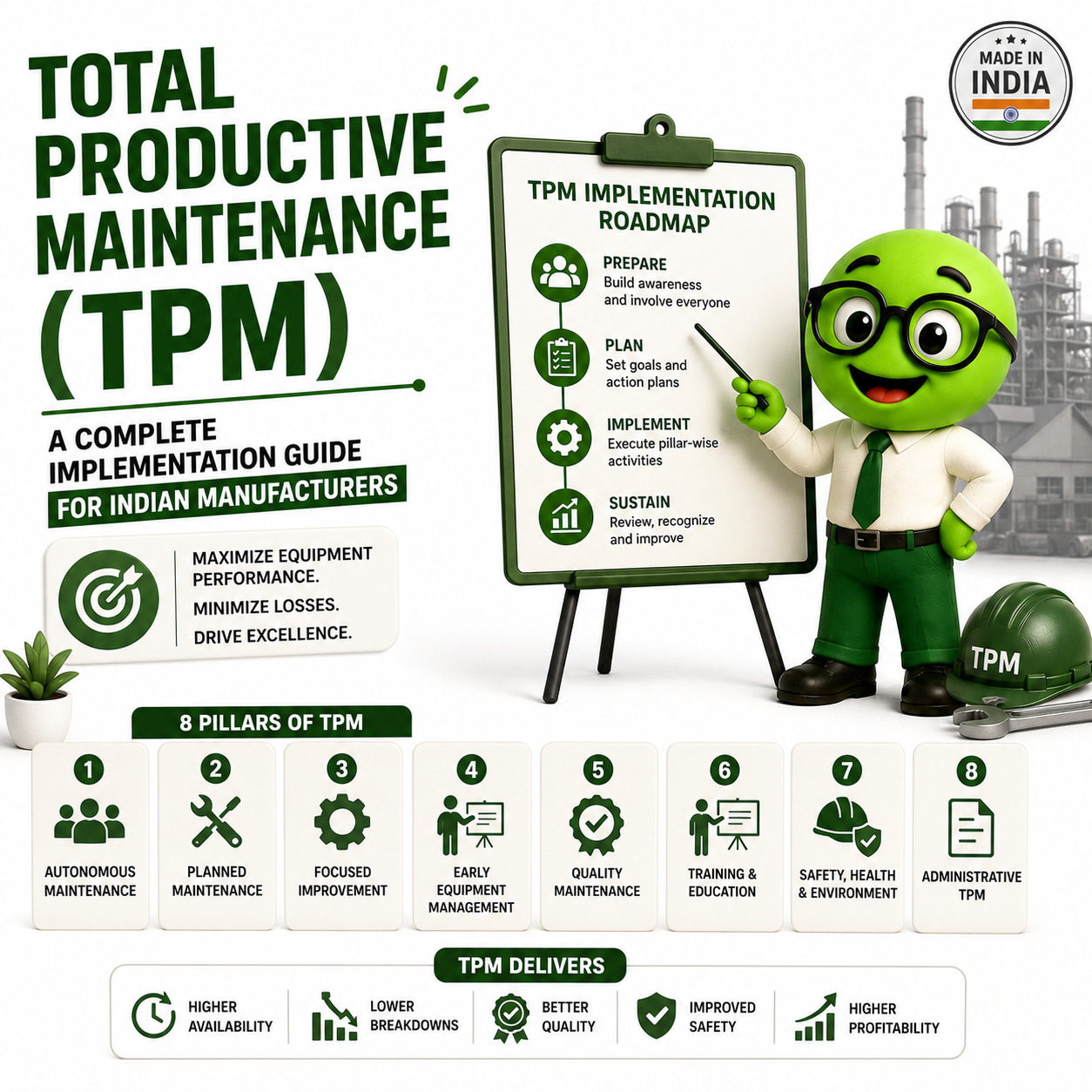
The 8 Pillars of TPM
TPM is built on eight foundational pillars. Think of them as the eight departments of a complete TPM system — each with its own focus, tools, and ownership.
Pillar 1 — Autonomous Maintenance (Jishu Hozen)
Operators take ownership of basic equipment care — cleaning, lubricating, inspecting, and tightening — without waiting for the maintenance department. The mindset shift is from “I operate, you maintain” to “I operate, I maintain.”
This is typically the most culturally challenging pillar for Indian plants, because it requires operators to genuinely care about equipment they do not own. Successful plants build this through a structured 7-step Jishu Hozen program and visible recognition systems.
Key outcome: Operators detect abnormalities early, before they become breakdowns.
Pillar 2 — Planned Maintenance (Keikaku Hozen)
The maintenance department shifts from reactive firefighting to planned, proactive maintenance. This pillar establishes schedules, spare parts management, MTBF (Mean Time Between Failures) tracking, and a systematic approach to eliminating recurring failures.
Key outcome: Breakdown frequency drops; maintenance costs become predictable.
Pillar 3 — Focused Improvement (Kobetsu Kaizen)
Cross-functional small teams identify and eliminate the root causes of the 16 Major Losses in production. Unlike general Kaizen, Kobetsu Kaizen is targeted — each project attacks one specific, quantified loss.
Key outcome: OEE improves through systematic loss elimination, not trial and error.
Pillar 4 — Education and Training
All employees — operators, supervisors, maintenance staff, managers — receive structured skill development. Training is not a one-time event; it is an ongoing system tied to each pillar’s requirements.
Key outcome: The plant builds internal capability to sustain and advance TPM independently.
Pillar 5 — Early Equipment Management (EEM)
Learning from current equipment problems is fed back into the design and procurement of new equipment. The goal is to commission new machines at full rated output in minimum time, with minimum teething problems.
Key outcome: New equipment reaches stable production faster, with lower lifecycle maintenance cost.
Pillar 6 — Quality Maintenance (Hinshitsu Hozen)
Equipment conditions are managed to prevent defect generation at the source. Instead of inspecting quality out at the end, this pillar builds quality into the process by maintaining the equipment conditions that produce good parts.
Key outcome: Defect rate moves toward zero; customer complaints reduce.
Pillar 7 — TPM in Administration (Office TPM)
TPM principles extend beyond the shop floor to support functions — purchase, planning, logistics, HR, finance. Administrative waste and inefficiency that impacts production is identified and eliminated.
Key outcome: The whole organization supports production efficiency, not just the plant floor.
Pillar 8 — Safety, Health and Environment (SHE)
A dedicated pillar ensures that all TPM activities are conducted safely, that the plant environment is healthy, and that environmental compliance is maintained. The target is zero accidents.
Key outcome: Safety incidents fall; the plant earns social license to operate and grow.
What Is OEE — and Why It Is the Heart of TPM
OEE (Overall Equipment Effectiveness) is the primary metric of TPM. It tells you what percentage of your planned production time is truly productive.
OEE = Availability × Performance × Quality
| Component | What It Measures | Formula |
|---|---|---|
| Availability | Equipment uptime vs. planned time | (Operating Time ÷ Planned Time) × 100 |
| Performance | Actual speed vs. ideal speed | (Actual Output ÷ Theoretical Output) × 100 |
| Quality | Good parts vs. total parts produced | (Good Parts ÷ Total Parts) × 100 |
Example: A machine running 90% availability, 85% performance, and 95% quality = OEE of 72.7% — below world class despite appearing to run well.
OEE Benchmarks
| OEE Level | Score | What It Means |
|---|---|---|
| World Class | 85%+ | Benchmark for best-in-class TPM plants |
| Good | 70–85% | Acceptable; improvement possible |
| Fair | 60–70% | Significant losses; prioritize action |
| Poor | Below 60% | Urgent intervention needed |
Most Indian SMEs start their TPM journey in the 40–60% range. Reaching 75–80% within 3 years is a realistic, achievable target with committed implementation.
The 16 Major Losses of TPM
TPM attacks productivity loss systematically. The 16 Major Losses framework categorizes every type of loss a manufacturing plant experiences.
Equipment Losses (directly impact OEE)
- Breakdown Loss — unplanned downtime from equipment failures
- Setup and Adjustment Loss — time lost during changeovers
- Cutting Blade Change Loss — tool replacement downtime
- Startup Loss — losses during machine warm-up or start of shift
- Minor Stoppage and Idling Loss — brief interruptions under 5 minutes
- Speed Loss — running below rated speed
- Defect and Rework Loss — producing scrap or parts needing rework
- Scheduled Downtime Loss — planned maintenance and inspections
Human Losses
- Management Loss — waiting for instructions, materials, or decisions
- Operating Motion Loss — non-value-added operator movement
- Line Organisation Loss — inefficient line balancing
- Logistics Loss — transportation and material handling waste
- Measurement and Adjustment Loss — excessive checking and correcting
Material and Energy Losses
- Yield Loss — raw material not converted to finished product
- Energy Loss — electricity, air, steam used without productive output
- Die, Jig and Tool Loss — consumable tooling losses
The 6 Big Losses of OEE (Breakdowns, Setup, Minor Stoppages, Speed Loss, Startup Defects, Running Defects) are a subset of these 16, specifically tied to OEE calculation.
How to Implement TPM: The 12 Steps (India-Practical Guide)
The JIPM implementation model follows 12 steps across four phases. Below is each step explained with what it actually means at a practical level for an Indian manufacturing plant.
Phase 1 — Preparation (Steps 1–5)
Typical duration for an Indian SME: 3–6 months
Step 1: Declaration by Top Management
Top management formally announces the decision to implement TPM — to employees, suppliers, and customers.
Why this step matters: TPM requires a 3–5 year commitment and will temporarily disrupt routines. Without a clear, public, senior-level declaration, middle management will not protect TPM activities from production pressures. The declaration is not a ceremony — it is a covenant.
What it looks like in practice: A formal communication on the notice board, in the employee meeting, and (for larger plants) in writing to key customers and suppliers. The communication should state the goal, the timeline, and the senior person accountable.
Common mistake: Management declares TPM without changing any budget, authority, or time allocation for maintenance activities. Operators quickly learn it is “the latest initiative” that will pass.
Step 2: TPM Education and Awareness
All employees receive TPM awareness training, calibrated to their role and grade.
Why this step matters: You cannot ask operators to perform Autonomous Maintenance if they do not understand why it matters, what the 8 pillars mean, or what the plant’s OEE target is. Training creates shared language and shared purpose.
What it looks like in practice:
- Senior management: 4-hour TPM strategy and ROI session
- Middle management: 1-day pillar awareness and measurement training
- Operators and supervisors: 4-hour shop-floor session with examples from their own machines
- Classroom, video, and on-the-job formats all work; the medium matters less than the relevance of the examples
Indian plant reality: In multilingual plants (common in Gujarat and Maharashtra), training materials in Gujarati, Hindi, or Marathi significantly improve comprehension and buy-in.
Step 3: Form the TPM Promotion Committee
A dedicated committee and sub-committees are established to drive TPM across the organization.
Why this step matters: TPM spans every department. Without a governance structure, each department pursues isolated activities, progress is invisible, and accountability disappears.
What it looks like in practice:
- Steering Committee: Plant head + department heads — sets direction and resolves cross-department issues
- Pillar Sub-Committees: One per pillar (AM, PM, Kobetsu Kaizen, etc.) — each led by a manager with 3–5 members
- Shop-floor TPM Circles: Small groups of 5–8 operators and supervisors — the people who actually implement daily
The committee meets monthly at steering level, weekly at pillar level. Meeting minutes and action tracking are non-negotiable.
Step 4: Establish TPM Targets and Baseline Data
Current performance is measured and documented. SMART targets are set for every key indicator.
Why this step matters: You cannot improve what you have not measured. Baseline data also provides the “before” picture that demonstrates ROI when implementation succeeds.
Metrics to baseline:
- OEE (by machine and line)
- Breakdown frequency and duration
- MTBF (Mean Time Between Failures)
- MTTR (Mean Time to Repair)
- Defect rate (PPM or % reject)
- Accident frequency rate
- Planned vs. unplanned maintenance ratio
What “SMART” means in this context: Not “improve OEE” — but “improve Line 3 OEE from 54% to 72% by March 2026, measured weekly.”
Step 5: Prepare the TPM Master Plan
A detailed, time-bound implementation roadmap is created, showing which pillar starts when, who leads it, and what milestones are expected.
Why this step matters: Without a master plan, the most urgent daily production pressure will always crowd out TPM activities. The plan protects TPM time.
Typical master plan horizon: 3 years, reviewed annually. Monthly and quarterly breakdowns show specific actions and responsibilities.
For Indian SMEs: It is realistic and advisable to start with 2–3 pillars (Autonomous Maintenance, Planned Maintenance, and Kobetsu Kaizen) before expanding to the full 8. Trying to run all 8 pillars simultaneously in a 200-person plant almost always ends in collapse.
Phase 2 — Launch (Step 6)
Typical duration: 1 day to 1 month
Step 6: TPM Kick-off
The plant formally launches TPM implementation in a company-wide event. Customers, suppliers, and statutory bodies are invited. TPM activities formally begin from this point.
Why this step matters: The kick-off is the public commitment. From this point, TPM is visible — to employees, customers, and leadership. This accountability is deliberate.
What it looks like in practice: A plant meeting with banners, a presentation of the master plan, and symbolic first actions (often the first 5S or cleaning activity on a model machine). Photography and documentation for JIPM award records begins here.
Phase 3 — Implementation (Steps 7–11)
Typical duration: 18–36 months
This phase is where the actual work happens — and where most TPM journeys stall.
Step 7: Improve Production Efficiency
The four core production-facing pillars are deployed:
Kobetsu Kaizen (Focused Improvement): Select 2–3 pilot lines or machines with the worst OEE or most frequent breakdowns. Form a cross-functional team (operator + maintenance + quality + production). Use data to identify the biggest single loss. Apply problem-solving tools (Why-Why Analysis, PM Analysis) to eliminate it. Document the result. Repeat. Each project should have a defined target, a measurable outcome, and a completion date.
Jishu Hozen — Autonomous Maintenance (7-Step System):
The 7 steps of Autonomous Maintenance are:
- Initial cleaning (clean and identify abnormalities)
- Countermeasures for contamination sources and hard-to-clean areas
- Cleaning and lubrication standards
- General inspection training
- Autonomous inspection
- Standardization
- Full autonomous management
Each step is audited and signed off before proceeding to the next. This is not a fast process — a well-implemented Jishu Hozen Step 1 alone takes 3–6 months on a model machine.
Planned Maintenance: The maintenance department classifies all equipment by criticality. Maintenance plans (periodic, predictive, corrective) are defined for each machine. A spare parts system is established. MTBF and MTTR are tracked monthly. The target over time is to shift the ratio from predominantly unplanned to predominantly planned maintenance.
Training and Education: Skill matrices are built for each operator and technician. Gaps are identified. Training programs fill those gaps systematically. One-Point Lessons (OPLs) — single-sheet visual instructions for specific tasks — are created by operators themselves and posted at machines.
Step 8: Early Equipment Management
Learning from current equipment problems is formally fed back into how new equipment is specified, designed, selected, and commissioned.
Why this matters for Indian plants: Many Indian SMEs purchase second-hand machinery or import equipment without adequate maintenance documentation. Step 8 creates the discipline to commission equipment with full maintenance plans from Day 1, significantly reducing the time to reach stable rated output.
Step 9: Quality Maintenance
Equipment conditions that cause defects are identified, standardized, and monitored. The approach is to maintain the machine conditions that produce good parts, rather than inspecting defects out at the end of the line.
Key tool: Quality Maintenance Matrix — a table mapping defect types to the machine conditions responsible for them, with inspection standards for each.
Step 10: TPM in Administration
Office and support functions — purchase, planning, HR, finance, logistics — apply TPM thinking to eliminate administrative losses that slow down production. This includes reducing order processing time, improving internal communication speed, and removing approval bottlenecks.
Indian plant reality: This pillar is often skipped or done superficially. The biggest administrative losses in most Indian plants are: waiting for material purchase approvals, delays in spare parts procurement, and slow internal communication between shifts.
Step 11: Safety, Health, and Environment
All TPM activities are audited for safety compliance. A hazard identification and risk assessment (HIRA) system is established. Environmental controls are documented. The target: zero accidents.
This pillar also ensures TPM activities align with ISO 45001 (Occupational Health & Safety) and ISO 14001 (Environmental Management) requirements — relevant for plants seeking or maintaining these certifications.
Phase 4 — Consolidation and Excellence (Step 12)
Ongoing — from year 3 onwards
Step 12: Complete Implementation and Continuous Improvement
The plant reaches stable TPM implementation and begins targeting higher performance levels. JIPM award application is prepared. New and higher targets are set for the next cycle.
JIPM Award Levels:
- Consistency Award — First recognition; demonstrates sustainable implementation
- Excellence Award (Category A & B) — Demonstrates significant measured improvement
- Special Award for Advanced TPM — World-class level
Indian companies including plants from Mahindra, Tata Motors, Maruti Suzuki, Lupin, and Sun Pharma have received JIPM recognition. The award requires detailed documentation of every step — which is why record-keeping from Step 6 onwards is essential.
TPM Implementation Timeline: What to Expect
| Phase | Timeline | Key Milestones |
|---|---|---|
| Preparation | Month 1–6 | Declaration, training, baseline data, master plan |
| Launch | Month 6 | Kick-off event; model machine selected |
| Early implementation | Month 7–18 | Autonomous Maintenance Step 1–3 on model machines; first Kobetsu Kaizen projects complete; Planned Maintenance system established |
| Expansion | Month 18–36 | AM rolled out across plant; Quality Maintenance pillar active; OEE visibly improving |
| Consolidation | Month 36+ | All 8 pillars operational; JIPM award preparation; new performance targets set |
Note for Indian SMEs: These timelines assume dedicated resources and consistent management commitment. Disruptions from production crises, staff turnover, and seasonal peaks are common — build buffer into your plan.
Benefits of TPM Implementation: What the Numbers Look Like
These benefits are realistic for plants that fully commit to implementation. Timeline to each benefit varies by starting condition and implementation quality.
| Benefit | Typical Improvement | Timeline |
|---|---|---|
| OEE improvement | +15 to +30 percentage points | 18–36 months |
| Unplanned breakdown reduction | 50–80% reduction | 12–24 months |
| Defect / rejection rate | 50–70% reduction | 18–36 months |
| Maintenance cost | 10–30% reduction | 24–36 months |
| Accident frequency | Significant reduction; target zero | Ongoing |
| Operator skill and engagement | Measurably higher | 12–18 months |
| Customer complaints | Reduction tied to quality improvement | 18–36 months |
Why TPM Implementations Fail: The 5 Most Common Mistakes
Based on our experience working with Indian manufacturing plants, these are the most consistent reasons TPM stalls or collapses:
1. Management declares but does not demonstrate commitment. TPM activities get cancelled the moment a production emergency occurs. This happens once or twice — then operators and supervisors correctly conclude that production always wins, and TPM is theatre. Solution: schedule TPM time as firmly as production time, and protect it visibly.
2. Autonomous Maintenance is treated as extra cleaning duty. Operators clean their machines but do not understand why or how to identify abnormalities. The cleaning becomes routine and produces no information. Solution: train operators to detect specific abnormalities and give them a system to report and track them.
3. All 8 pillars are launched simultaneously. In a plant of 100–300 people, running 8 pillar sub-committees, weekly reviews, training programs, and model machine activities at the same time is too much. Everything gets done superficially. Solution: sequence the pillars. Start with Autonomous Maintenance, Planned Maintenance, and Kobetsu Kaizen. Add pillars as capacity grows.
4. Metrics are collected but not used. OEE dashboards are created, filled in weekly, and reviewed at monthly meetings — but the data never drives decisions about where to focus improvement activities. Solution: make OEE and breakdown data the primary input to Kobetsu Kaizen project selection.
5. TPM is owned by the maintenance department. When operators see TPM as “the maintenance department’s project,” Autonomous Maintenance never genuinely takes root. Solution: pillar ownership must sit with cross-functional teams. Production managers must be as accountable for TPM progress as the maintenance manager.
How 5S Fits Into TPM
5S(Sort, Set in Order, Shine, Standardize, Sustain) is not a separate methodology from TPM — it is the foundation of the Autonomous Maintenance pillar.
The relationship works like this:
- Sort (Seiri) removes unnecessary items from the work area, so operators know exactly what belongs and can instantly identify abnormalities
- Set in Order (Seiton) creates designated places for tools and parts, eliminating the search time that hides problems
- Shine (Seiso) — the first cleaning — is literally Step 1 of Jishu Hozen (Autonomous Maintenance). Cleaning with purpose reveals lubrication leaks, loose bolts, abnormal vibrations, and wear that daily production pressure masks
- Standardize (Seiketsu) creates the visual standards that operators use to audit their own equipment
- Sustain (Shitsuke) is the discipline that keeps Autonomous Maintenance alive after the initial energy fades
Practical implication for your plant: If you have not done 5S, do not start Autonomous Maintenance. The sequence is: 5S → Initial Cleaning → Jishu Hozen Step 1. Plants that skip 5S and jump directly to AM find that cleaning reveals so much contamination and so many abnormalities that the activity collapses under its own weight.
TPM Self-Assessment: Is Your Plant Ready?
Use this checklist to assess your current readiness before starting TPM. Answer honestly.
| Question | Yes | Partial | No |
|---|---|---|---|
| Does top management understand TPM (not just the name)? | |||
| Is your current OEE tracked and available by machine? | |||
| Do you have a dedicated maintenance team with documented plans? | |||
| Is 5S implemented and sustained in at least one area of the plant? | |||
| Can operators explain the last breakdown on their machine? | |||
| Is there a system for operators to report equipment abnormalities? | |||
| Does the maintenance team have MTBF data for critical machines? | |||
| Is there a training system for operator skill development? | |||
| Does management have 3+ years of commitment to this program? | |||
| Is there budget allocated for TPM training and implementation? |
Scoring guide:
- 8–10 Yes: Strong foundation — you are ready to begin TPM implementation
- 5–7 Yes: Preparation needed in specific areas before full launch
- Below 5 Yes: Start with 5S and OEE measurement before planning TPM
Frequently Asked Questions About TPM
What does TPM stand for? TPM stands for Total Productive Maintenance. “Total” means all employees participate. “Productive” means maintenance is done without stopping production where possible. “Maintenance” refers to keeping equipment in optimal condition proactively.
Who invented TPM? TPM was developed by Seiichi Nakajima at the Japan Institute of Plant Maintenance (JIPM) and first implemented at Nippondenso (now Denso Corporation) in 1971.
What is the difference between TPM and Total Quality Management (TQM)? TQM focuses on quality throughout the organization and is primarily about processes and customer satisfaction. TPM focuses on equipment effectiveness and operator ownership of machinery. The two are complementary — many plants implement both. TPM is often described as “TQM applied to equipment.”
Can small manufacturing companies implement TPM? Yes. TPM is scalable. A 50-person press shop in Rajkot and a 5,000-person automotive plant can both implement TPM — the scale and complexity of implementation differ, but the principles are identical. Smaller plants should start with 2–3 pillars rather than all 8.
How long does TPM implementation take? Full implementation across all 8 pillars takes 3–5 years. However, visible improvements — particularly from Autonomous Maintenance and Kobetsu Kaizen — appear within the first 12–18 months if implementation is genuine. Rushing the timeline is one of the most common causes of failure.
What is Jishu Hozen in simple terms? Jishu Hozen (Autonomous Maintenance) means operators take responsibility for the basic care of their own machines — cleaning, lubricating, inspecting, and tightening. Instead of only operating the machine and calling maintenance when something breaks, operators become the first line of detection and prevention.
How do I calculate OEE? OEE = Availability × Performance × Quality. For example: if a machine is available 90% of planned time, runs at 85% of ideal speed, and produces 95% good parts, OEE = 0.90 × 0.85 × 0.95 = 72.7%.
What is the JIPM Award and how do Indian companies get it? The JIPM (Japan Institute of Plant Maintenance) runs a global TPM Excellence Award program. Indian companies apply through JIPM’s formal assessment process, which evaluates documentation, results, and sustenance across all 8 pillars. The Confederation of Indian Industry (CII) provides support and guidance for Indian plants seeking JIPM recognition. Companies like Mahindra, Maruti Suzuki, and Lupin plants have received this recognition.
What is the first step to start TPM in my plant? Measure your current OEE by machine. Without baseline data, you cannot prioritize where to start, set meaningful targets, or demonstrate improvement. Even a rough manual OEE measurement (not a sophisticated system) is enough to begin.
Is TPM related to Lean Manufacturing? Yes. TPM and Lean are complementary systems. Lean focuses on eliminating waste across the value stream. TPM focuses specifically on maximizing equipment effectiveness. Many plants implement both: Lean provides the value stream thinking, TPM provides the equipment reliability that makes Lean flow possible. You cannot have reliable Lean flow on unreliable equipment.
GreenDot’s Approach to TPM Implementation
At GreenDot Management Solutions, we have worked with manufacturing plants in Gujarat, Maharashtra, and Rajasthan across sectors including engineering, chemicals, plastics, packaging, and textiles.
Our TPM engagements are not textbook workshops. We start with a plant floor assessment — understanding your current OEE, breakdown patterns, maintenance practices, and operator culture. From there, we build a phased implementation plan that fits your plant size, team capacity, and business priorities.
We do not recommend starting all 8 pillars simultaneously. We help you pick the right starting pillars, build momentum with early visible results, and systematically expand from there.
If you are considering TPM implementation — or if a previous attempt stalled — we would be glad to talk.