
ISO 9001 Certification Process: 8 Steps and Timeline for Indian Manufacturers (2026)
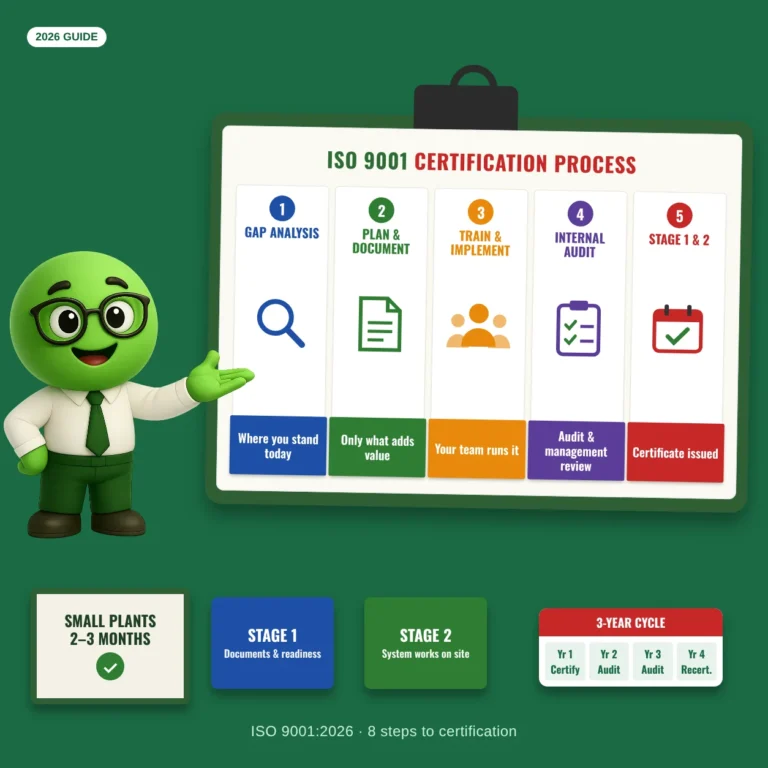
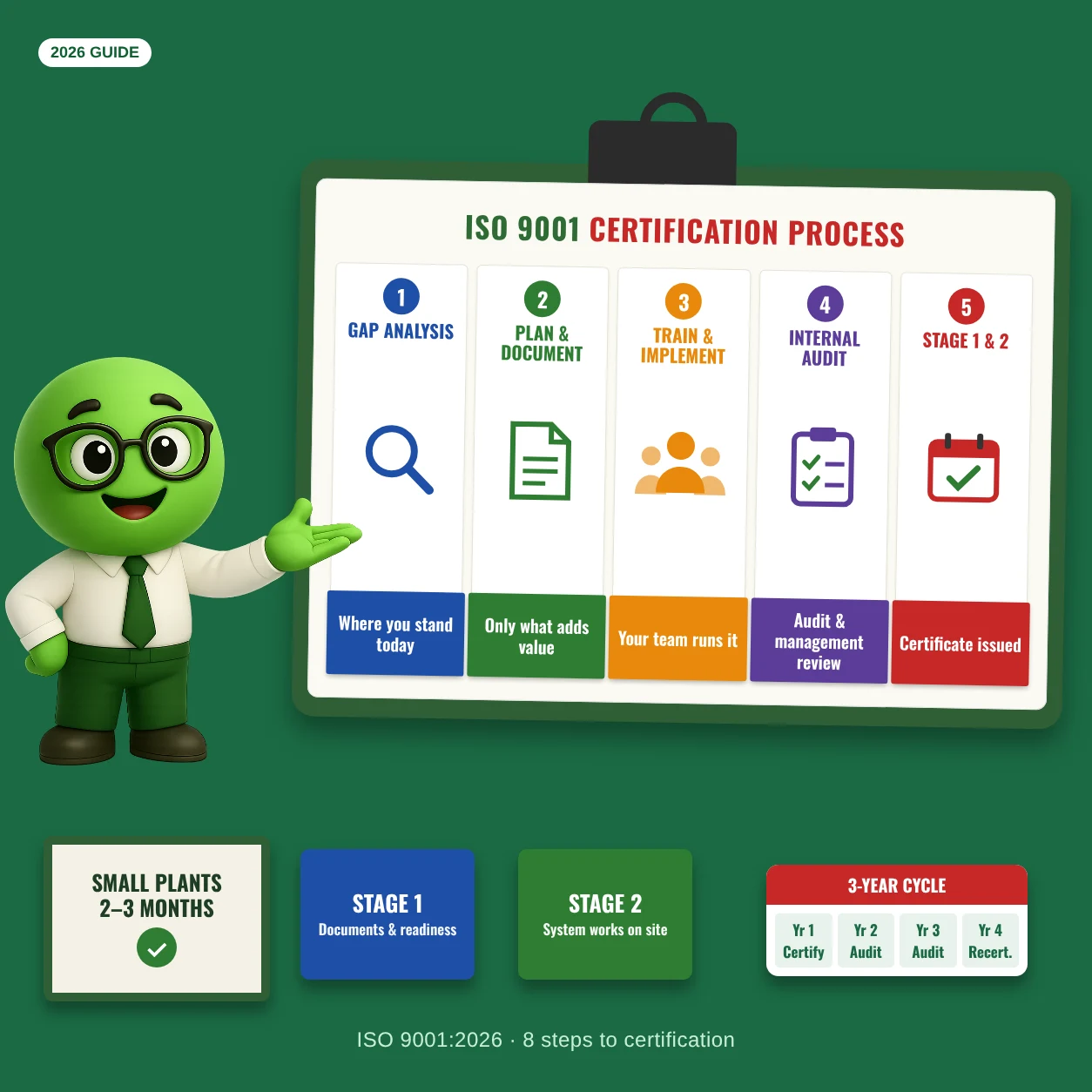
The ISO 9001 certification process has eight steps: gap analysis, planning (context, risks, objectives), documentation, training, implementation, internal audit and management review, a Stage 1 audit and a Stage 2 audit by an accredited certification body, which then issues the certificate. Small plants are typically certification-ready in 2–3 months; the certificate is valid for three years with yearly surveillance audits.
The 8 steps of ISO 9001 certification
| Step | What happens | What you get |
|---|---|---|
| 1. Gap analysis | Compare how your plant works today with ISO 9001:2026, clause by clause, on the shop floor. | A list of gaps and a project plan with owners and dates. |
| 2. Context, risks and objectives | Define scope, interested parties, processes, risks and opportunities, and measurable quality objectives. | Scope, process map, risk and opportunity registers, objectives. |
| 3. Practical documentation | Write only the procedures, formats and records you need — built around how you already work. | Quality policy, procedures, formats, master list. |
| 4. Training and awareness | Train top management, process owners and all employees; train two or three internal auditors. | Training records and competence matrix. |
| 5. Implementation | Run the new system on the floor and keep records for some weeks so there is evidence. | Filled records: inspection, calibration, supplier evaluation, complaints. |
| 6. Internal audit and management review | Audit every process against ISO 9001, close findings, and hold a management review with real data. | Internal audit reports, closed NCs, management review minutes. |
| 7. Stage 1 audit | The certification body reviews your documents and readiness, and confirms the plan for Stage 2. | Stage 1 report with any areas of concern. |
| 8. Stage 2 audit and certificate | The certification body audits on site to check the system works. You close any findings, and the certificate is issued. | ISO 9001 certificate, valid three years. |
Want to know where you stand today? Book a free 30-minute ISO 9001 Gap Check with an IRCA-certified Lead Auditor.
Step by step in detail
1. Gap analysis
Compare how your plant works today with ISO 9001:2026, clause by clause, on the shop floor. Output: A list of gaps and a project plan with owners and dates.
2. Context, risks and objectives
Define scope, interested parties, processes, risks and opportunities, and measurable quality objectives. Output: Scope, process map, risk and opportunity registers, objectives.
3. Practical documentation
Write only the procedures, formats and records you need — built around how you already work. Output: Quality policy, procedures, formats, master list.
4. Training and awareness
Train top management, process owners and all employees; train two or three internal auditors. Output: Training records and competence matrix.
5. Implementation
Run the new system on the floor and keep records for some weeks so there is evidence. Output: Filled records: inspection, calibration, supplier evaluation, complaints.
6. Internal audit and management review
Audit every process against ISO 9001, close findings, and hold a management review with real data. Output: Internal audit reports, closed NCs, management review minutes.
7. Stage 1 audit
The certification body reviews your documents and readiness, and confirms the plan for Stage 2. Output: Stage 1 report with any areas of concern.
8. Stage 2 audit and certificate
The certification body audits on site to check the system works. You close any findings, and the certificate is issued. Output: ISO 9001 certificate, valid three years.
How long does ISO 9001 certification take?
| Plant | Typical time to be certification-ready |
|---|---|
| Small plant (few departments, one site) | 2–3 months with a structured approach |
| Larger or multi-site plant | Longer — depends on departments, processes, sites and how much of a system already exists |
After you are ready, the certification body schedules the Stage 1 and Stage 2 audits. The certificate is issued once any findings are closed.
Stage 1 vs Stage 2 audit
| Stage 1 | Stage 2 | |
|---|---|---|
| Purpose | Check readiness and documents | Check the system works in practice |
| Where | Documents and a site visit | On site — shop floor, offices, stores |
| Auditor looks at | Scope, policy, objectives, processes, internal audit and management review | Records, interviews, observation in every process |
| Result | Areas of concern to fix before Stage 2 | Recommendation for certification, after findings are closed |
Who does what in the process
| Who | Role |
|---|---|
| Your company | Runs the system every day and keeps records |
| Consultant (e.g. Greendot) | Builds the system with you, trains your team, prepares you for audits — does not issue certificates |
| Certification body | Audits you (Stage 1, Stage 2, surveillance) and issues the certificate |
| Accreditation body (NABCB in India, or another IAF member) | Checks that the certification body is competent |
How to choose a certification body
- Check it is accredited by NABCB or another accreditation body that is a member of the International Accreditation Forum (IAF)
- Check its certificates can be verified online (for example on IAF CertSearch)
- Ask your main customers whether they prefer any particular body
- Compare audit days and fees for the full three-year cycle, not only year one
- Greendot works with any accredited body you choose and has no tie-ups
Beware of 'apply online, certificate in 7 days' offers
Some websites promise an ISO 9001 certificate in days without any audit. These certificates usually come from bodies that are not accredited, and buyers, OEMs and export customers reject them. A genuine ISO 9001 certificate always follows a real audit of your system by an accredited certification body.
After certification: the three-year cycle
| Year | What happens |
|---|---|
| Year 1 | Initial certification (Stage 1 + Stage 2) |
| Year 2 | First surveillance audit |
| Year 3 | Second surveillance audit |
| Year 4 | Recertification audit — new three-year cycle |
Already certified to ISO 9001:2015? Plan your transition to ISO 9001:2026 into your next audit
Common reasons the process gets delayed
- Copying template documents that do not match how the plant works
- No records kept long enough before the audit
- Internal audit done in a hurry by people auditing their own work
- Top management not involved in management review
- Calibration and supplier evaluation left until the last week
See the 7 most common reasons ISO audits fail
How Greendot helps
Greendot Management Solutions has worked with 1,200+ mid and large-size companies since 1999. Our IRCA-certified Lead Auditors take you through every step on your shop floor, from Ahmedabad to Mumbai.
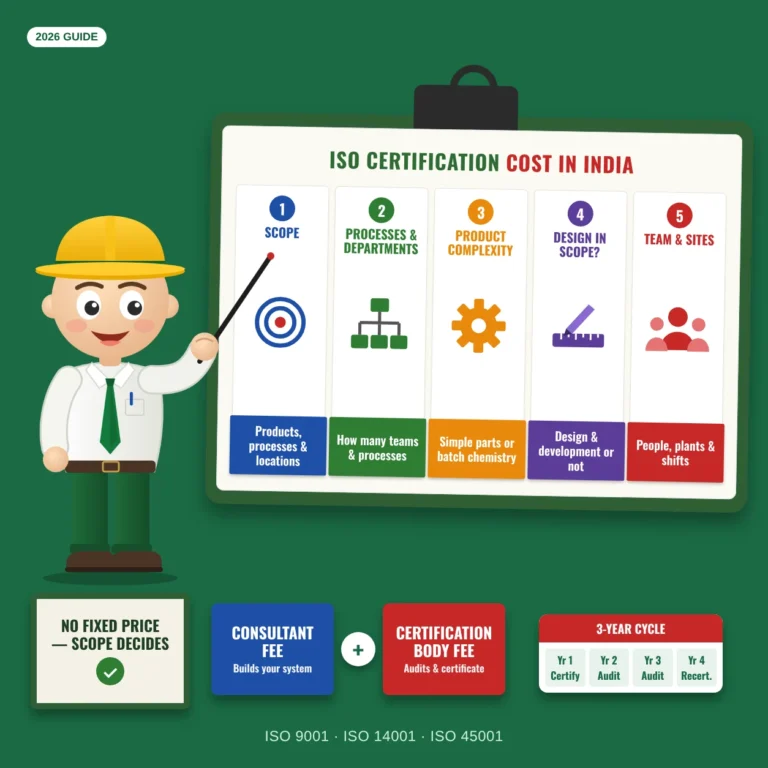
What decides the cost. ISO certification cost in India ·
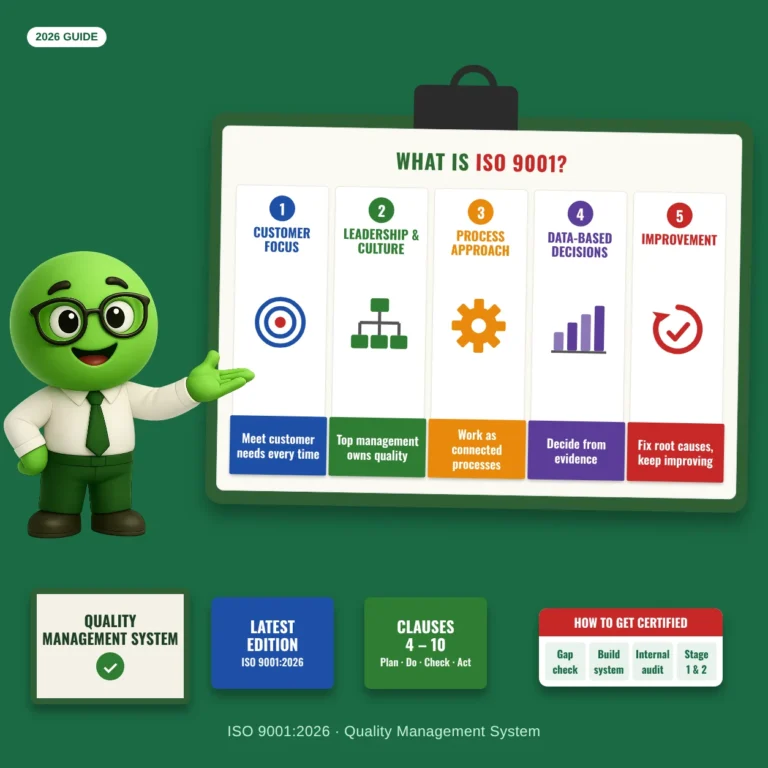
New to ISO 9001? What is ISO 9001?
Frequently asked questions
Q: How long is the ISO 9001 certification process?
With a structured approach, small plants are typically certification-ready in 2–3 months. Larger plants take longer depending on the number of departments, processes and sites. The certification body then schedules Stage 1 and Stage 2.
Q: What is the difference between Stage 1 and Stage 2 audits?
Stage 1 checks your documents and whether you are ready. Stage 2 is the main on-site audit that checks whether your system actually works in practice.
Q: Can I apply for ISO 9001 certification online?
You can request a quote online, but genuine certification always needs an audit of your system by an accredited certification body. A certificate issued without an audit is not accepted by serious buyers.
Q: What happens if the auditor finds non-conformities?
You get a deadline to correct them, usually by finding the root cause and submitting evidence. Major non-conformities must be closed before the certificate is issued.
Q: How long is an ISO 9001 certificate valid?
Three years, with surveillance audits in years two and three and a recertification audit before it expires.
Q: Do I need a consultant for ISO 9001 certification?
It is not mandatory, but a consultant who is a qualified Lead Auditor helps you avoid over-documentation and repeat findings, so you get certified faster with a system your team actually uses.