
What is the 5S Methodology?
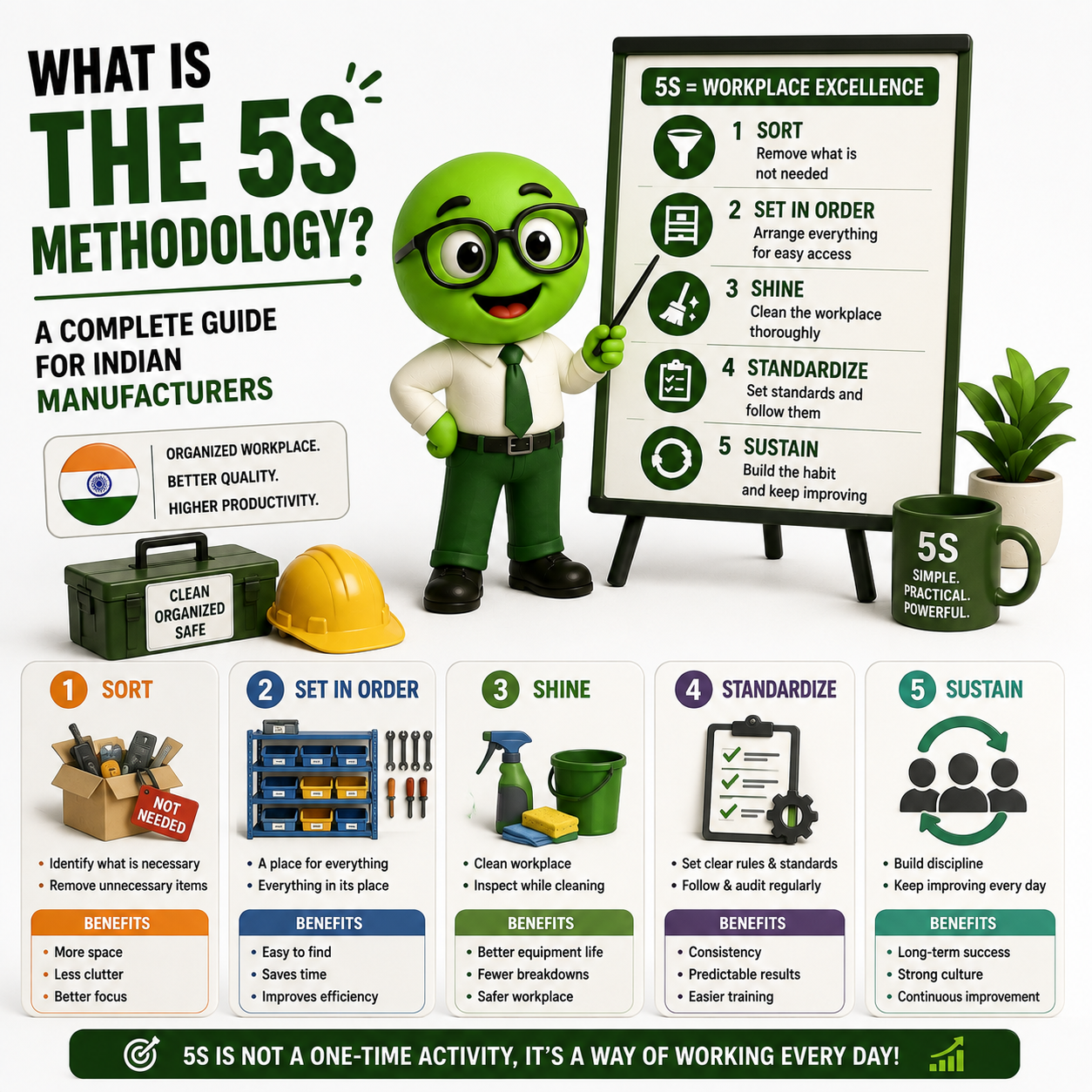
The 5S methodology is a structured workplace organisation system developed in Japan as part of the Toyota Production System. It uses five sequential steps — Sort, Set in Order, Shine, Standardize, and Sustain — to create a clean, organised, and safe working environment where waste is visible, problems surface quickly, and every operator knows exactly what good looks like.
The name comes from five Japanese words: Seiri, Seiton, Seiso, Seiketsu, and Shitsuke. Each begins with the letter S, which is how the system got its name.
5S is not a housekeeping programme. It is the foundation of Lean Manufacturing. When done correctly, it changes how a shop floor operates — reducing the time operators spend searching for tools, reducing the chance of machine breakdowns, and creating the visual stability that every other Lean tool (Kaizen, TPM, SMED) depends on.
In India, 5S is becoming a baseline requirement in several sectors. Chemical companies in Gujarat’s GIDC belt, automotive Tier-1 and Tier-2 suppliers in Maharashtra’s Pune-Chakan corridor, and pharmaceutical manufacturers across Ahmedabad and Ankleshwar are all implementing 5S — partly for internal efficiency gains and partly because multinational customers now audit their suppliers’ workplace standards.
The 5 S’s Explained — With Shop Floor Examples
1st S — Sort (Seiri): Remove What You Don’t Need
Sorting means going through every item in the workspace — tools, machines, materials, documents, spare parts — and making a clear decision: needed or not needed?
The standard tool for this step is the Red Tag System. Any item whose necessity is in question gets a red tag attached to it. Tagged items are moved to a designated holding area (called the Red Tag zone) for a fixed period — typically two to four weeks. If no one retrieves the item during that time, it is either discarded, sold, or relocated. This structured approach prevents arguments about what to keep and creates an objective record of decisions.
What Sort looks like in an Indian factory:
A machine shop in Vapi running three shifts has accumulated — over five years — dozens of worn jigs, outdated job cards, duplicate tooling sets, and partially used consumables spread across five cabinets. In the Sort phase, the team physically touches every item and red-tags anything unused in the past 90 days. In one typical Sort exercise, 30 to 50 percent of cabinet contents are removed. The floor space recovered often surprises even the plant manager.
Common mistake: Treating Sort as a one-afternoon spring cleaning. In reality, Sort takes one to two weeks for a production area of any size, and requires a cross-functional team — not just housekeeping staff.
2nd S — Set in Order (Seiton): A Place for Everything, Everything in its Place
Once unnecessary items are removed, every remaining item gets a fixed location — one that is logical, labelled, and visual. The standard should be that any operator, on any shift, can find any tool within 30 seconds without asking anyone.
Key visual management tools used in this step:
- Shadow boards: Pegboards or foam-lined boards with outlines of each tool. If a tool is missing, the empty shadow is immediately visible.
- Floor markings: Colour-coded tape or paint demarcating machine zones, walkways, material staging areas, and safety zones.
- Labelling: Every rack, shelf, bin, and cabinet is labelled with what belongs there and the maximum quantity allowed.
- Colour coding: Different colours for different departments, shift teams, or product lines — making visual checks fast and foolproof.
What Set in Order looks like in an Indian factory:
A textile dyeing unit in Surat operates across three shifts, with different operators using the same set of dosing equipment. Before Set in Order, operators wasted 10 to 15 minutes per shift locating measuring cups, pH meters, and sample records stored in different places by different shifts. After Set in Order — with a dedicated, labelled station for each item — retrieval time dropped to under 2 minutes. The direct productivity gain was meaningful; the reduction in dosing errors was more significant.
3rd S — Shine (Seiso): Clean and Inspect
Shine means more than cleaning. The real purpose of Seiso is inspection through cleaning. When operators clean their own machines and workstations daily, they notice things: an unusual oil leak, a loose guard, a vibrating bearing, a hairline crack. These are early warning signs that, caught early, prevent breakdowns. Ignored, they become unplanned stoppages.
A good Shine programme includes:
- A cleaning responsibility chart — who cleans what, how often (daily, weekly, monthly)
- Defined cleaning standards — what clean looks like, with a photo or visual reference
- A cleaning inspection checklist — so Shine is verified, not assumed
- Immediate reporting of abnormalities found during cleaning
This is also where 5S connects directly to TPM (Total Productive Maintenance). TPM’s Jishu Hozen pillar — autonomous maintenance — is built entirely on the foundation that operators who clean also inspect, and operators who inspect also detect problems early.
A common pattern we see: Factories skip Shine or treat it as a monthly event. Then they wonder why their machines break down frequently. Shine done daily is a maintenance programme, not a cleaning programme.
4th S — Standardize (Seiketsu): Make the First 3 S’s the Official Way of Working
The first three steps can be done in a burst of energy over one or two weeks. The 4th S is what converts that burst into a permanent system. Standardize means:
- Creating visual SOPs (Standard Operating Procedures) that show how each area should look
- Establishing a 5S audit schedule — typically weekly at the team level, monthly at the management level
- Setting a 5S score for each area so performance is visible and comparable
- Making 5S responsibilities part of each operator’s daily routine — not an add-on
Visual management is the backbone of Standardize. The standard should be visible on the shop floor — not stored in a file on HR’s computer. Photo-based before/after comparisons posted at each workstation are one of the simplest and most effective tools.
5th S — Sustain (Shitsuke): Build Discipline and Habit
Sustain is where most 5S programmes fail — and fail completely. It is also the most important S, because without it, the other four degrade within weeks.
Sustain is not about policing. It is about building a culture in which 5S is simply how work is done — not an inspection that happens once a month. The mechanisms that create this culture:
- Daily management walkthroughs by supervisors and line leaders — not audits, just visible checking
- 5S boards in each area showing the current audit score and trend over time
- Recognition for teams that maintain high scores — this matters more than most managers expect
- Escalation when scores drop — not punishment, but investigation: why did it slip and what needs to change?
- 5S champions in each department who own the programme and train new operators
The deeper problem with Sustain in Indian manufacturing is cultural. Many organisations implement 5S as a project with a launch day and a ribbon-cutting photo. Twelve months later, the workplace looks the same as it did before. The difference between a 5S implementation that lasts and one that doesn’t is almost entirely about whether the 5th S has a real system behind it — not good intentions.
We have written about this in detail in our blog: 5S Sustain — Is It a Problem?
5S vs 6S: What is the Difference?
Some organisations — particularly those in sectors with high safety risk — add a sixth S: Safety (Safe).
| Aspect | 5S | 6S |
|---|---|---|
| Steps | Sort, Set in Order, Shine, Standardize, Sustain | All 5 S’s + Safety |
| Primary focus | Workplace organisation and efficiency | Organisation, efficiency, and accident prevention |
| When to use | Any manufacturing or office environment | High-risk environments: chemicals, heavy engineering, pharmaceuticals, construction |
| Where Safety fits | Safety is implicit in Sort (removing hazards) and Shine (identifying risks) | Safety becomes a standalone audit dimension with its own standards |
| Common in India | Broadly applicable across all sectors | Particularly relevant for GIDC chemical clusters, pharma, and heavy engineering |
Our view: For most Indian SMEs, 5S done well already improves safety significantly — because removing clutter, defining walkways, and maintaining clean machines all reduce accident risk. Adding a formal 6th S makes sense when the organisation has completed the first five and wants to embed safety standards into the same audit framework.
How Does 5S Connect to the Broader Lean System?
5S is the starting point — not the destination. Understanding where it sits in the Lean ecosystem helps manufacturers sequence their improvement journey correctly.
| Lean Tool | What It Does | How 5S Enables It |
|---|---|---|
| 5S | Organises the workplace | The foundation — everything else builds on this |
| Kaizen | Continuous, daily improvement | 5S makes waste visible so the team can improve it |
| TPM | Keeps machines at peak performance | Shine (Seiso) is the first step in autonomous maintenance |
| SMED | Reduces changeover time | Set in Order (Seiton) places changeover tools where operators need them |
| Kanban | Controls inventory flow | Standardized locations make pull systems visible and functional |
| Quality Circle | Team-driven quality improvement | 5S culture creates the team discipline quality circles need |
A common mistake: organisations try to implement Kaizen or TPM in a workplace that has not done 5S. The result is always frustrating — improvements are made, but they don’t stick because the underlying environment is chaotic. 5S first, then build.
5S in Indian Manufacturing: Sectors and Realities
5S is a universal methodology, but how it is implemented varies significantly by industry and by the specific realities of Indian manufacturing. Here is what we observe working across Gujarat, Maharashtra, and Rajasthan:
Chemical and Pharmaceutical (Vapi, Ankleshwar, Ahmedabad GIDC): These sectors have the strongest external pressure to implement 5S because multinational customers — in Europe, the US, and Japan — audit supplier workplaces. A well-maintained 5S environment directly supports GMP compliance, and many companies find that 5S makes their ISO 9001 and ISO 14001 documentation more disciplined. The challenge here is chemical storage: hazardous materials require specific Sort and Set in Order protocols that go beyond standard 5S training.
Automotive Ancillaries (Pune-Chakan, Rajkot, Ahmedabad): OEMs like Tata Motors, Maruti, and Mahindra audit their Tier-1 and Tier-2 suppliers’ workplace standards. A poor 5S score in a customer audit can directly cost a supplier their order. This creates strong motivation to implement 5S — but also creates a risk: factories implement 5S for the audit rather than for the culture, and scores collapse between audits.
Textile and Garments (Surat, Ahmedabad, Tirupur): Surat’s weaving, dyeing, and embroidery units face a specific challenge: high contract labour turnover means new operators regularly enter a workplace. Good Set in Order and Standardize practices are critical here — the workplace must communicate its own standards visually, because you cannot rely on every operator having been trained. Shadow boards, colour coding, and photo-based SOPs become especially valuable.
Engineering and Fabrication (across MIDC Maharashtra, Rajkot, Coimbatore): Machine shops and fabrication units often have the most complex 5S challenges: hundreds of different jigs, fixtures, and tools in constant rotation. The Red Tag exercise in these environments consistently reveals that 30 to 50 percent of stored tooling is either obsolete, duplicated, or belongs to a job that was completed years ago.
5S and ISO 9001: A Practical Connection
Many manufacturers ask whether 5S is required for ISO 9001:2015 certification. It is not explicitly required by name — but the intent of 5S maps directly to several ISO 9001 clauses:
- Clause 7.1.3 (Infrastructure): The organisation must determine, provide, and maintain the infrastructure needed for its operations. A 5S programme is a structured approach to doing exactly this.
- Clause 7.5 (Documented Information): 5S audit records, cleaning schedules, and visual SOPs are exactly the kind of documented information that ISO auditors look for.
- Clause 6.1 (Actions to Address Risks and Opportunities): A well-run Shine programme systematically identifies risks (machine abnormalities, hazards) before they become problems.
In practice, factories with a working 5S system consistently find their ISO 9001 certification process smoother — because the discipline of 5S builds the documentation habit and the visual management that ISO audits reward.
GreenDot provides both 5S consulting and ISO certification consulting. Clients who work with us on both find that the programmes reinforce each other significantly.
Why Does 5S Fail? The Most Common Reasons in Indian Factories
Based on 25+ years of implementing 5S across Indian manufacturing, these are the real reasons 5S fails — not the textbook reasons:
1. It starts as a launch event, not a system. The factory does a big Sort day, takes photos, and calls it a 5S launch. There is no Sustain mechanism. Within three months, the clutter is back.
2. 5S is given to the housekeeping team. 5S must be owned by production — operators, supervisors, line leaders. If it is delegated to a cleaning contractor, it will fail. The whole point is that operators take ownership of their workspace.
3. The 5th S has no teeth. Audit scores are collected and filed — but never displayed, never discussed, never acted on. Scores that don’t drive behaviour are meaningless.
4. Management does walkthroughs without acting. Leaders walk the shop floor, see a problem, say nothing, and move on. Operators read this as: “the standard doesn’t actually matter.” One unaddressed violation does more damage than a month of good audits.
5. 5S is treated as a one-time project. 5S is a daily discipline, not a project with a completion date. Factories that have sustained 5S for 5+ years still do daily walkthroughs and monthly audits. The moment it becomes “we already did 5S,” it begins to decay.
6. New operators are not trained. Labour turnover in Indian manufacturing — particularly in textile and packaging — is significant. If new operators are not trained on 5S standards within their first week, they will work to their previous habits, and those habits will spread.
5S Audit: How to Score Your Workplace
A 5S audit is a structured assessment of how well each of the five S’s has been implemented and sustained. The standard scoring method is a 0 to 5 scale for each S, giving a maximum total score of 25.
| Score | What It Means |
|---|---|
| 0–1 | Not started or severely deteriorated |
| 2 | Started but inconsistent; lapses are common |
| 3 | Basic compliance; most standards are met most of the time |
| 4 | Good compliance; deviations are exceptions, not the rule |
| 5 | World-class; system is self-sustaining and continuously improving |
Realistic starting points we see in Indian manufacturing:
- First audit (before any implementation): typically 1.0 to 2.0 out of 5 per S
- After 3 months of active implementation: typically 3.0 to 3.5
- After 12 months with strong Sustain: 4.0 to 4.5
A score of 4.5 or above across all five S’s is genuinely world-class and requires years of consistent effort.
How to Implement 5S: An 8-Step Guide for Indian SMEs
Step 1: Secure Management Commitment (Week 1)
5S cannot succeed without visible, sustained commitment from the plant head or business owner. This means: management walks the shop floor during Sort, management reviews audit scores, and management acts when standards slip. A memo is not commitment. Presence is commitment.
Step 2: Form a 5S Steering Team (Week 1–2)
Appoint a 5S coordinator (typically a production or quality manager) and 5S champions in each department. These are not honorary titles — they have specific responsibilities: conducting audits, training new operators, and escalating issues.
Step 3: Conduct a Baseline Audit and Photography (Week 2)
Before touching anything, photograph the current state of every area. This serves two purposes: it establishes the baseline for comparison and it creates powerful before/after evidence that motivates teams. Score each area against the 5S audit criteria.
Step 4: Run 5S Awareness Training (Week 2–3)
Train all operators, supervisors, and department heads on the principles and tools of 5S. Critically: training must be in the language operators actually use — Hindi, Gujarati, Marathi, depending on your workforce. 5S concepts delivered in English to shop-floor workers in Vapi or Rajkot don’t land. We conduct all training in the local language.
Step 5: Implement Sort — The Red Tag Exercise (Week 3–4)
Execute Sort across the entire production area. Every item is touched and assessed. Red-tagged items are moved to the Red Tag zone. Decisions on disposal, relocation, or retention are made within 30 days. Photograph everything.
Step 6: Implement Set in Order (Weeks 4–6)
Design and install the visual management system: shadow boards, floor markings, labels, colour coding. Involve operators in the design — they know better than anyone where tools should be placed for minimum motion. When operators design their own workstations, they also own them.
Step 7: Implement Shine — Establish Cleaning Standards (Weeks 6–8)
Define cleaning responsibilities, frequencies, and standards for every area and machine. Create a cleaning checklist. Conduct the first Shine exercise as a team event. Then make it daily habit.
Step 8: Standardize and Sustain — Build the System (Month 3 onwards)
Establish the weekly audit schedule, publish scores on 5S boards, and run monthly management reviews. This phase never ends. The goal is to make 5S invisible — not a programme, but the way work is done.
Realistic timeline: Visible improvement in 6 to 8 weeks. Stable, self-sustaining 5S requires 9 to 12 months of consistent effort.
GreenDot’s Experience: What We See in Indian Factories
GreenDot Management Solutions has implemented 5S across more than 200 factories in Gujarat, Maharashtra, and Rajasthan over 25 years. Our clients include companies in the chemical, pharmaceutical, engineering, textile, FMCG, and automotive sectors — including Atul Limited, Castrol, Pidilite, and UPL.
A consistent pattern we observe: the factories that sustain 5S long-term are not necessarily the largest or most resourced. They are the ones where the plant head participates personally in monthly audits and treats a dropping score as a genuine business problem — not an HR or facilities issue.
The factories where 5S collapses within a year are almost always the ones where it was launched with fanfare but handed to a junior person with no authority to enforce standards.
At Atul Limited, our 5S work focused on bringing each operator into ownership of their area — not as a task, but as a professional standard. The Atul team’s reflection: “5S is not only housekeeping improvement, but it helps us in many other areas — productivity, inventory, motivation, and identifying unwanted items that can generate money.” (Source: Atul Limited, Head of Engineering — testimonial on mygreendot.co.in)
5S vs No-5S: What Changes on the Shop Floor?
| Aspect | Without 5S | With 5S |
|---|---|---|
| Tool retrieval | 10–20 minutes searching; often not found | Under 2 minutes; fixed location, always there |
| Machine breakdowns | Detected during stoppage | Often caught during Shine before they occur |
| New operator onboarding | Reliant on word of mouth from colleagues | Visual standards communicate expectations immediately |
| Inventory | Excess stock hidden in corners; expiry risks | Defined quantities, FIFO visible, excess flagged |
| Safety | Hazards hidden in clutter | Walkways clear, hazards visible and tagged |
| Quality | Defects linked to wrong tools or materials used | Correct items always in correct place; traceability improved |
| Audit readiness | Scramble before customer or ISO audit | Shop floor is always audit-ready |
| Space utilisation | 20–40% of floor area used for storage of unnecessary items | Recovered space used for production or buffer |
Frequently Asked Questions About 5S
What is the 5S methodology in simple terms? 5S is a Japanese workplace organisation system with five steps — Sort, Set in Order, Shine, Standardize, and Sustain. The goal is to create a clean, organised workplace where every item has a fixed place, standards are visual, and improvement happens daily.
What is the difference between 5S and 6S? 5S covers Sort, Set in Order, Shine, Standardize, and Sustain. 6S adds a sixth step — Safety — as an explicit discipline. For most Indian manufacturers, strong 5S implementation already significantly improves safety. The 6S framework makes safety a formal, scored audit dimension — particularly useful in chemical, pharmaceutical, and heavy engineering environments.
How long does 5S implementation take? Visible improvements are typically seen within 6 to 8 weeks of the Sort and Set in Order phases. A stable, self-sustaining 5S system takes 9 to 12 months of consistent implementation. World-class 5S — scoring 4.5 or above across all five dimensions — requires several years of sustained effort and discipline.
Is 5S only for large factories? No. 5S is particularly effective for SMEs because it requires very little capital investment. The primary requirement is time and management commitment, not budget. We have implemented 5S in companies with 20 employees and companies with 2,000 employees — the principles are identical.
What is the Red Tag system in 5S? The Red Tag system is the standard tool used in the Sort (Seiri) phase. Any item whose necessity is uncertain gets a red tag attached to it. Tagged items are moved to a Red Tag holding zone for a defined period — typically 2 to 4 weeks. If unclaimed, they are disposed of, sold, or relocated. This creates an objective, documented process for decluttering rather than relying on individual opinions.
How do you sustain 5S after the initial implementation? Sustain (Shitsuke) requires three things: a regular audit with visible scores, daily management walkthroughs that actually enforce standards, and recognition for teams that maintain high performance. The biggest risk to Sustain is management walking past a problem and saying nothing. One ignored violation communicates to every operator that the standard is optional.
What results can a company realistically expect from 5S? Commonly reported outcomes include: tool and material retrieval time reduced by 50 to 80 percent; floor space recovered of 10 to 20 percent; machine breakdown frequency reduced through early detection during Shine; new operator onboarding time shortened; and improved audit readiness for customer or ISO assessments. The exact results vary by industry, starting point, and how seriously Sustain is managed.
How does 5S relate to ISO 9001 certification? 5S directly supports ISO 9001:2015 in several clauses — particularly infrastructure management (Clause 7.1.3) and documented information (Clause 7.5). Factories with a working 5S system consistently find ISO certification audits more straightforward because they already have the documentation discipline and visual management that ISO auditors look for.
Can 5S be implemented in offices or non-manufacturing environments? Yes. The principles of Sort, Set in Order, Shine, Standardize, and Sustain apply to any workspace — offices, warehouses, hospitals, laboratories, and service counters. The specific tools change (shadow boards become labelled drawers; floor markings become desk organisation standards) but the logic is identical.
What is the difference between 5S and Kaizen? 5S organises the workplace. Kaizen improves the work itself. They are sequential: 5S first creates a stable, visual environment where waste becomes apparent. Kaizen then gives the team the method to eliminate that waste through daily, small improvements. Attempting Kaizen in a disorganised workplace produces improvements that rarely stick. For more, read our guide on Kaizen implementation.
Ready to Implement 5S in Your Factory?
GreenDot Management Solutions provides 5S consulting and implementation across Gujarat, Maharashtra, and Rajasthan. Our approach is practical and industry-specific — we work on your shop floor, in your language, with your team.
We also offer 5S training programmes — including a Train the Trainer format — so your internal team can own and sustain the system independently.
If you are considering 5S as a starting point for your Lean journey, we recommend beginning with a free conversation about your current situation before committing to a programme.