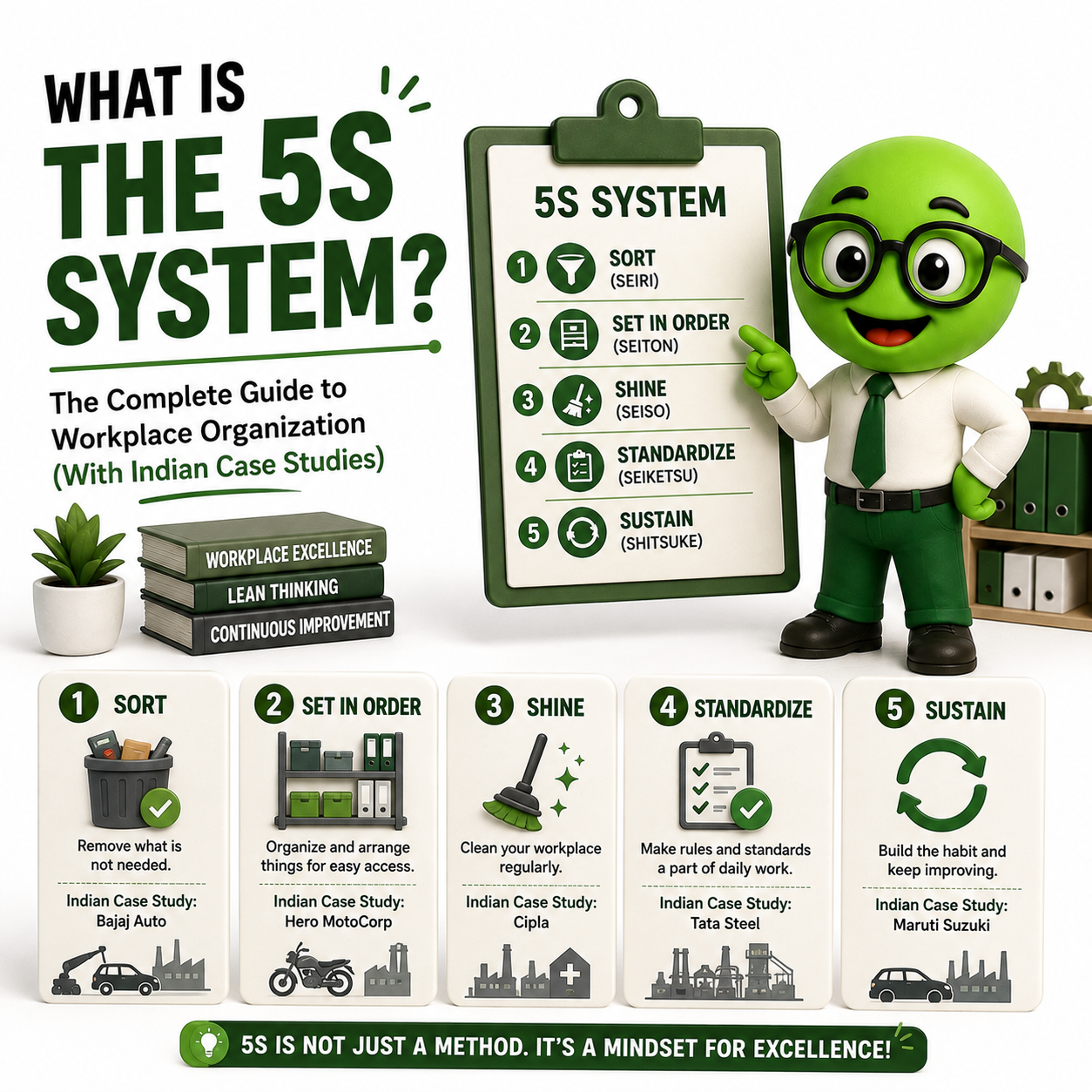

What Is the 5S System?
The Complete Guide to Workplace Organization (With Indian Case Studies)
The 5S system is a workplace organization methodology used across manufacturing, pharma, chemical, textile, and service industries to eliminate waste, reduce accidents, and improve productivity. It consists of five sequential steps — Sort, Set in Order, Shine, Standardize, and Sustain — that together turn a cluttered, inconsistent workplace into a clean, predictable, and safer one.
This guide covers what 5S is, how it compares to related methodologies like Kaizen and Six Sigma, how to implement it step by step, why most 5S programs eventually fail, and what it has actually delivered at two GreenDot client sites in Gujarat and Dadra & Nagar Haveli.
1. Understanding the 5S System
1.1 What Is the 5S System?
The 5S methodology is derived from five Japanese words — Seiri, Seiton, Seiso, Seiketsu, and Shitsuke — each representing a discipline for organizing and maintaining a workplace. The system aims to eliminate waste, increase productivity, and create a safer, more consistent work environment by giving every item, process, and habit a defined place and standard.
| # | Japanese term | Transliteration | English translation | What it means in practice |
|---|---|---|---|---|
| 1 | 整理 | Seiri | Sort | Remove anything from the workspace that isn’t needed for current work |
| 2 | 整頓 | Seiton | Set in Order | Give every remaining item a fixed, labeled, easy-to-reach location |
| 3 | 清掃 | Seiso | Shine | Clean the workspace and inspect equipment while doing so |
| 4 | 清潔 | Seiketsu | Standardize | Turn the first three S’s into a written, repeatable standard |
| 5 | しつけ | Shitsuke | Sustain | Build habits and audits so the standard holds without constant supervision |
1.2 Origin of the 5S System
5S grew out of the Toyota Production System (TPS), the manufacturing philosophy Toyota developed in Japan in the decades following World War II under production engineer Taiichi Ohno. TPS focused on eliminating waste (muda) in all its forms, and 5S became the foundational discipline that made the rest of TPS — just-in-time production, standardized work, visual management — possible. A disorganized workstation makes waste invisible; 5S makes it visible, which is why it’s typically the first Lean tool any organization implements.
2. The Five Steps of 5S — In Detail
2.1 Sort (Seiri)
Go through every item in the workspace — tools, materials, documents, fixtures — and separate what’s needed from what isn’t. A common technique is red-tagging: attach a red tag to any item whose need is uncertain, move it to a holding area, and if no one asks for it within an agreed period (commonly 30 days), remove it permanently. This step alone typically frees up significant floor and shelf space before any other change is made.
2.2 Set in Order (Seiton)
Once only necessary items remain, give each one a fixed, marked location — the Lean principle of “a place for everything, and everything in its place.” This includes floor markings, shadow boards for tools, labeled shelving, and color-coded storage. The goal is that anyone, including a new employee, can find or return an item within seconds without asking.
2.3 Shine (Seiso)
Cleaning here isn’t cosmetic — it’s inspection. Regular cleaning of machines, floors, and workstations surfaces early signs of wear, leaks, or misalignment before they become breakdowns or safety incidents. Effective Shine programs assign specific zones to specific people on a fixed schedule, with a simple checklist rather than a vague instruction to “keep it clean.”
2.4 Standardize (Seiketsu)
This is where the first three S’s stop being a one-time cleanup event and become a system. Standardize means writing down what “sorted, set in order, and shining” looks like for each area — with visual references (photos, floor plans, checklists) — so the standard is unambiguous and consistent across shifts and teams.
2.5 Sustain (Shitsuke)
The hardest step, and the one most programs fail at (see Section 5). Sustain means building 5S into the organization’s culture through scheduled audits, visible scoring, management walk-throughs, and recognition — not through one-off announcements. Without a sustain mechanism, workplaces typically drift back to their pre-5S state within a few months.
3. 5S vs. Related Methodologies
5S is often confused with, or treated as interchangeable with, other improvement frameworks. It isn’t — it’s usually the foundation the others are built on.
| Methodology | What it primarily addresses | Relationship to 5S |
|---|---|---|
| 5S | Physical workplace organization, visual order | Foundational — usually implemented first |
| 6S | 5S + Safety as an explicit, separately audited pillar | An extension of 5S, not a replacement |
| Kaizen | Continuous, incremental improvement culture across all processes | 5S is often the first Kaizen activity a team runs |
| Lean Manufacturing | Eliminating all forms of waste across the value stream | 5S is one of many Lean tools, alongside Kanban, SMED, JIT |
| Six Sigma | Reducing process variation and defects using statistical methods | Complementary; typically applied after basic order (5S) exists, to solve harder quality problems |
In short: 5S organizes the workplace. Kaizen builds the habit of improving it. Lean removes waste from the whole process. Six Sigma removes variation from the numbers. Most organizations that succeed with the others started with 5S.
4. Benefits of Implementing 5S
- Improved efficiency — less time spent searching for tools and materials, fewer errors from misplaced or mislabeled items
- Enhanced safety — clear pathways, proper storage of hazardous materials, fewer slip/trip/fall risks
- Streamlined processes — bottlenecks become visible once clutter is removed, reducing production delays
- Increased employee morale — a clean, organized workplace fosters ownership and pride; employees often start correcting disorder without being asked (see the Apple Insulated Wires case study below)
- Waste reduction — less time, material, and motion wasted across the workflow
- Better compliance readiness — an organized facility is significantly easier to prepare for ISO 9001, ISO 45001, or customer/regulatory audits
- Higher quality and fewer defects — standardized processes reduce the variation that causes rework
- Visual management — labels, color-coding, and signage let any employee, including new hires, understand a process at a glance
5. Why Most 5S Programs Fail — And How to Avoid It
5S is simple to explain and hard to sustain. In our experience, failure almost always traces back to one of these patterns:
| Common failure mode | What it looks like | How to prevent it |
|---|---|---|
| Treated as a one-time cleanup | A big push before an audit or client visit, then no follow-through | Build Sustain (5S #5) into the plan from day one, not as an afterthought |
| No ownership at area level | 5S is “the consultant’s project,” not the team’s | Assign a named owner and a visible scorecard to every zone |
| No audit rhythm | Standards exist on paper but no one checks them | Fixed-interval audits (weekly or monthly) with scores, not spot checks |
| Management doesn’t walk the floor | Employees see 5S as unimportant because leadership never shows up | Scheduled leadership walk-throughs signal it matters |
| Jumping straight to Standardize | Skipping proper Sort and Set in Order, then trying to “standardize” clutter | Don’t move to Step 4 until Steps 1–3 hold for at least a few weeks |
| No link to daily work | 5S feels separate from “real” production targets | Tie 5S scores to existing KPI reviews so it isn’t a side activity |
6. How to Implement 5S: A Practical Roadmap
Step 1 — Assess and Plan
Walk the current workplace, photograph problem areas, and identify a pilot zone rather than attempting a plant-wide rollout on day one. A dedicated cross-functional team (not just the safety or QA department) should own the plan.
Step 2 — Train Employees
Everyone working in the pilot zone — operators, supervisors, and support staff — needs to understand the five steps and why they matter, not just be told to “keep the area clean.” Training should include hands-on practice, not only a presentation.
Step 3 — Run the Pilot (Sort → Set in Order → Shine)
Execute the first three S’s in the pilot area with visible before/after documentation. This is usually where the most dramatic visual change happens and where buy-in is won or lost.
Step 4 — Standardize
Document the new standard with photos, floor plans, and checklists so it can be replicated in other areas and held consistent across shifts.
Step 5 — Audit and Sustain
Set a fixed audit schedule with a simple scoring system (see the checklist below), assign zone owners, and review scores in existing management meetings — not a separate, easily-skipped forum.
How long does it typically take?
Timelines depend heavily on facility size, number of zones, and how much cross-functional coordination is needed — a single pilot area can show visible results in weeks, while a full multi-department rollout with a mature audit system typically takes several months to establish properly. GreenDot scopes this after an on-site assessment rather than quoting a fixed timeline in advance, since a wire-drawing unit and a chemical plant have very different starting points.
What does it cost?
Cost depends on facility size, number of areas, storage/labeling infrastructure needed, and whether training and audits are ongoing or one-time. Rather than publish a generic figure that wouldn’t be accurate for every industry, GreenDot provides a scoped estimate after a site walk-through.
7. 5S Audit Checklist (Sample Scoring Framework)
Use a simple 0–4 scale per area, scored on a fixed schedule (e.g., monthly):
| Criteria | 0 (Not started) | 2 (Partial) | 4 (Fully met) |
|---|---|---|---|
| Sort | Unneeded items still present | Some red-tagging done, not resolved | Only necessary items remain, red-tag process active |
| Set in Order | No fixed locations | Some items labeled | Every item has a marked, findable location |
| Shine | Visible dirt/clutter, no schedule | Irregular cleaning | Scheduled cleaning doubling as inspection |
| Standardize | No documented standard | Standard exists but not visible/followed | Visual standard posted and consistently followed |
| Sustain | No audits happening | Audits happen but scores aren’t tracked/reviewed | Regular audits, scores tracked, and reviewed by leadership |
A zone scoring below 12/20 typically indicates the program has drifted back toward its pre-5S state and needs a refresh, not just a reminder.
8. 5S in Action: Two Gujarat Region Case Studies
(Based on client testimonial videos published on GreenDot’s YouTube channel. Figures below are as stated by the client representatives in those recordings.)
Case Study 1 — Atul Limited, Anisole Plant, Valsad
In a testimonial from Ranjan Mahapatra, Atul Limited describes two specific 5S-driven changes at its Anisole plant:
- RF Resonator tar handling was a major housekeeping problem caused by a manual system. GreenDot’s team helped implement a closed-loop melting and charging system, which improved plant cleanliness and reduced the manpower required for that process by six people over the following year.
- Sodium sulphate handling was improved by installing a sparkle filter system, allowing the sodium sulphate to be filtered and sold as a byproduct instead of being treated as disposal waste — while also reducing manual handling requirements by two people.
- Combined result: an eight-person reduction in manpower requirement for these processes, alongside a productivity increase in the Anisole plant from 67 kg/hour to 150 kg/hour, along with improved plant safety and efficiency attributed to the 5S framework.
This is a strong example of 5S extending beyond housekeeping into genuine process redesign — the physical reorganization exposed an opportunity (selling a byproduct instead of disposing of it) that wouldn’t have been visible in a cluttered, manually-handled process.
Case Study 2 — Apple Insulated Wires, Silvassa
In a testimonial from the company’s director, Apple Insulated Wires — a manufacturer of enameled copper and aluminum winding wires — describes the early stages of its Lean and 5S implementation with GreenDot:
- The company began with the first stages of 5S and Kaizen, focused on identifying and segregating items to create designated areas for tools and materials — the “a place for everything, and everything in its place” principle.
- The director specifically notes a cultural shift: employees began organizing their own work areas without being prompted, rather than waiting for instruction.
- At the time of the testimonial, the company had completed the initial stages and was planning to continue through the remaining 5S stages (3S–5S), anticipating further transformation in manufacturing operations.
This case is a useful counterpoint to the Atul example — it shows what 5S looks like in its early phase, before the process-redesign gains typically show up, and illustrates that the first visible win is usually behavioral (employees taking ownership) before it becomes numerical.
9. 5S in the Indian Manufacturing Context
5S is widely discussed in generic, Western-manufacturing terms online, but its practical challenges differ in the Indian context — multi-shift operations, contract labor turnover, space-constrained MSME units, and mixed-language shop floors are common realities that most 5S content ignores.
GreenDot Management Consulting has been implementing Lean, 5S, and TPM programs across Gujarat and neighboring industrial regions for over 25 years, with a 40-member team operating from four branch offices across Gujarat. Client engagements span chemical and petrochemical, pharmaceuticals, engineering, plastics and packaging, and textile manufacturing, including flagship projects with organizations such as Atul Limited, Castrol, Pidilite, and UPL, among others.
For MSMEs specifically, 5S is often the highest-ROI starting point precisely because it requires minimal capital investment relative to automation or major equipment upgrades — the constraint is usually consistency and follow-through, not budget.
10. Frequently Asked Questions
What is the 5S system? 5S is a workplace organization methodology consisting of five steps — Sort, Set in Order, Shine, Standardize, and Sustain — that eliminates waste and creates a clean, safe, and consistent work environment.
What is the 5S system in Hindi? The 5S system in Hindi is known as “पांच एस सिस्टम” (Panch S System), referring to the same five-step methodology of workplace organization, efficiency, and safety.
What is the 5S system in industry? In an industrial setting, 5S is applied to production floors, warehouses, and maintenance areas to eliminate clutter, reduce search and setup time, and create a systematic approach to organization that supports quality and safety standards.
What is the 5S system of housekeeping? 5S housekeeping refers to using the five-step structure — rather than ad hoc cleaning — to maintain a workplace, ensuring cleanliness and order are built into a repeatable system instead of depending on occasional cleanup drives.
How does 5S improve efficiency? By removing unnecessary items and giving remaining items fixed, labeled locations, 5S reduces the time employees spend searching for tools and materials, and standardized layouts reduce errors and rework.
How does 5S enhance safety? 5S reduces hazards by clearing walkways, properly storing materials (including hazardous substances), and making leaks, spills, or equipment issues visible during routine cleaning/inspection (Shine) before they cause accidents.
How can organizations sustain a 5S program? Sustain requires scheduled audits with a simple scoring system, named ownership for each zone, visible tracking of scores over time, and regular management walk-throughs — without these, most 5S programs revert to their pre-implementation state within a few months.
Why do most 5S programs fail? The most common causes are treating 5S as a one-time cleanup rather than an ongoing system, lack of area-level ownership, no audit rhythm, and leadership not visibly engaging with the program. See Section 5 above for a full breakdown.
Can 5S be implemented in non-manufacturing industries? Yes. While 5S originated in manufacturing, the same principles apply to healthcare, offices, retail, warehousing, and service industries — anywhere physical or digital clutter slows down work or introduces error risk.
Is there an official 5S certification or ISO standard? There is no single global ISO standard specifically for “5S certification.” However, 5S is a recognized supporting practice for broader management system standards such as ISO 9001 (quality management) and ISO 45001 (occupational health and safety) — an organized, well-audited workplace makes these certifications significantly easier to achieve and maintain. GreenDot separately offers ISO 9001 and ISO 45001 consulting for organizations pursuing formal certification.
What’s the difference between 5S and 6S? 6S adds “Safety” as its own explicitly audited pillar rather than treating safety as an implicit byproduct of the other five steps. It’s the same core system with safety made a formal, measured component.
How is 5S different from Kaizen, Lean, and Six Sigma? See the comparison table in Section 3 — in short, 5S organizes the physical workplace; Kaizen builds a continuous-improvement culture; Lean removes waste from the entire value stream; Six Sigma reduces statistical variation in processes. They’re complementary, not competing, methodologies.